

Tillinghast’s resonator
Tillinghast’s apparatus in From Beyond is an electrical machine that exposes observers to normally inaccessible forms of perception. Commonly described in later usage as a resonator, it makes the unseen environment perceptible while also making the observers vulnerable to beings within it.
3 min read · 599 words
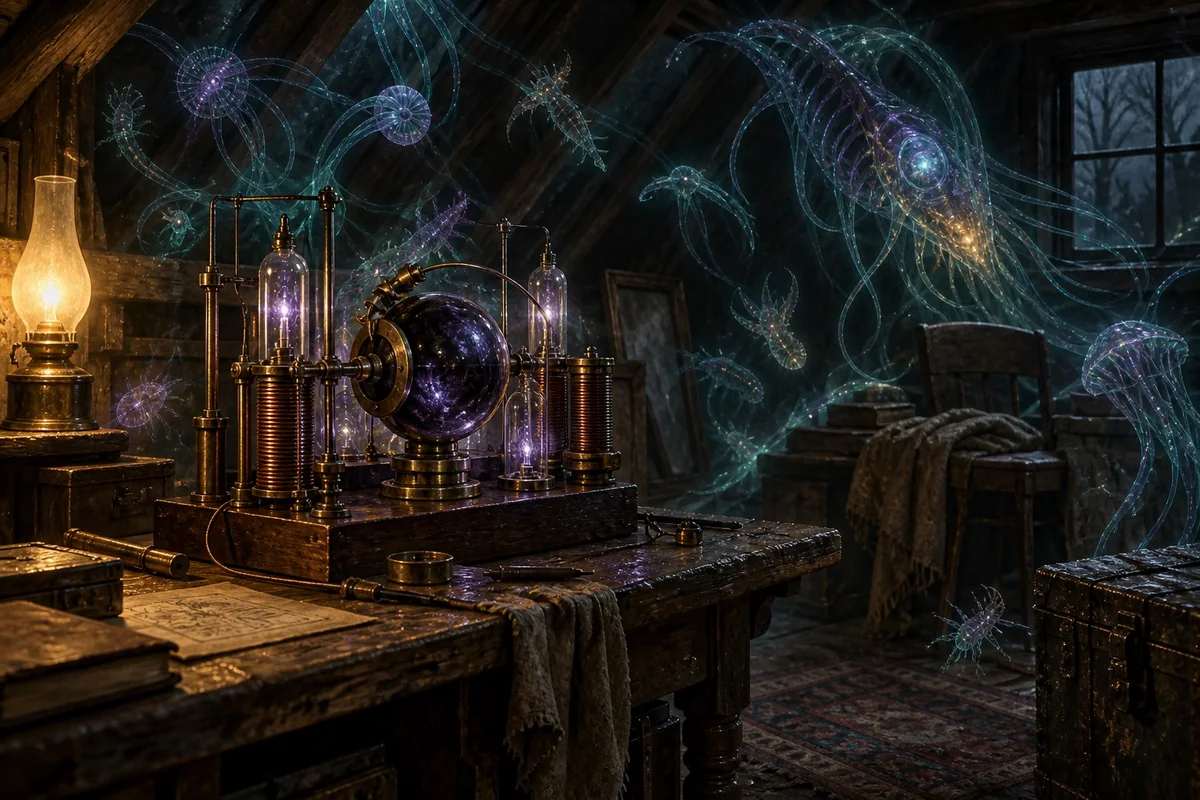
What the original text describes
The machine stands in Crawford Tillinghast’s attic laboratory. A powerful chemical battery is connected to it, and glass bulbs form its upper cluster. A switch below that cluster begins the demonstration.
Its sound changes from sputtering to whining and then a low drone. A violet luminosity is present even before the visitor thinks it is receiving current, and Tillinghast says the glow is not electrical in a sense the guest can understand.
The text offers these physical particulars without a circuit diagram, dimensions, frequency setting or reproducible construction method. The familiar label resonator should not be mistaken for a complete technical specification supplied in the story.
The proposed mechanism
Tillinghast says the waves stimulate sensory organs that have become dormant through evolution. Existing senses receive some impressions, while other capacities supply unfamiliar forms of awareness. He gives the pineal gland a central role in transmitting visual-like impressions.
The visitor’s ability to perceive what Tillinghast identifies as ultraviolet is presented as early evidence of the change. Later experiences move far beyond a simple extension of the visible spectrum.
This is fictional physiology. The apparatus’s narrative function is to alter the boundary of perception, not to describe a medically established means of activating hidden organs.
Overlapping worlds rather than a single doorway
The revealed forms occupy space that previously seemed empty and pass through familiar objects. The ordinary laboratory remains partly visible while another order of life is superimposed upon it.
That presentation differs from a portal through which a creature must physically step from a remote chamber. Tillinghast’s account emphasizes proximity: the unfamiliar world has been present around the observer all along.
The effects nevertheless involve contact as well as sight. The apparatus changes the relationship between the two orders of existence, allowing a formerly unnoticed person to become perceptible and vulnerable.
Transmission through the house
Tillinghast attributes the servants’ disappearance to Mrs. Updike turning on the downstairs lights. He says the wiring picked up sympathetic vibrations, extending the dangerous condition beyond the laboratory.
The story establishes that explanation through his testimony and the empty clothes he reports finding. It does not provide an independent experiment isolating every electrical pathway.
The episode explains the otherwise puzzling use of candles and the disabled house lighting. The researcher has learned a practical limitation at the cost of people who were not informed participants in his work.
Visibility and movement
Tillinghast warns the visitor that the rays permit him to be seen by the beings he is observing. Remaining still offers limited protection, according to the scientist, while movement can attract the fatal threat.
The visitor sees large jelly-like organisms and assumes they are responsible for the missing servants. Tillinghast says they are harmless and directs attention toward something else approaching from behind.
The apparatus therefore reveals more than one kind of life and danger. A visual design that treats the first visible creature as the only antagonist would simplify a distinction explicitly made by the source.
Destruction and aftermath
The narrator ends the immediate experiment by shooting the machine. Police find it shattered and establish that the bullet did not kill Tillinghast.
Ordinary perception returns, but the psychological consequences persist. The survivor can no longer regard empty air or apparent solitude as reassuring, especially because the servants’ bodies are never recovered.
The apparatus’s destruction closes the episode without proving that the revealed beings have ceased to exist. The machine changes access to them; it is not established as their creator.
References
- From Beyond — Unspeakable Tales ebook
The fictional narrative is evidence for what the story says, not proof of events in the real world.
At a glance
From Beyond
Crawford Tillinghast
Attic laboratory
Chemical battery
Glass bulbs; switch; luminous mechanism
Stimulation of dormant senses
Observers become perceptible to unseen beings
Destroyed by the narrator’s gunshot