

The Black Soul Bottles
The two black bottles in Two Black Bottles contain the separated souls of Abel Foster and Johannes Vanderhoof. Their fragility contrasts with the unnatural persistence of the bodies associated with them. The vessels share a function, but their different fates prevent a simple formula for release and restoration.
3 min read · 571 words
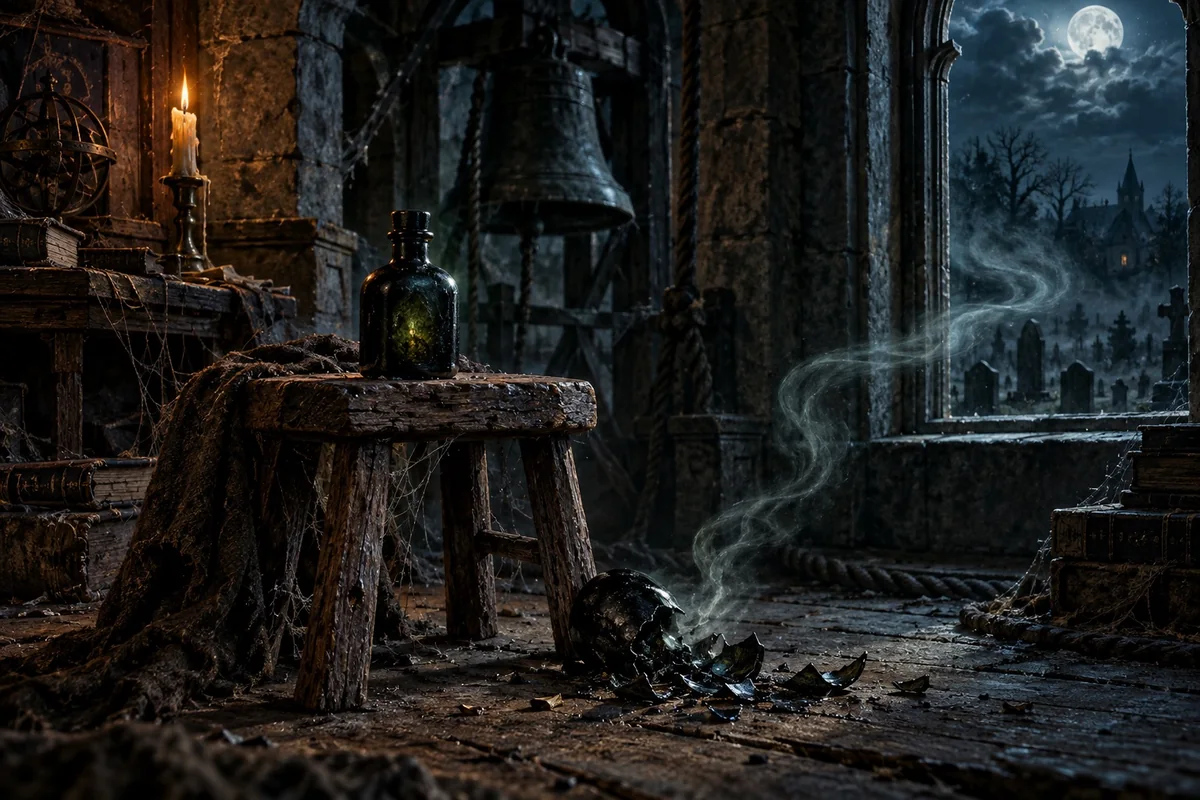
The paired objects
Hoffman finds the vessels in the belfry of the abandoned church at Daalbergen during his confrontation with its sexton, Abel Foster. They stand on a low stool behind Foster amid a larger collection of occult books and preserved specimens.
The story describes the vessels as black and relatively small. It does not specify a maker, an inscription, a seal design or an exact material composition beyond the broken glass observed after the struggle.
The title refers to this pair. Other bottles and jars in the room contain preserved animals, and there is no basis for assuming that every container in the collection imprisons a human soul.
Sources: Two Black Bottles — original text
Vanderhoof’s bottle
Foster admits that he has taken the soul of the minister Johannes Vanderhoof and enclosed it in a bottle. He explains that the resulting separation leaves the buried man unable to complete an ordinary passage into the afterlife.
That explanation belongs to Foster's account of his own magic. The movement in the grave and the figure later seen emerging provide supporting events, but the story never offers an independent theology covering all separated souls.
Hoffman proposes restoring the soul to its owner. Foster says that he has forgotten the formula and refuses to help. Possession of the container alone therefore does not solve the problem within the scene.
Sources: Two Black Bottles — original text
Foster’s bottle
The second vessel contains Foster's own soul. That fact is withheld until the bottle breaks during Hoffman's attempt to seize the pair.
Foster says that Dominie Slott removed his soul about two hundred years earlier. His continued bodily existence makes the vessel part of the explanation for his concealed age, although the text does not narrate every stage of that long survival.
The admission also corrects his earlier story of finding Slott's books only after arriving as sexton. His connection with the first pastor is direct and much older than the village understands.
Sources: Two Black Bottles — original text
Breakage and survival
When one bottle hits the floor, a blue flash appears and a pale vapor escapes through the open window. Foster's body changes color and rapidly loses its integrity, finally leaving dust and collapsed clothing.
The intact bottle in Hoffman's hand grows warm and faintly luminous. At the same time the grave's disturbance becomes unmistakable. Hoffman sets the vessel down and flees before the figure from the burial ground reaches the church.
The story thus records destruction in one case and continued enclosure in the other. It does not demonstrate that opening, uncorking or breaking Vanderhoof's vessel would have the same effect as breaking Foster's, or that either act would safely restore a person.
Sources: Two Black Bottles — original text
The missing vessel and the wandering figure
During the next morning's examination, Hoffman and a villager find the intact bottle missing. The broken fragments remain, together with large footprints in the remains of Foster's body.
The ending reports a later belief that a large figure wanders with a bottle near the church. This is local testimony rather than a new encounter narrated directly by Hoffman.
Taken together, the missing object and the rumor suggest that Vanderhoof has recovered the vessel but not the means of completing his return. The object becomes a sign of unresolved identity: the lost part is apparently within reach, yet ordinary personhood has not visibly resumed.
Sources: Two Black Bottles — original text
References
- Two Black Bottles — original text
The fictional narrative is evidence for what the story says, not proof of events in the real world.
At a glance
Two Black Bottles (1927)
Two
Abel Foster; Johannes Vanderhoof
One broken; one missing after the grave is opened