

Two Black Bottles
Two Black Bottles follows a nephew investigating the death of a village minister and the sexton who controlled him. Its supernatural economy depends on souls separated from bodies and held in fragile vessels. The collaboration with Wilfred Blanch Talman combines a decaying church, a misleading confession and a revenant whose final purpose remains unfulfilled.
7 min read · 1,366 words
Composition, credit and publication
The Archive credits Wilfred Blanch Talman with H. P. Lovecraft and dates composition to July–October 1926. The story first appeared in the August 1927 Weird Tales, volume 10, number 2, on pages 251–258 and 287.
Hoffman, the first-person narrator, writes after the events. His opening already complicates the death announced in the letter that brought him to Daalbergen: he accepts that his uncle was buried but cannot comfortably describe him as either ordinarily alive or finally dead.
The narrative first reconstructs the village's recent decline through another man's testimony. It then narrows to Hoffman's encounter with Abel Foster and concludes with physical traces examined the next morning.
Sources: Two Black Bottles — original text, H. P. Lovecraft Archive — fiction in composition order, Two Black Bottles — publication data
Daalbergen and the summons
Daalbergen is a fictional village in the Ramapo Mountains. Its former reliance on an iron mine helps explain the dwindling population and weak finances. When the ore gives out, some inhabitants leave and others attempt to survive by farming difficult ground.
Hoffman arrives on 4 October after receiving a letter from the grocer Mark Haines. His uncle, the minister Johannes Vanderhoof, has reportedly died, and Hoffman may inherit a small estate. The story does not supply a year for this arrival.
Haines also wants someone to investigate the circumstances that have isolated the church and parsonage from the community. Hoffman knows little about his uncle beyond family recollections of a physically imposing but timid man.
At first he regards the villagers' explanation as superstition imposed on unrelated misfortunes. The economic collapse has an ordinary stated cause; the later supernatural evidence does not prove that every local difficulty was produced by a curse.
Sources: Two Black Bottles — original text
The altered ministry
According to Haines, Abel Foster came to Daalbergen about ten years earlier and became the church sexton. His manner, muttering and apparent conversations near graves made him an object of suspicion.
Vanderhoof's sermons changed after Foster's arrival. Their disturbing subjects frightened the congregation, and repeated requests for reform failed despite the minister's promises. The account suggests pressure that he could not resist.
As attendance fell, the congregation could not afford to replace him. Eventually the villagers stopped approaching the church at all. Vanderhoof remained in the parsonage, while Foster bought provisions and maintained the graveyard.
The carefully tended graves contrast with the abandoned religious life around them. Foster's attention to the grave of Guilliam Slott, the church's first pastor in 1701, becomes particularly significant once his own history emerges.
Sources: Two Black Bottles — original text
The burial and the journey across the moor
Villagers see Foster prepare a grave, hear the bell and watch him move a coffin from the parsonage for burial. He later announces Vanderhoof's death with a satisfaction that increases their unease.
Hoffman insists on visiting before nightfall. The route crosses a swamp and passes beneath willows before reaching the stone church, parsonage and graveyard. The early loss of sunlight behind the mountain makes the approach darker than he expects.
He notices a new wooden cross over his uncle's grave beside Slott's older burial. The fresh mound gives him an impression of suppressed movement or life, though this first reaction is an intuition rather than an observed emergence.
Finding the parsonage apparently empty, he enters the church and follows signs of light and drunken singing toward the belfry. His initial confidence has already given way to fear.
Sources: Two Black Bottles — original text
Foster’s fear
The belfry room contains old manuscripts, books and preserved animals. Foster sits drinking among these materials. When Hoffman touches him, he recoils as if the visitor were someone he expected with dread.
He explains that Vanderhoof has been trying to escape from the grave. The cross falls repeatedly, and the earth becomes increasingly difficult to keep in place. Hoffman's own observations soon support the report: the marker changes position during his visit.
Foster is therefore more than a triumphant magician celebrating his victim's death. He has created a condition he cannot safely reverse and fears the physical strength of the person he has buried.
His drunkenness complicates the credibility of the confession, but the changing grave and subsequent events prevent Hoffman from dismissing everything as incoherent speech.
Sources: Two Black Bottles — original text
Slott’s legacy and the eyes in the painting
Foster says that the occult materials belonged to Dominie Slott. He first seems to imply personal knowledge of the long-dead minister, then retreats to the claim that he discovered the books after becoming sexton.
He describes studying spells and directing them against the village. In his account, the church itself initially resists his attempts, but Vanderhoof's weak will offers another route to control.
Foster watches the minister through openings in a painting of Christ's temptation. The openings occupy the Devil's eyes. This detail explains how concealed observation and intimidation could operate within the church's own imagery.
The story uses an explicitly Christian framework of sacrilege, souls and divine resistance. It does not need a hidden Cthulhu cult to explain the corruption of the congregation, and no such identification is made in the text.
Sources: Two Black Bottles — original text
The two captive souls
Foster finally says that he removed Vanderhoof's soul and placed it in a black bottle. The body was buried, but its separated condition prevents the ordinary passage to heaven or hell described in his explanation.
Hoffman proposes opening the grave and restoring the soul. Foster refuses: he claims to have forgotten the necessary formula and fears that the emerging body will kill them. Knowing where the vessel is kept is not enough to guarantee a successful restoration.
When Hoffman advances, Foster begins an incantation. Hoffman experiences a weakening of sight and a sensation of something being drawn upward within him. The episode suggests that the same form of coercion may be directed at another victim, without supplying a complete account of the procedure.
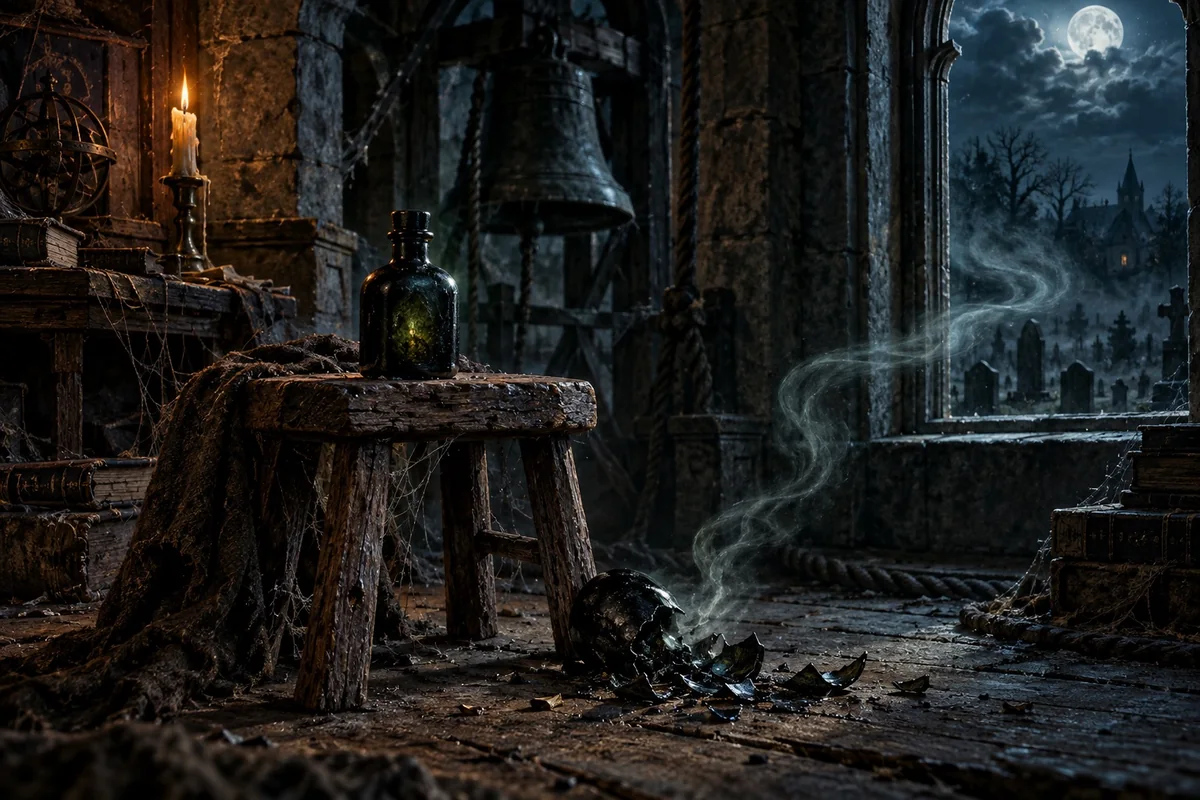
Two black bottles stand near Foster. Hoffman seizes at them during the struggle, retaining one as the other falls and breaks.
Sources: Two Black Bottles — original text
The broken bottle and the older deception
A blue flash, a sulfurous odor and an escaping pale vapor accompany the breakage. Foster immediately begins to collapse and change color; his body then disintegrates, leaving clothing and dust.
His final explanation reverses the earlier chronology. The broken vessel held his own soul, which Slott removed roughly two centuries before. Foster's apparent slip about knowing Slott was thus a clue to an age concealed by his account of recent discovery.
The two bottles have parallel contents but different narrative effects. Breaking Foster's vessel ends his bodily survival. The unbroken vessel associated with Vanderhoof becomes warm and luminous as movement increases in the grave below.
This sequence should not be reduced to a universal rule that smashing any soul bottle restores its owner to ordinary life. The one broken bottle produces precisely the opposite outcome.
Sources: Two Black Bottles — original text
The emergence and the next morning
Hoffman hears earth slipping, sees the fallen cross and flees. Looking back, he sees a huge dark figure emerging from the grave and moving toward the church. He does not remain to witness its actions in the belfry.
The next morning most villagers decline to accompany him, even while showing skepticism about his account. One older man agrees, recalling a family story connected with Slott.
They find Vanderhoof's grave open and empty. The intact bottle has vanished from the belfry, while the fragments of the broken one remain. Large footprints mark the dust and clothing left by Foster.
These traces strongly connect the emerging figure with the disappearance of the bottle, but the actual recovery is not shown. The men burn the occult papers, refill the grave and throw the fallen cross into the fire.
Sources: Two Black Bottles — original text
An unresolved return
The final report belongs to local rumor: a gigantic, confused figure is said to wander near the church at the full moon, carrying a bottle and searching without a remembered purpose.
The rumor suggests that bodily return and possession of the vessel have not restored Vanderhoof's former life. It also leaves the completion of any reunion between soul and body unconfirmed.
The story's central reversals concern custody and dependence. The apparently powerful sexton is himself bound to a fragile container, while the apparently dead minister retains enough agency to escape his burial. Neither condition corresponds to the simple opposition between living master and inert victim with which Hoffman began his investigation.
Sources: Two Black Bottles — original text
References
- Two Black Bottles — original text
The fictional narrative is evidence for what the story says, not proof of events in the real world.
- H. P. Lovecraft Archive — fiction in composition order
Composition dates; question marks and ranges retain the source uncertainty.
- Two Black Bottles — publication data
At a glance
H. P. Lovecraft; Wilfred Blanch Talman
July–October 1926
1927, August
Weird Tales, 10, No. 2
Fiction