

The God of Yekub
The god of Yekub is the hovering spherical deity seized by George Campbell near the end of The Challenge from Beyond. Initially ivory-colored and then red, it is worshipped as untouchable by the planet’s inhabitants. Robert E. Howard introduces its sanctuary and capture; Frank Belknap Long makes it speak, explain the failed alien occupation of Campbell’s body and transform Campbell into a benevolent ruler.
4 min read · 660 words
An unnamed god in the original story
The deity is not given a personal name in the five-author narrative. This entry uses its role and location as a descriptive title. Names assigned in later reference traditions should not be silently inserted into the 1935 text.
The being first appears in Howard's section, after Lovecraft's contribution has ended. Long then gives it direct speech and an active role in the resolution. Although the story belongs to the broader collaborative Mythos context, the god's actions cannot all be credited specifically to Lovecraft.
No genealogy connecting it with Azathoth, Yog-Sothoth or another named power is provided. Nor does the narrative assign it to a formal category of Outer Gods, Elder Gods or Great Old Ones.
Sources: The Challenge from Beyond — original text, The Challenge from Beyond — publication data
Sanctuary, shape and color
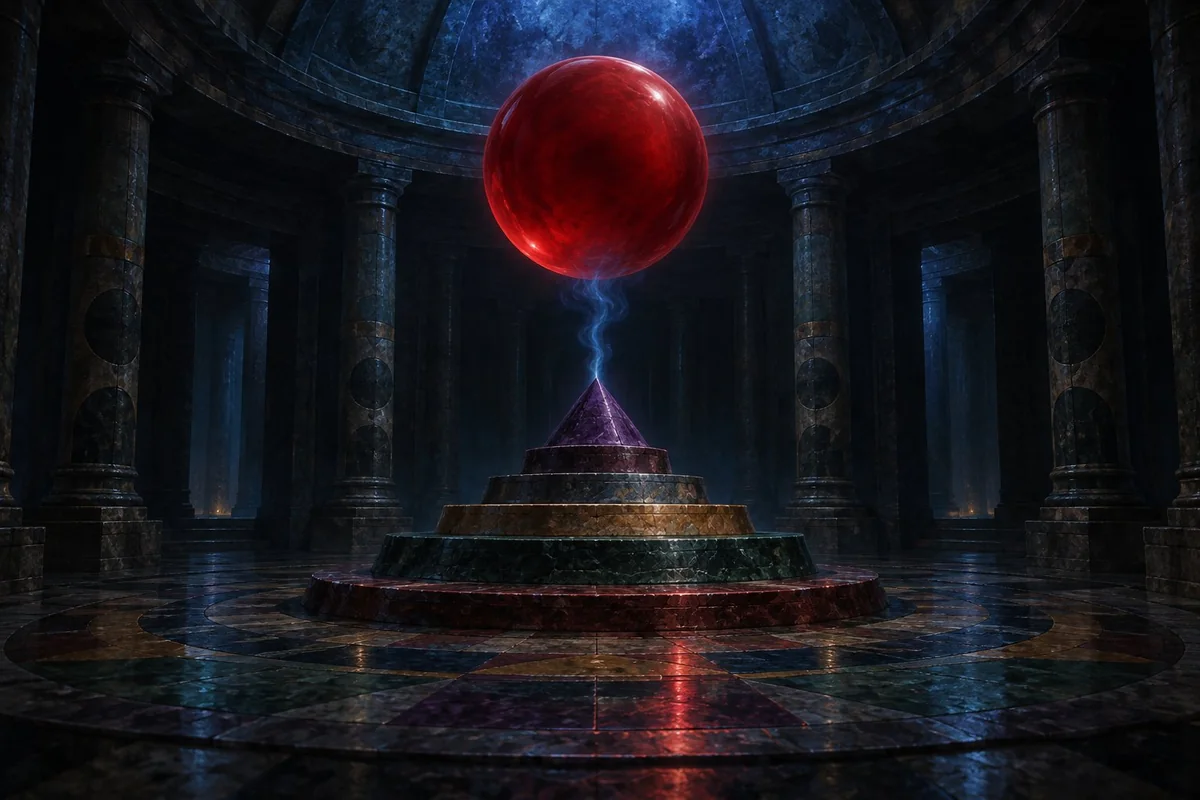
Campbell reaches a round chamber with a dome, blue illumination and a floor of multiple colors. A tiered altar rises at its center. Its uppermost element is a purple cone, from which blue vapor ascends toward a floating sphere.
The sphere initially resembles translucent ivory. As Campbell climbs toward it, the surrounding structure reacts, the vapor increases and the sphere becomes red. The change is directly associated with the confrontation but is not explained as a repeatable chemical or magical process.
The story gives no face, conventional limbs or fixed humanlike anatomy to the deity. Its ability to speak in the final section does not require a mouth to be added to the description. A pictured face or elaborate crown would be an illustrator's invention.
Taboo and Campbell’s attempted hostage-taking
Knowledge preserved in Tothe's body tells Campbell that the sphere is the god of Yekub. The original reasons for its worship have been forgotten over an immense span of time. The prohibition on touching its altar is so deeply established that the priest cannot imagine Campbell crossing that boundary.
Campbell kills the priest and climbs toward the deity. He reasons that the population will obey whoever possesses its god, treating a sacred presence as an object of political leverage.
That reasoning is initially rewarded: inhabitants bow as he carries the red sphere through their city. Nevertheless, the final section turns the apparent hostage into the authority that interprets events and remakes the would-be conqueror.
The explanation of Tothe’s death
Long alternates Campbell's progress on Yekub with the breakdown of his original body on Earth. A trapper discovers that body drowned after it has displayed increasingly bestial behavior.
The god tells Campbell that a Yekubian mind cannot control the violent impulses of a human organism. According to its explanation, human minds have been conditioned across generations to restrain urges that the alien occupant cannot master. It interprets the body's self-destruction through an overriding tendency toward death.
This is a specific speech by a fictional divine character. It should not become an encyclopedia's unsupported assertion about evolutionary psychology, instinct or mental illness. Nor does the narrative demonstrate that the deity directly kills Tothe at a distance; its expressed role is explanatory.
Transformation and the ending
The deity energizes Campbell's borrowed body and purges the impulses associated with his earlier appetite for domination. He remains physically alien but becomes a ruler whom the closing narration calls exceptionally wise and kind.
There is an important distinction between that ending and the motive that brought him to the altar. Howard's Campbell acts violently in pursuit of unrestricted power. Long's conclusion makes the same ascent lead to a spiritual change that qualifies or replaces those desires.
The story stops at this transformed accession. It does not describe a wider divine agenda, other worshipping worlds, a later conflict with the Great Race or a subsequent return to Earth. The deity's powers are impressive within the scene, but their ultimate range remains unspecified.
References
- The Challenge from Beyond — original text
The fictional narrative is evidence for what the story says, not proof of events in the real world.
- The Challenge from Beyond — publication data
At a glance
Not supplied
Hovering sphere; ivory-colored, then red
Robert E. Howard’s section
Frank Belknap Long’s section