

Yekubians
The Yekubians are the wormlike, many-limbed inhabitants of the alien world in The Challenge from Beyond. Their crystal probes allow them to capture distant minds and explore through stolen bodies. Lovecraft supplies their physical description and expansionist history; Howard and Long develop the encounter with George Campbell and expose limits that their extraordinary technology does not overcome.
5 min read · 980 words
A descriptive collective name
Yekubians is used here as a convenient name for the people of Yekub. The story describes them through terms such as worms and centipedes, not through a formal biological classification. Resemblance to terrestrial invertebrates does not establish descent from them.
The principal source is the 1935 five-author version of The Challenge from Beyond. Moore and Merritt introduce the mysterious crystal; Lovecraft explains its makers and shows one of their bodies; Howard names Yekub, Tothe and Yukth; Long supplies the final account of bodily incompatibility and divine intervention.
The anatomy, technology and final philosophy should consequently be read as parts of a collaborative narrative. They are not a single zoological dossier written by one author.
Sources: The Challenge from Beyond — original text, The Challenge from Beyond — publication data
Physical form and communication
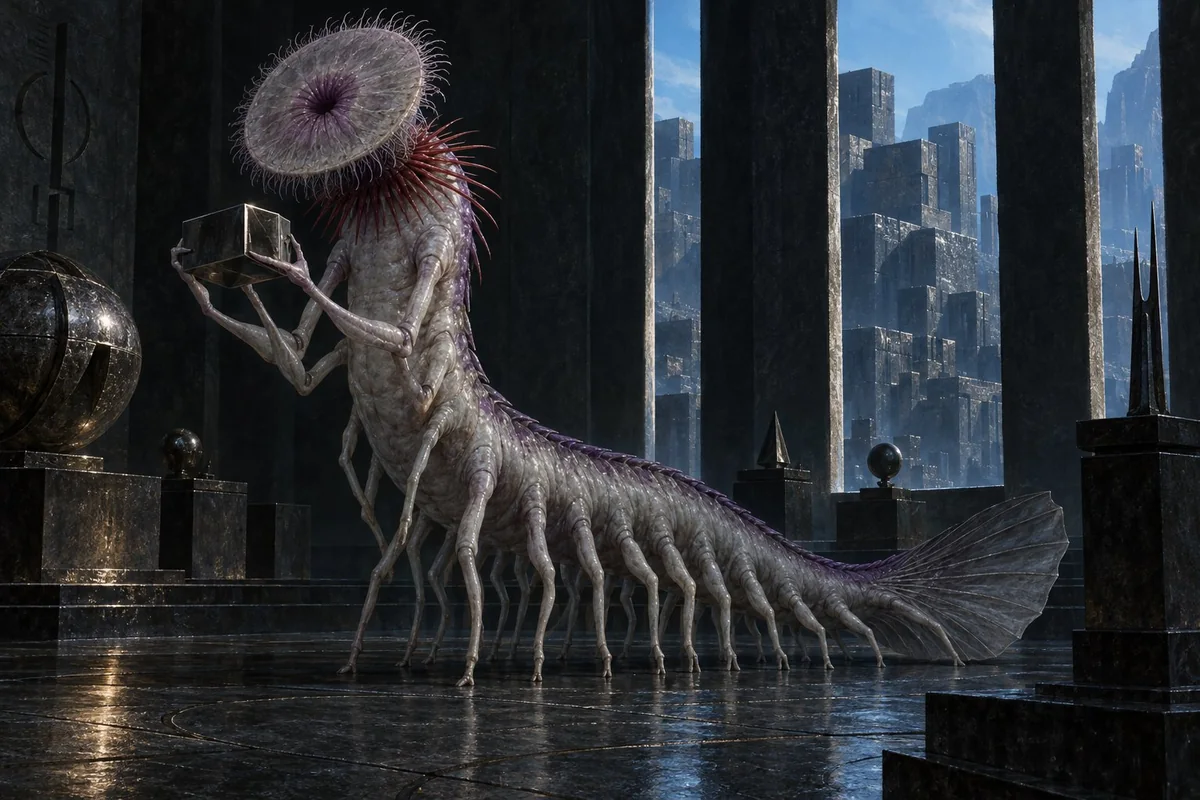
The specimen Campbell sees is pale gray, about as thick as a human torso and roughly twice a person's length. Its many legs support a body that can raise its forward section while moving on the rear pairs. At least two pairs near the front can function as arms.
The head resembles a disc bordered by fine cilia, with a purple opening at its center and no apparent eyes. A purple crest follows the back, and a gray membrane forms a fanlike tail. Flexible red projections around the neck produce patterned sounds.
These sounds are meaningful communication, as Campbell later understands through Tothe's retained memories. The narrative describes their rhythm and physical production but does not supply a vocabulary or writing system that can be reconstructed into a usable language.
Campbell's new vision initially lacks familiar focus and seems to register the surrounding room in several directions at once. The difficulty is partly one of adaptation: his human expectations do not immediately fit the borrowed sensory organs. The text does not require an illustrator to add ordinary eyes to make those senses comprehensible.
An interstellar civilization with a transgalactic limit
The history recalled from the Eltdown Shards describes a civilization that settled the habitable worlds of its own galaxy and killed populations already living there. Its domination is technological and political, not merely a reputation attached to frightening anatomy.
Physical travel beyond that galaxy remains beyond its reach. The crystals extend exploration by providing a connection between distant minds and receiving machinery. Successful contact therefore depends on a discoverable object landing on a suitable inhabited world.
The process is neither instantaneous omniscience nor an unlimited power to take any body anywhere. Most probes never produce contact, their destinations cannot be accurately chosen, and the crystals themselves depend on materials available only on the home world. A colony in foreign bodies cannot reproduce every achievement of the original civilization.
Captivity and the interchange of minds
A person who attends to an activated crystal is mentally drawn into the apparatus. The captured consciousness first exists without ordinary bodily sensation while an investigator examines its contents. Subsequent exchanges place the captive in an alien body and send the investigator into the abandoned body on the remote world.
Some captives are eventually returned. Others are destroyed, particularly when their civilizations present a strategic danger or a desirable target for occupation. Scientific investigation and conquest are explicitly connected in this history.
Campbell's experience supplies a particular instance. He finds himself in Tothe's body and is approached by Yukth carrying a reflective instrument or container. The reflection confirms his transformation before he learns how to use the new form.
The ancient encounter with Earth
The alleged translation of the Eltdown Shards records an earlier probe reaching Earth while a cone-shaped civilization ruled it. Those terrestrial beings recognize the displaced personalities as invaders and destroy the occupied bodies, sacrificing the minds stranded abroad.
They retain the dangerous cube under guard for possible research. Later unauthorized encounters give the distant worm people information about the defeat of their explorers. Attempts to send more probes toward Earth fail to reproduce the original accidental contact.
The defenders strongly recall the Great Race described in The Shadow out of Time. The parallel is useful, but the Yekubians remain a separate civilization with a different characteristic body and method of reaching distant worlds. The two groups are not interchangeable names for mind-transferring aliens.
Sources: The Challenge from Beyond — original text, The Shadow out of Time — original text
Tothe, Yukth and the reversal of advantage
Howard makes Campbell discover memories embedded in Tothe's brain. These memories tell him the local names and help him understand speech and movement. His response changes from revulsion at the new body to excitement at its possibilities.
Yukth does not anticipate an ordinary scientific implement being used as a weapon. Campbell kills him and escapes toward the sanctuary. This immediate vulnerability sits uneasily beside the earlier account of ruthless galactic conquest. It is a tension within the published sequence, not a reason to invent an unmentioned pacifist reform or a lost chapter of history.
On Earth, Tothe fares worse. The borrowed human body becomes increasingly animal-like and finally drowns. Long's red deity attributes the failure to human instincts that the alien mind cannot restrain. That explanation is the god's fictional doctrine, not a statement of real human biology.
The civilization after Campbell’s accession
The inhabitants submit when Campbell carries their god through the city. The ending presents him as a benevolent ruler after the deity changes his motivations, leaving his new alien form intact.
No later history of his reign is narrated. The story does not show him abolishing the probe system, ending every conquest or restoring all displaced minds. Those would be possible continuations, not events established by the text.
The Yekubians matter within the wider encyclopedia because they make bodies, memory and political power inseparable. Their technology can remove a mind from its home, yet the organic habits of a body and the authority of a local religion prove decisive in ways that the original experiment does not control.
References
- The Challenge from Beyond — original text
The fictional narrative is evidence for what the story says, not proof of events in the real world.
- The Challenge from Beyond — publication data
- The Shadow out of Time — original text
The fictional narrative is evidence for what the story says, not proof of events in the real world.
At a glance
The Challenge from Beyond (1935)
Pale-gray, many-legged, wormlike; disc-shaped head
Tothe; Yukth
Crystal-mediated mental exchange
Descriptive collective derived from Yekub