

Rue d’Auseil
The Rue d’Auseil is the steep, untraceable street where the narrator of The Music of Erich Zann once rented a room. Its crowded architecture culminates in a high wall and a single attic window that appears to open beyond ordinary urban space.
4 min read · 654 words
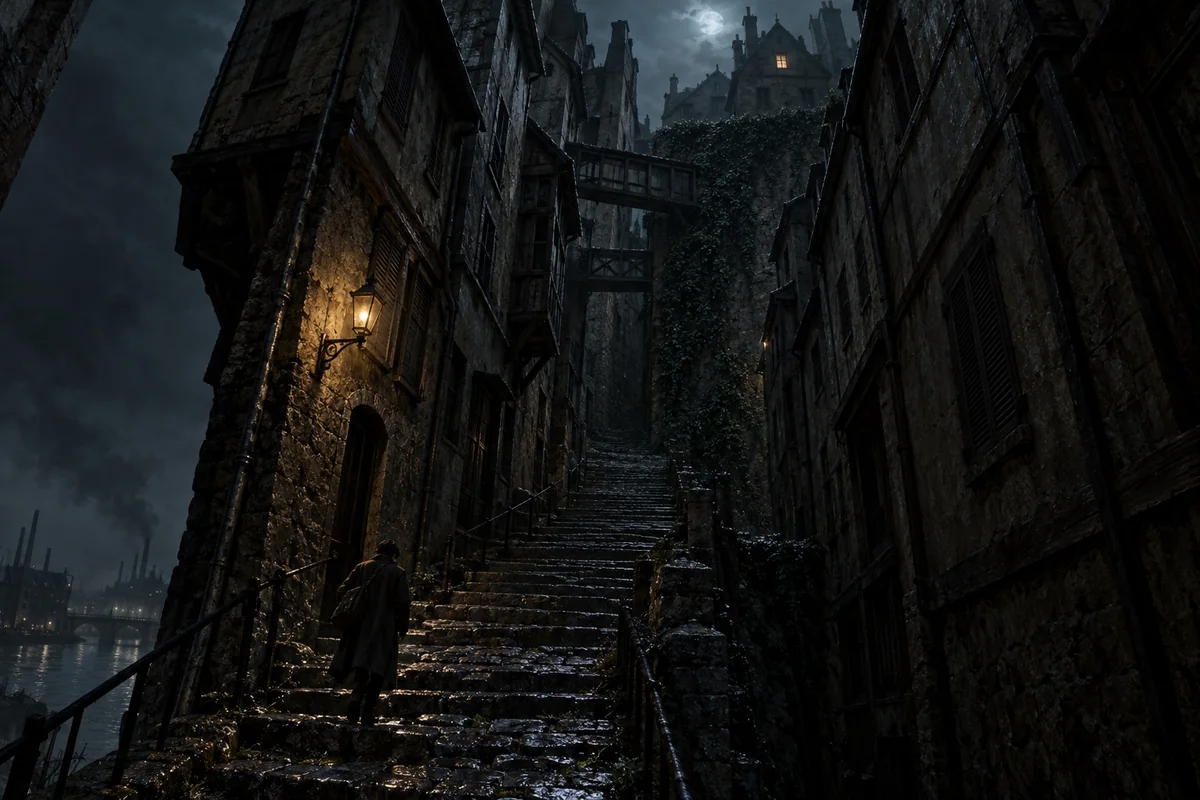
Approach from the university
The narrator remembers the street as lying within about half an hour’s walk of his university. Reaching it requires crossing a dark stone bridge over a river bordered by high brick warehouses.
Sources: [1]
The river district is shadowed and foul-smelling. Beyond it, narrow streets rise toward the much steeper Rue d’Auseil. The remembered route gives the place a physical relationship to the city while withholding a name for the city itself.
French street terminology and Zann’s French note do not establish a precise real-world address. The story supplies neither coordinates nor a verified identification with a particular Paris street.
A street approaching a cliff
The incline is extreme enough that vehicles cannot use it. Steps interrupt the paving, which varies among slabs, cobbles and exposed ground with sparse vegetation. The houses lean at unusual angles, and opposing upper stories sometimes nearly meet.
Bridges connect some buildings above the street. Their height and the leaning facades restrict the light reaching the ground. The architecture makes the ascent feel enclosed rather than like an approach to a broad open viewpoint.
A tall ivy-covered wall closes the upper end. The narrator’s curiosity about what lies beyond it becomes stronger precisely because ordinary movement through the street provides no answer.
Sources: [1]
Blandot’s lodging house
Blandot’s house is the third building from the top and the tallest on the street. It is nearly empty. The narrator initially occupies the only inhabited room on the fifth floor, with Zann’s garret above.
After the musician’s request, the student moves to the third floor, between the rooms of a moneylender and an upholsterer. The fourth floor remains unoccupied. These changes matter acoustically: the lower room is intended to separate the student from Zann’s late-night music.
The arrangement fails because curiosity brings him back up the stairs. The vertical structure of the house therefore organizes both the attempted protection and the repeated approach to danger.
Sources: [1]
The western window
Zann’s room is on the west side of the garret. Its gable window is said to be the only point on the street from which someone can see over the terminating wall and across the city beyond.
Curtains, a shutter and the musician’s interventions keep that view unavailable. When the window finally breaks, the narrator expects familiar lights but encounters a seemingly unlimited darkness alive with movement and music.
The opening functions as a threshold in the story, but the text supplies no engineering or spell that created it. Its relationship to the street’s later disappearance remains part of the unresolved experience.
Sources: [1]
The return to ordinary streets
During the crisis, violent wind fills the attic and carries away Zann’s written account. The narrator escapes through the house, down the steep street and across the river.
In the broader city he finds moonlight, familiar lamps and no wind. The contrast suggests that the disturbance has not simply been an ordinary storm affecting the whole neighborhood.
The escape is remembered in fragments of movement rather than as a measured itinerary. It leaves enough physical detail to make the place vivid, but not enough corroborated evidence to restore it to a map.
Sources: [1]
A location that cannot be recovered
The narrator searches modern maps, older records and the city itself. He considers the possibility of a changed street name and looks for the broader locality as well as the exact house. None of these methods succeeds.
His poor health during the original residence and the absence of visiting acquaintances complicate verification. Yet the specific architecture and repeated journeys resist easy dismissal in his own mind.
The story ends with the Rue d’Auseil as both a remembered place and a failed object of research. Its loss preserves the boundary around Zann’s experience: the surviving witness can describe the approach, but neither he nor the reader can return through an independently confirmed route.
Sources: [1]
References
- The Music of Erich Zann — Unspeakable Tales ebook
The fictional narrative is evidence for what the story says, not proof of events in the real world.
At a glance
The Music of Erich Zann
Unnamed in the story
Across a dark stone bridge and uphill from the river
High ivy-covered wall
Blandot’s lodging house, third from the top
Zann’s western garret window
Cannot be relocated by the narrator