

The Music of Erich Zann
The Music of Erich Zann concerns an impoverished student who hears extraordinary playing from an old musician’s attic and discovers that the room’s window opens onto something beyond the expected city. Written in December 1921 and first published in March 1922, the tale makes music an apparent act of resistance while withholding the explanation its frightened performer tries to write.
6 min read · 1,249 words
Publication and the missing street
Lovecraft wrote the story in December 1921, and it appeared in the March 1922 National Amateur. Its unnamed narrator begins after the events, describing unsuccessful attempts to locate the Rue d’Auseil on modern and historical maps or through personal exploration.
He remembers living there while studying metaphysics at a university. Poor health and a disturbed state complicate his recollections, but the place’s striking features make its disappearance from ordinary geography difficult for him to accept. He never took an acquaintance there and has found no one who recognizes it.
The framing therefore introduces a problem of verification before the musician appears. The account can be told, but its principal location cannot be revisited and examined.
Sources: H. P. Lovecraft Archive — fiction in composition order, H. P. Lovecraft Archive — fiction in publication order, The Music of Erich Zann — Unspeakable Tales ebook
The house above the river
The street lies across a dark, foul-smelling river, reached by a large stone bridge. It climbs so steeply that parts of it become flights of steps, and its upper end is blocked by a high ivy-covered wall. Leaning houses nearly meet overhead, with occasional bridges connecting them.
The narrator rents a fifth-floor room in a nearly empty house run by Blandot. The building is the third from the top of the street and the tallest there. Above the student lives Erich Zann, a German musician who cannot speak and earns his living in a cheap theater orchestra.
Zann’s western attic window is said to be the only window on the street high enough to offer a view beyond the wall. That apparently desirable vantage point becomes the center of the narrative’s danger.
Music heard through the ceiling
The student first encounters Zann through sound. The nightly playing is unfamiliar and compelling, even though the narrator admits limited musical knowledge. He concludes that the performer must be a remarkably original composer.
After about a week he introduces himself and asks to listen in the attic. Zann initially appears frightened and irritated, but eventually admits him. The room is large, bare and neglected, with scattered music, simple furniture and a covered instrument.
The private performance is beautiful but lacks the unsettling passages the student has heard from below. This difference establishes that Zann can play for an audience in one manner while reserving another kind of music for his solitary nights.
The forbidden imitation and the window
The student asks to hear the stranger harmonies and begins whistling a remembered phrase. Zann reacts sharply, stopping his mouth and glancing toward the curtained window.
Curiosity then leads the visitor toward the window itself. The musician again intervenes, apparently desperate to prevent him from looking out. A quarrel nearly ends the visit, but Zann writes an apology in imperfect French and explains that he suffers from fears and nervous difficulties connected with his music.
He asks the student to move to a lower room where the nocturnal playing will no longer be audible, offering to pay the difference in rent. The student accepts. Zann’s behavior begins to look less like artistic vanity than an effort to control what another person hears and sees.
Listening outside the locked door
The narrator moves to the third floor but remains fascinated. Zann becomes less welcoming and eventually refuses visits. During the day he sleeps, while his evening theater work leaves the attic locked and inaccessible.
The student resumes listening from the upper landing. The music grows increasingly wild and sometimes seems too complex or immense to come from a single player. At the same time, Zann becomes visibly more exhausted and furtive.
The visitor still interprets much of this through the idea of extraordinary genius. The story allows artistic fascination to delay recognition that the performer may be struggling against something, rather than freely pursuing an unusual creative method.
A written explanation interrupted
One night the playing is followed by an inarticulate cry of extreme distress. The student knocks and waits until Zann, apparently recovering from a collapse, admits him. This time the musician seems sincerely relieved to have company.
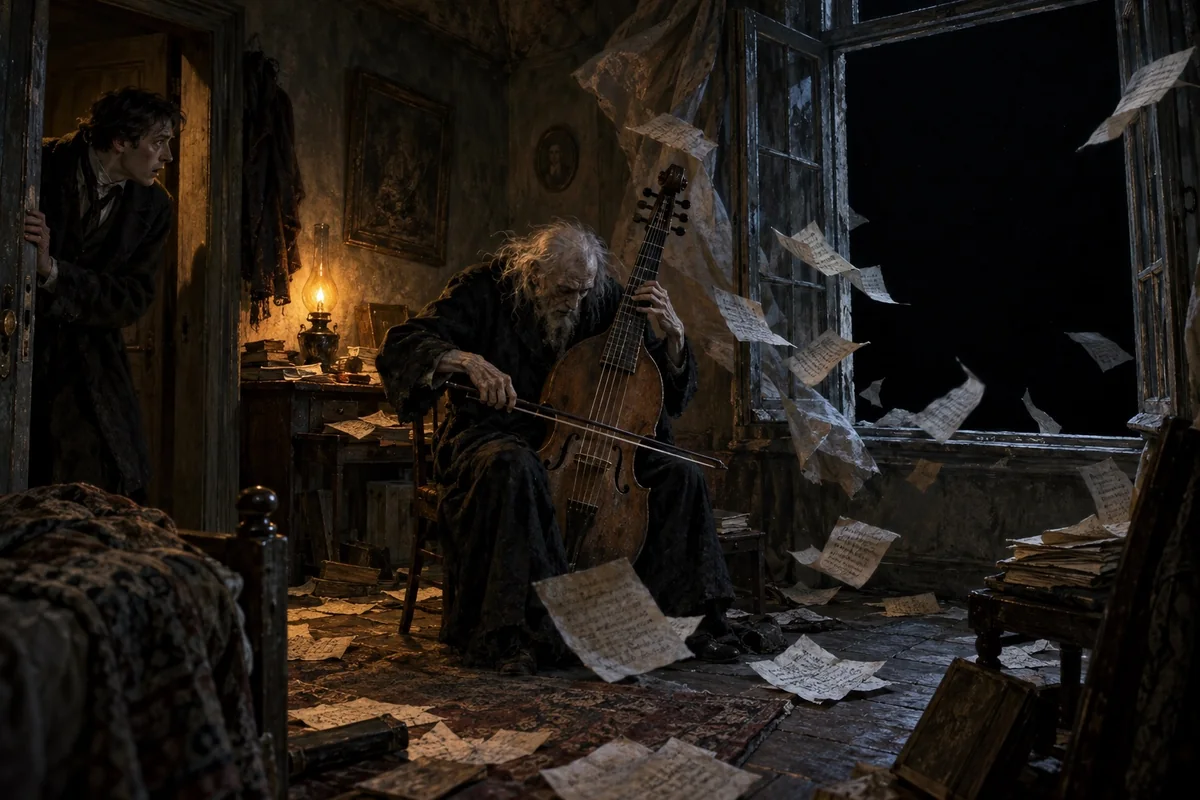
Zann begins writing a full explanation in German and asks the visitor to wait. Pages accumulate for about an hour. Before he can finish, a distant musical note appears to come from beyond the window.
He abandons the pencil and takes up his instrument. The explanation is interrupted at the moment when the reader might expect the earlier mysteries to become intelligible. Written language has begun to promise an account, but immediate danger forces a return to music.
The last performance
The narrator now sees that fear drives Zann’s playing. It appears intended to drown out or ward off something outside. At one point the music includes a wild Hungarian dance familiar from the theater, showing that the defensive performance is not restricted to a single secret composition.
Another sound seems to answer from the west: steady, deliberate and remote. The shutters rattle, a violent wind rises and the window breaks. Zann keeps playing as his face and movements become increasingly mechanical.
A gust carries the written pages toward the opening. The student rushes after them but cannot recover them. The only substantial explanation offered within the story disappears before it can be read.
What lies beyond the glass
At the broken window, the narrator finally looks for the expected cityscape. He sees no roofs, streets or familiar lights. Instead there is an apparently limitless black space filled with motion and music unlike anything terrestrial.
The wind extinguishes the candles. Trying to rescue Zann, the student gropes through the room and reaches the still-playing musician. His face is cold and rigid, and he no longer breathes, yet the instrument continues sounding.
The narrator escapes down the stairs and through the street. Beyond the bridge he finds an ordinary night with moonlight, city lamps and no wind. The contrast makes the violence in the attic seem locally concentrated around a boundary that ordinary streets do not reveal.
The ending’s two losses
The narrator never finds the Rue d’Auseil again. He has also lost the German manuscript that might have explained Zann’s fear and knowledge. These are different failures of access: the place cannot be located, and the account cannot be recovered.
The story does not identify the distant player, name a god outside the window or explain why Zann’s apparent corpse continues performing. His instrument is called a viol in the text. Replacing that wording with an asserted modern instrument type or an elaborate magical specification would add certainty the narrative does not provide.
The narrator is not entirely sorry that the street and pages remain inaccessible. His desire for knowledge survives, but the experience has changed his estimate of what further discovery might cost.
Interpretation: art as defense
In this encyclopedia’s reading, the initial misunderstanding concerns what the music is for. The student approaches it as a work to enjoy, classify and hear again. Zann behaves as someone whose performance has immediate consequences that an uninformed listener cannot recognize.
The final use of a familiar theatrical dance is especially suggestive. It prevents a simple equation between strange music and supernatural power: urgency, volume, performance and resistance matter alongside originality. The text nevertheless stops short of describing a reproducible protective technique.
The story also frustrates the conventional expectation that a final document will explain everything. Zann tries to become his own witness, but his testimony is physically lost. The narrator can describe the result of crossing the room and looking out, while the cause remains beyond his account.
References
- H. P. Lovecraft Archive — fiction in composition order
Composition dates; question marks and ranges retain the source uncertainty.
- H. P. Lovecraft Archive — fiction in publication order
First publication dates and venues; issue dates can differ from actual release dates.
- The Music of Erich Zann — Unspeakable Tales ebook
The fictional narrative is evidence for what the story says, not proof of events in the real world.
At a glance
H. P. Lovecraft
December 1921
1922, March
The National Amateur, 44, No. 4
Fiction