

The Shadow of Nath
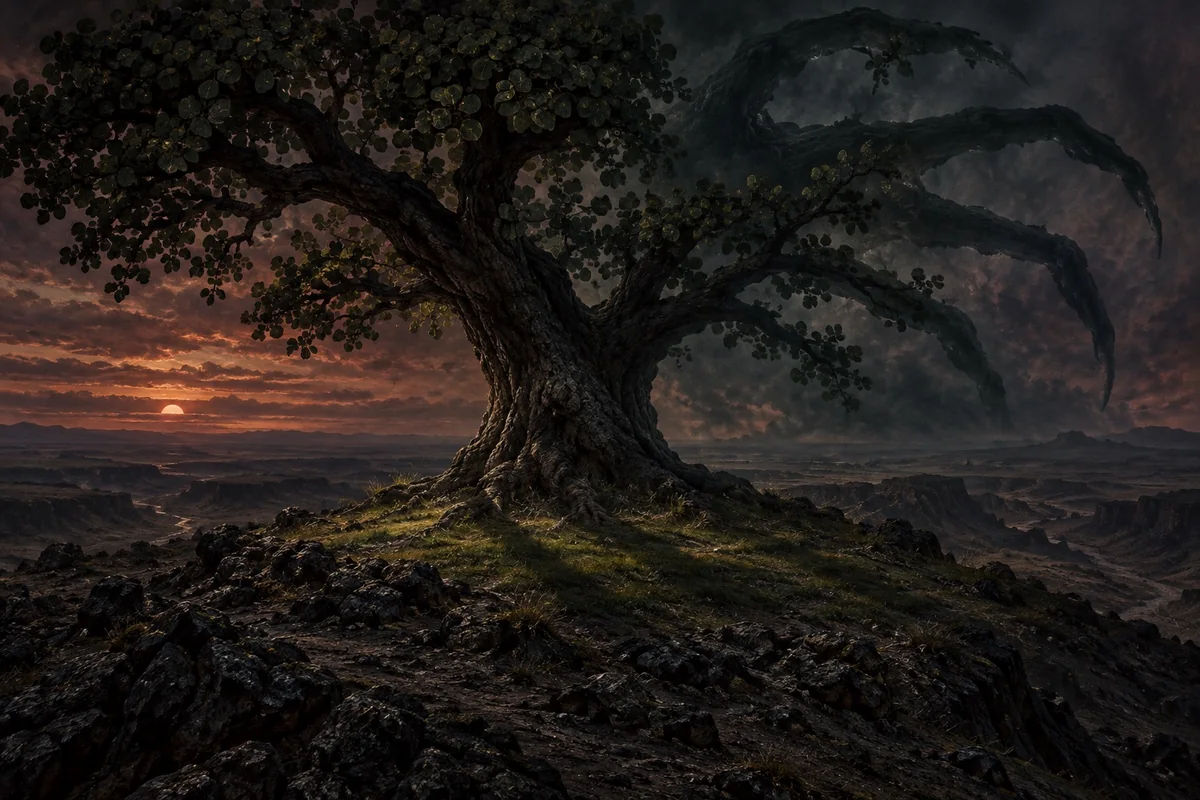
The Shadow of Nath is this wiki’s descriptive name for the predatory presence associated with the Chronicle of Nath in The Tree on the Hill. It conceals itself within recognizable appearances and alluring dreams. An unfinished drawing suggests that the apparent tree is only an extremity of something far larger than the landscape’s human visitor understands.
4 min read · 770 words
Name and source boundaries
The story does not introduce a proper species name for its antagonist. The Chronicle calls the ancient presence a shadow, and Constantine Theunis interprets Single's modern encounter through that account. This entry groups those connected descriptions without implying that Shadow of Nath is an official biological or theological classification.
The source is the collaboration by Duane W. Rimel and H. P. Lovecraft, composed in 1934 and first published in 1940. Its events take place in 1938. Those three dates describe different aspects of the work and should not be combined into one supposed date of the entity's creation or arrival.
The creature is not explicitly named as Shub-Niggurath, Nyarlathotep or an established extraterrestrial species. Such identifications require evidence beyond similarities of vocabulary or atmosphere.
Sources: The Tree on the Hill — original text, H. P. Lovecraft Archive — fiction in composition order, The Tree on the Hill — publication data
The ancient predation
In the Chronicle's account, a presence arrives in Nath during the Year of the Black Goat. Its form does not belong to the ordinary visual categories of Earth. It takes on familiar or desired shapes so that its victims do not recognize what is consuming them.
The dreams associated with it promise freedom in the Land of the Three Suns. The contrast between that promise and the loss of the victim's soul is essential: attraction is the mechanism that makes the danger difficult to resist.
The account names earlier attempts to confront the shadow and says that it eventually withdrew after feeding. It also anticipates a return when the dangerous cycle recurs. The passage does not give an exact astronomical period or a complete list of earlier manifestations.
Sources: The Tree on the Hill — original text
The tree as an appearance
Single encounters the modern manifestation in an otherwise barren part of Hell's Acres near Hampden. The tree resembles an oak but has unusually uniform round leaves and an appearance that he cannot match to a known species.
Grass grows beneath it while nearby ground lacks ordinary vegetation and animal activity. Shade and softness invite him to rest. The apparent refuge places him exactly where the final drawing will suggest an immense appendage reaching toward a human figure.
The story does not establish whether the entire barren region was physically consumed by the presence, created as an illusion or affected through another process. Its strangeness is observable; its full causal history is not.
Sources: The Tree on the Hill — original text
Dreams, attraction and disrupted memory
Rest beneath the tree leads Single into visions of three suns, an unfamiliar temple and a dark region containing indistinct beings. After waking from the first experience, he photographs the place but remains unwilling to depart.
A second episode ends with him injured on a distant slope. He has moved without retaining a coherent memory of the journey. Later, even after Theunis warns him, he repeatedly longs to revisit the hill.
These effects support the Chronicle's account of a lure operating through desire and altered perception. They do not show the completed consumption of Single's soul: he survives and writes about the encounter, however deeply it changes him.
Sources: The Tree on the Hill — original text
The form behind the landscape
The photographs show multiple shadows and vegetation arranged in unsettling ways. They expose inconsistencies that Single did not consciously register, but they still do not disclose a complete body.
Theunis uses the Gem to examine a photograph and makes a hurried drawing of what becomes visible. Single later sees the sketch and understands the apparent tree as a hand or talon extending from an immense alien whole.
The surrounding scene also appears to participate in that larger form. The revelation concerns a false division between landscape and inhabitant, rather than simply a monster hidden behind a normal tree.
The sketch is incomplete, and the most detailed viewing leaves Theunis hospitalized. A definitive illustration of the creature's entire anatomy would therefore go beyond the evidence. The accompanying image is an artistic interpretation of the tree-and-talon relationship, not a canonical full-body portrait.
Sources: The Tree on the Hill — original text
Resistance and the remaining threat
According to the Chronicle, surviving a view of the true form makes resistance possible. Theunis believes that his experiment has expelled the presence and made Single safe.
He nevertheless orders the photographs destroyed. Their continued attraction gives them a dangerous role even after the immediate encounter is thought to be over. Single burns them and subsequently destroys the drawing as well.
The Gem is preserved because another cycle may require its use. The ending thus combines a reported local victory with a future vulnerability that has not been abolished. Single's lasting fear is that other ordinary scenes may conceal equally unfamiliar realities.
Sources: The Tree on the Hill — original text
References
- The Tree on the Hill — original text
The fictional narrative is evidence for what the story says, not proof of events in the real world.
- The Tree on the Hill — publication data
- H. P. Lovecraft Archive — fiction in composition order
Composition dates; question marks and ranges retain the source uncertainty.
At a glance
The Tree on the Hill
Descriptive index name; no proper species name supplied
An unfamiliar oak-like tree and surrounding landscape
An immense hand or talon in an unfinished drawing