

The Tree on the Hill
The Tree on the Hill concerns a solitary excursion whose photographs reveal a landscape different from the one consciously perceived. In this collaboration with Duane W. Rimel, a scholar uses an ancient crystal to expose the presence disguised as an inviting tree. The story links dreams, optical evidence and deceptive scale without assigning its unnamed antagonist to a familiar Mythos species.
8 min read · 1,479 words
Composition and first appearance
The Archive dates composition to May 1934 and credits Duane W. Rimel and H. P. Lovecraft. The first publication was in the September 1940 Polaris, volume 1, number 4, on pages 4–11.
The narrated events occur in the summer of 1938. That fictional date should remain separate from both the date of composition and the posthumous publication date.
The narrator is addressed by the surname Single. His companion, Constantine Theunis, is studying Egyptian mythology. Their different kinds of knowledge shape the plot: Single encounters and records the place, while Theunis recognizes a pattern that requires a dangerous act of interpretation.
Sources: The Tree on the Hill — original text, H. P. Lovecraft Archive — fiction in composition order, The Tree on the Hill — publication data
Hampden and Hell’s Acres
Single and Theunis share a cabin in Hampden. To the southeast lies a difficult region of ravines and steep slopes near the Salmon River gorge, locally called Hell's Acres. The narrator associates it with a forest reserve and with stories of beings from outside the ordinary world.
The text attributes some of these stories to the Nez Perce. That attribution is part of the fiction's presentation of ominous local knowledge; it should not be extracted as a verified statement about Nez Perce tradition.
On 23 June, Single walks into the hills. He finds an expanse without the expected grass or wildlife. The terrain looks damaged by heat, yet a closer examination does not disclose an ordinary fire.
The lack of an adequate natural explanation prepares the encounter without identifying its cause. The place is already wrong before the apparently welcoming tree comes into view.
Sources: The Tree on the Hill — original text
The anomalous tree
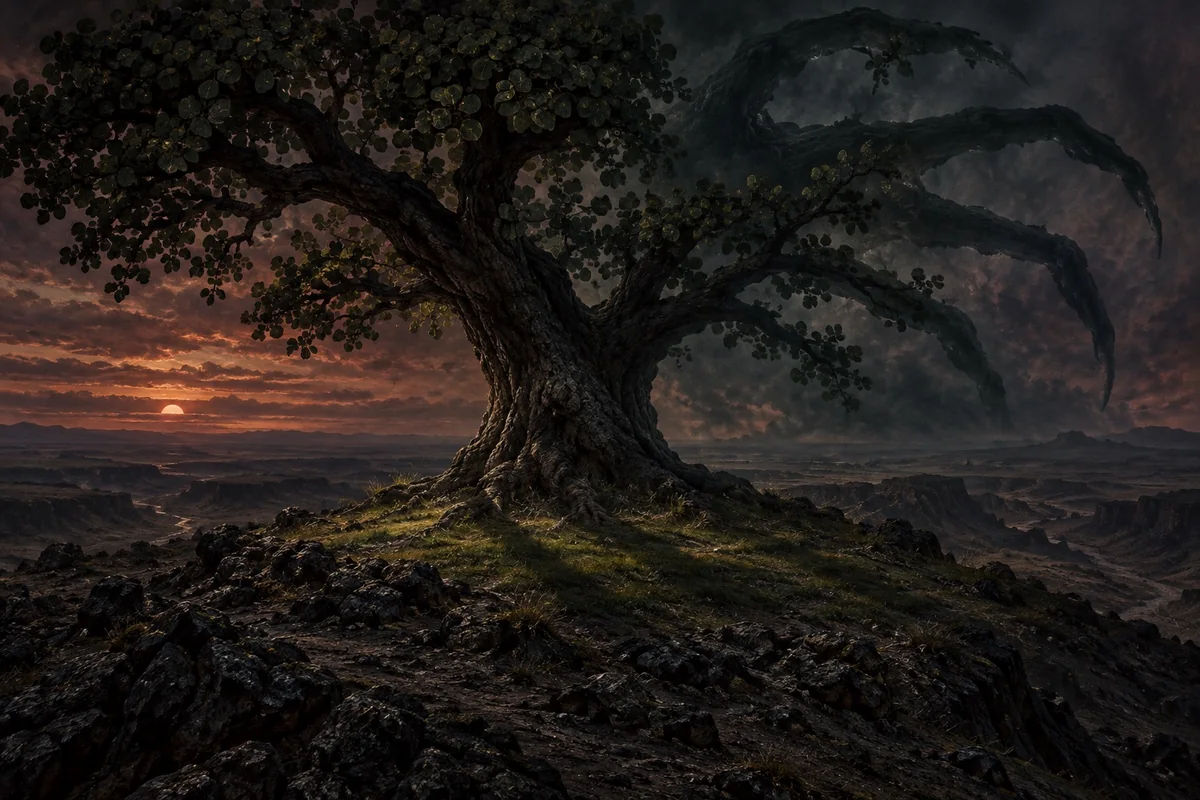
A solitary tree stands on a hill above the barren ground. Its broad trunk and spreading limbs suggest an oak, but Single cannot place it among familiar trees. The rounded leaves have an unusually uniform appearance.
Grass grows thickly beneath it, in contrast to the surrounding desolation. This small fertile space offers shade and rest after the difficult walk. Its attraction is therefore practical before it becomes psychologically disturbing.
From the hill Single sees distant snow-covered mountains that he identifies as the Bitterroots. He believes they should not be visible from that elevation. The impossible view extends the anomaly beyond one plant to the relation between observer, landscape and distance.
He lies beneath the tree, removes his camera and hat, and closes his eyes. The restful scene becomes the threshold of a vision whose connection with the physical place will emerge only later.
Sources: The Tree on the Hill — original text
The land with three suns
Single dreams of a reddish sky illuminated by three suns, winged creatures and a vast structure beside a muddy sea. The temple's unfamiliar color and architecture contribute to the sense of a world beyond ordinary experience.
At its entrance he perceives movement in darkness and what seem to be three burning eyes. He wakes in fear, attempts to regain composure and photographs the tree and surrounding views.
Despite the first vision, he remains reluctant to leave. A second lapse draws him more deeply into the temple and into an immeasurable region populated by indistinct forms. Flight occurs within the vision, but his actual movements are missing from his memory.
When he wakes again, he is on a rocky slope some distance away. Torn clothing and injured hands suggest a difficult physical passage, possibly including crawling. His watch has stopped at 10:34, while the sun indicates that much of the day has passed.
The story does not offer a precise conversion between dream duration and elapsed time. The stopped watch marks disrupted continuity without functioning as a measurement of another dimension.
Sources: The Tree on the Hill — original text
What the camera records
Three days later, Theunis opens the developed photographs. They show three shadows for objects that should have only one under the earthly sun. The pattern corresponds to Single's dreams of a world with three suns.
Other details are also unsettling. Vegetation takes improbable positions, the tree appears more grotesque than Single remembers, and familiar landmarks are absent. The photographs preserve a scene, but they do not provide a dependable map for returning to it.
The camera has recorded more than its operator consciously noticed. That does not make the image a complete revelation. Theunis still sees an elusive suggestion that he cannot resolve by looking at the photographs unaided.
The proposed excursion back to the hill is abandoned in favor of investigating the pictures. The danger has acquired a portable form: Single can leave the place while retaining an image that continues to attract him.
Sources: The Tree on the Hill — original text
The Chronicle of Nath
Theunis consults an early English translation of the Chronicle of Nath, attributed within the story to the German mystic and alchemist Rudolf Yergler. It describes a predatory shadow that appears during a recurring period called the Year of the Black Goat.
The shadow disguises itself in shapes that people can recognize or desire. Dreams draw victims toward the Land of the Three Suns while concealing the destruction taking place. According to the chronicle, someone who perceives its true form and survives may repel it.
An ancient object called the Gem enables that perception. The account names the high priest Ka-Nefer as its guardian and Phrenes as a figure who disappears after confronting the horror. These details form the chronicle's internal history, not an independently verified chronology of ancient Egypt.
Theunis applies the passage to the photographs and believes that the current year is the relevant dangerous cycle. The phrase Black Goat does not by itself identify the shadow as Shub-Niggurath. The story provides no explicit equation between them.
Sources: The Tree on the Hill — original text
The optical experiment
Theunis knows where the Gem is held and arranges to borrow it. Back in Croydon, he builds a viewing apparatus that combines the crystal with a photograph. His reports mention refraction, polarization and unfamiliar relations of space and time.
The terminology gives the investigation an optical form, but the story does not present a reproducible scientific design. The crystal reveals what a normal photographic process cannot fully express, and Theunis must attempt to draw what he sees.
Single meanwhile alternates between fear of the hill and a compulsive desire to return. Knowledge that the place is dangerous does not end its attraction.
On the sixteenth day he learns that Theunis has been hospitalized following a collapse. Friends entered after hearing cries and found him unconscious. The experiment has yielded information at a severe personal cost.
Sources: The Tree on the Hill — original text
Theunis’s instructions
In hospital, Theunis says that seeing the hidden form has driven the presence away. He believes Single and the wider world are safe, although his hope that the tree will not reappear retains an element of uncertainty.
He tells Single to destroy the photographs and secure the Gem for eventual return to its custodians. The images are expendable and dangerous; the crystal must survive because another cycle may make it necessary again.
Single goes to the house, removes the photograph and amber-colored crystal from the apparatus, and puts the latter in the safe. He notices the crystal's strange angles and an unusual sensation when touching it.
He burns the photographs despite a lingering desire to preserve them. Crucially, he does not look through the assembled instrument. The final shock reaches him through a less direct form of evidence.
Sources: The Tree on the Hill — original text
The drawing and the concealed body
Among the papers near the apparatus, Single discovers Theunis's unfinished sketch. Curiosity overcomes his intention to leave it alone. He looks and loses consciousness.
After recovering, he burns the drawing. He can nevertheless describe enough of it to reveal the central transformation: the familiar landscape appears to be part of a vastly larger, alien presence, and the tree occupies the position of an extended hand or talon.
The branching forms become fingers or feelers reaching toward the ground or the observer. Single thinks he can make out the place where a human body lay beneath them, but the rough sketch leaves him uncertain.
The ending therefore does not simply reveal an evil botanical species. It revises the scale and organization of the entire scene. What seemed to be a discrete tree may have been an extremity of something too large and unfamiliar for ordinary sight to organize correctly.
Sources: The Tree on the Hill — original text
Interpretation and the limits of identification
The story proceeds through several representations: remembered landscape, dream, photograph, refracted view and drawing. Each reveals something while leaving something else inaccessible. Even Single's retrospective account cannot supply the complete form that incapacitated Theunis.
The chronicle offers a working explanation and a means of resistance, but it does not become an exhaustive catalogue of the entity. The text gives no established species name, exact dimensions or relation to a named god.
Connections with dangerous art, dimensional thresholds and unreliable perception are consequently stronger than attempts to assign the shadow a fixed position in a universal pantheon. The narrative's enduring threat is that apparently familiar scenery may be an accommodating disguise for an encounter already underway.
Sources: The Tree on the Hill — original text
References
- The Tree on the Hill — original text
The fictional narrative is evidence for what the story says, not proof of events in the real world.
- H. P. Lovecraft Archive — fiction in composition order
Composition dates; question marks and ranges retain the source uncertainty.
- The Tree on the Hill — publication data
At a glance
H. P. Lovecraft; Duane W. Rimel
May 1934
1940, September
Polaris
Fiction