

Memory
Memory is a brief prose fantasy set among the ruins of humanity in the valley of Nis. A moon-associated Genie asks the Daemon of the Valley about the builders of the abandoned structures. The answer reduces the whole human past to a fading resemblance and a remembered name, making extinction a problem of lost significance as well as lost life.
3 min read · 469 words
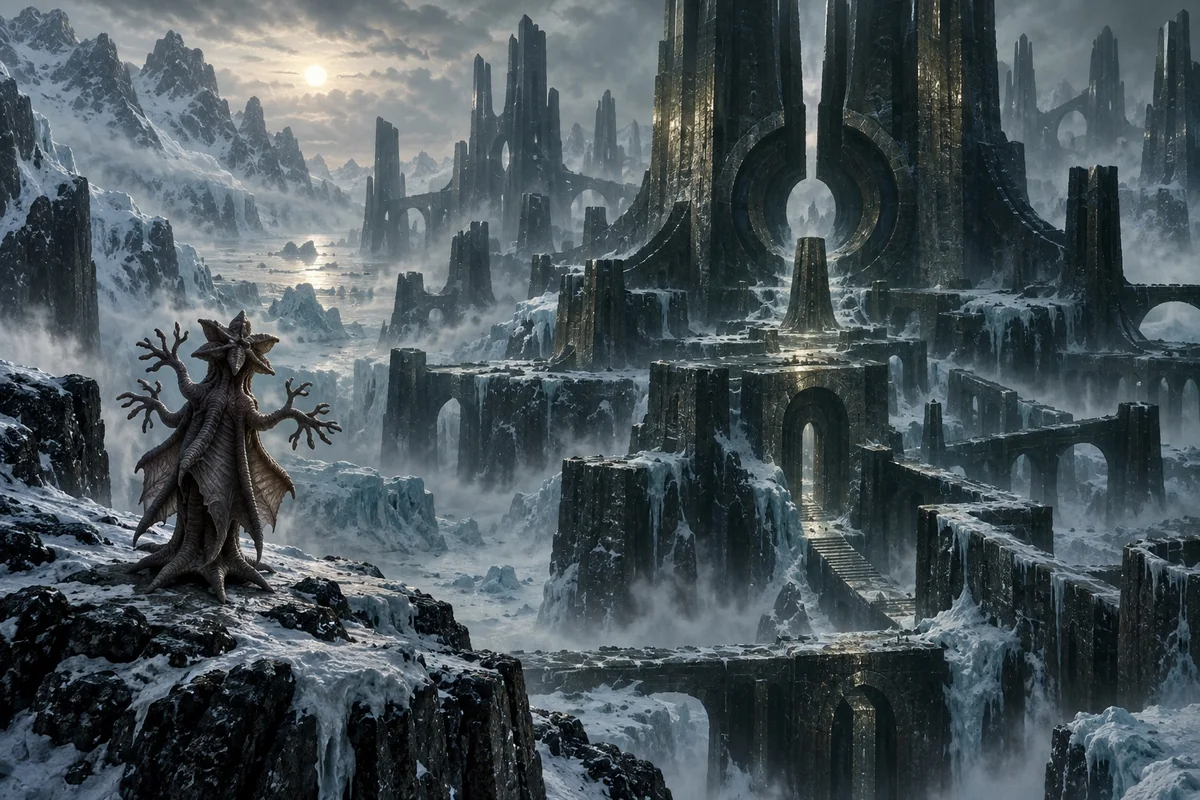
The valley after its builders
The valley contains ruined palaces, broken columns, monoliths and marble pavements overtaken by vegetation. Apes move through trees in former courtyards, and other animals inhabit vaults and fallen masonry.
Sources: [1]
The builders intended their works to endure. They have, in a limited sense, succeeded: the stones remain and still provide shelter. The irony is that their present beneficiaries are animals, while the purposes for which the structures were made have vanished.
The river and the two speakers
The river Than rises from hidden sources and disappears into subterranean grottoes. Even the Daemon does not fully understand its destination or the reason for its color. The landscape exceeds the knowledge of the being associated with its memory.
The Genie is old and forgetful, and asks for the deeds, appearance and name of the builders. The Daemon identifies itself as Memory but admits its own limitations. Neither figure acts as an omniscient narrator capable of restoring the entire lost civilization.
Sources: [1]
What remains of humanity
Memory can no longer recall the builders' deeds, describing them as too brief to retain. It remembers their appearance only dimly, through a resemblance to the small apes now occupying the ruins.
Their name survives because it rhymes with the river's name: Man. The connection preserves a word after the culture and achievements it designated have become inaccessible. The final image returns attention to an ape in a ruined courtyard rather than to a recovered human glory.
Sources: [1]
Time, scale and the title
The title makes forgetting more severe by assigning it to Memory itself. If even the personification of recollection cannot retain human deeds, the implied timescale has overwhelmed the usual hope that history preserves significance.
The effect does not require a narrated war, plague or cosmic attack. Lovecraft withholds the cause and date of humanity's disappearance. The reader encounters only the aftermath and the indifference of a world that continues to support other life.
This is an editorial reading of the fable's structure. It should not be expanded into a definite future chronology or identified with a named catastrophe from another story.
Sources: [1]
Connections and limits
The ruined landscape connects the piece thematically with Lovecraft's longer accounts of vanished civilizations. Its particular force lies in brevity: the expected account of human achievement collapses into the inability to remember it.
The text names Nis and Than and presents the Genie and Daemon, but supplies no map, dynasty or history of their rule. Neither speaker is explicitly identified as one of the later named Mythos gods. Their roles are sufficiently complete within this short meditation without such additions.
Sources: [1]
References
- Memory — original text
The fictional narrative is evidence for what the story says, not proof of events in the real world.
At a glance
H. P. Lovecraft
1919
1919, June
The United Co-operative, 1, No. 2
Fiction