

The Terrible Old Man
The Terrible Old Man follows three robbers who mistake an elderly Kingsport resident’s apparent frailty for helplessness. Local stories about his stones and strangely responsive bottles mean nothing to the intruders until the attempted robbery becomes a catastrophe. The brief tale keeps the violence offstage and makes a waiting accomplice’s mistaken interpretation carry the suspense.
5 min read · 860 words
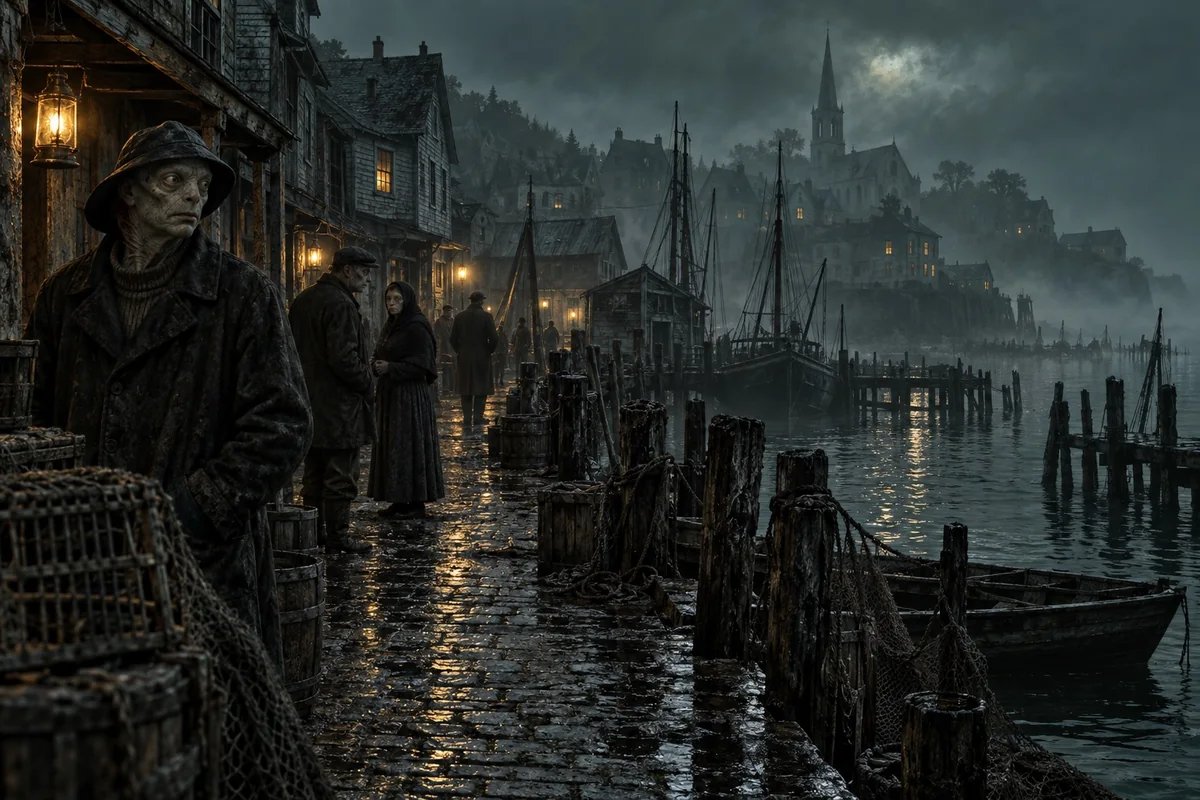
Composition, publication and form
Lovecraft wrote the story on 28 January 1920. It first appeared in The Tryout in July 1921. Its compact third-person narration moves from the planning robbers to the accomplice waiting outside, then to the town’s later discovery of bodies.
The old man’s name is not disclosed. His local nickname supplies the title and establishes a reputation the criminals fail to take seriously. Unlike an investigative story that eventually translates its mystery into a complete history, this one ends with that reputation strengthened but still unexplained.
Sources: H. P. Lovecraft Archive — fiction in composition order, H. P. Lovecraft Archive — fiction in publication order, The Terrible Old Man — Unspeakable Tales ebook
A tempting victim
Angelo Ricci, Joe Czanek and Manuel Silva believe the old man possesses considerable hidden wealth. He has no bank account and buys necessities with Spanish coins centuries old, making his house seem a promising target.
He lives alone near the sea in Water Street, walks with a knotted cane and has trembling hands. The robbers interpret these signs of age as evidence that two men can force him to disclose the money’s location.
The narrator’s mock-politeness repeatedly softens the language of their intentions while allowing readers to see the planned violence. Their supposed concern for his comfort is incompatible with the coercion they expect to use.
The stones and bottles
Residents believe he once captained East India clipper ships, but nobody remembers his youth. Painted stones stand among the trees in his yard, suggesting unfamiliar temple idols and discouraging children who might otherwise torment him.
Curious observers also report bottles on a table, each containing a small piece of lead suspended by a thread. He addresses them by personal names, and the lead appears to move in response. The names include figures such as Long Tom and Mate Ellis, suggesting a maritime company without proving exactly who or what the bottles contain.
The text does not explicitly state that they imprison the souls of murdered sailors. That is a possible interpretation of the clues, not a narrated revelation. The mechanism of their response remains unspecified.
The attempted robbery
The men choose the night of 11 April. Ricci and Silva approach the front door, while Czanek waits in a covered automobile near the rear gate in Ship Street. Their separate arrivals and planned exit are intended to reduce attention.
At the house, the two intruders hear the old man speaking to his bottles. They put on masks and knock. The narrative then leaves them and follows Czanek’s increasingly anxious wait.
He hears dreadful screams but assumes they come from the intended victim. As the delay grows, he wonders whether his companions have killed the old man before learning where the money is hidden. His expectations keep him from interpreting the evidence correctly.
The figure at the gate
Czanek hears someone approaching the rear gate and expects the others to emerge with their loot. Instead the old man appears alone, leaning on his cane and smiling. In the dim streetlight, Czanek notices his yellow eyes.
The scene stops before any explicit attack on the driver. The next passage moves to the later discovery of three mutilated bodies washed in by the tide. Their injuries resemble cuts from cutlasses and crushing by heavy boot heels.
The number of bodies and the abandoned car connect the discovery with the robbers, but the townspeople cannot identify them. No police solution or confession follows. The old man remains indifferent to the gossip.
What the ending implies
The responsive bottles, maritime names and apparent weapon marks encourage readers to imagine an old crew acting for its captain. Yet the story never shows that crew materializing or explains whether the old man’s own body is human.
Its effect depends on the gap between the intruders’ narrow assessment and the reader’s accumulated unease. The visible old man has not become less frail; the meaning of frailty has changed because the unseen resources around him were excluded from the robbers’ calculation.
The final ironic comments about his long experience preserve the same withholding. The account closes on his composure rather than on a catalogue of supernatural powers.
Xenophobia in the framing
The narrative explicitly places the robbers outside the inherited community of New England and connects their outsider status with failure to understand local tradition. Their criminal plan is real within the plot, but the emphasis on alien ancestry adds a prejudicial social explanation that the synopsis should identify rather than adopt.
The contrast is therefore not merely between informed residents and uninformed visitors. It carries the author’s exclusionary idea of who belongs inside the region’s cultural life, making the apparent victory of local knowledge ethically more complicated.
The old man’s later appearance
The Strange High House in the Mist reuses the figure as a source of local memory. He receives Thomas Olney despite his general dislike of strangers and later interprets the philosopher’s altered return from the cliff house.
That later role broadens him beyond the unseen punishment of criminals. He becomes a custodian of stories and a concerned observer of supernatural effects on the town’s young people, while his own origins remain obscure.
Sources: The Terrible Old Man — Unspeakable Tales ebook, The Strange High House in the Mist — original text
References
- H. P. Lovecraft Archive — fiction in composition order
Composition dates; question marks and ranges retain the source uncertainty.
- H. P. Lovecraft Archive — fiction in publication order
First publication dates and venues; issue dates can differ from actual release dates.
- The Terrible Old Man — Unspeakable Tales ebook
The fictional narrative is evidence for what the story says, not proof of events in the real world.
- The Strange High House in the Mist — original text
The fictional narrative is evidence for what the story says, not proof of events in the real world.
At a glance
H. P. Lovecraft
28 January 1920
1921, July
The Tryout, 7, No. 4
Fiction