

The Trap
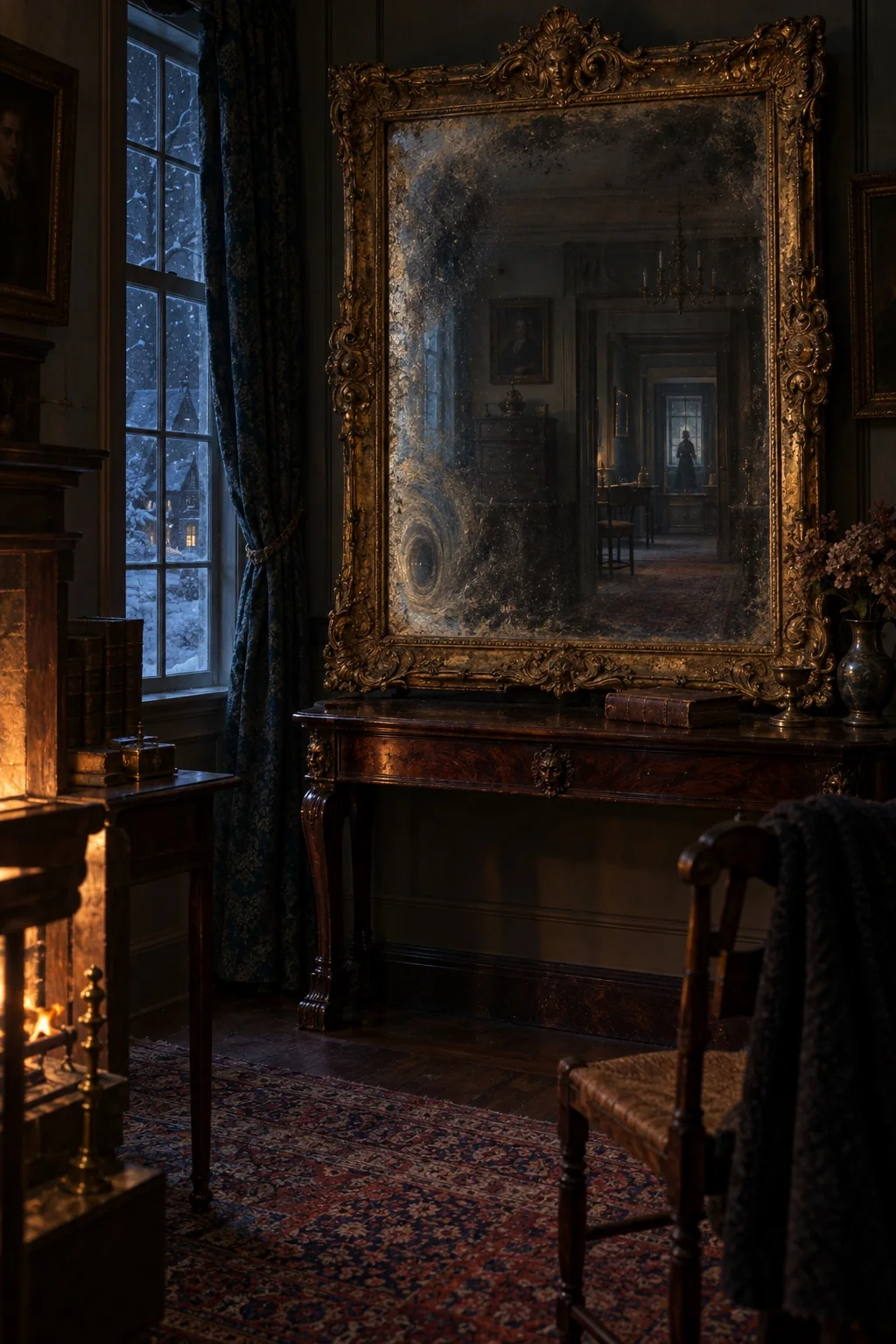
The Trap turns an antique mirror into a prison whose inhabitants retain their bodies and consciousness while ordinary aging is suspended. When fifteen-year-old Robert Grandison disappears from a Connecticut school, his tutor Canevin learns to communicate with him in dreams and attempts a physical intervention from outside. The collaboration with Henry S. Whitehead combines an occult artifact, a carefully elaborated imaginary geometry and a rescue that leaves permanent bodily evidence.
11 min read · 2,242 words
Composition, publication and narrator
The Archive dates the collaboration with Henry S. Whitehead to late 1931. Its first publication was in the March 1932 Strange Tales of Mystery and Terror, volume 2, number 1, on pages 73–88. Its inclusion among Lovecraft's revisions and collaborations should not obscure Whitehead's credit.
Canevin tells the story retrospectively in the first person. His experience of unusual events in the West Indies helps explain his readiness to consider an extraordinary explanation, but the narrative begins in an ordinary educational setting rather than an established cult center.
At the time of the incident he is staying partly as a guest and partly as a tutor at a school run by his friend Browne. His separate rooms in a dormitory wing provide both the scene of the disappearance and the private space in which he can investigate it.
The Copenhagen mirror
Canevin recovered the mirror from an outbuilding on an abandoned estate in the Northside district of Santa Cruz. The old glass had become cloudy in the tropical climate, and its gilded frame required repairs. After several years in storage, he unpacked it at the school and placed it above an inherited rosewood console.
The arrangement of his rooms creates a visual corridor: a second mirror in the bedroom reflects the larger one through the intervening doors. On a Thursday morning in December he notices apparent movement within this repeated reflection, although nobody else is present.
A failure of the school heating brings his class to the living-room fire. Robert Grandison remains afterward to study and notices that irregularities in the antique glass appear to converge on one point. Touching the spot gives him the sensation that his finger is being pulled inward.
Canevin verifies the visual peculiarity from the appropriate angle. The point cannot be observed in quite the same way from every position, and its apparent movement suggests both rotation and inward flow. At this stage he still frames the problem as an intriguing optical effect.
Sources: [1]
Robert disappears
Robert returns after lessons while Canevin is away. He is drawn to touch the center again and is pulled through the glass in a violent bodily transition. Canevin initially knows none of this: the immediate problem is a pupil absent from the compulsory afternoon assembly.
Searches of the buildings and surrounding countryside fail. Robert's outdoor clothes and possessions remain where they belong, and inquiries establish that he has not gone home. His parents arrive, then leave again without an explanation. The approaching Christmas holiday empties the school and intensifies its atmosphere of loss.
The disappearance has a specific institutional context. Browne feels responsible for a child entrusted to his care, while Canevin's earlier encounter with the mirror has not yet become a consciously accepted solution. The ordinary search exhausts plausible locations before the narrative turns to dream communication.
Sources: [1]
Communication during sleep
After the holiday departures, Canevin dozes by his fire and wakes with an impression that Robert has tried to reach him. He goes to bed hoping to renew the contact. A subsequent dream presents the boy in altered colors, struggling to speak across an invisible separation.
Robert's apparent size behaves contrary to ordinary perspective: he seems larger as he moves away and smaller as he approaches. His skin and clothes have undergone complementary color changes. His voice is difficult to understand, and his outline initially lacks stability.
Through repeated sleeping encounters, Canevin gradually assembles an account of the prison. He later supplements this information with Robert's testimony after the rescue. The story therefore does not present every detail as something Canevin personally sees through the mirror.
Indeed, it explicitly distinguishes telepathic images from ordinary interdimensional sight. Canevin cannot inspect the entire inner landscape, and Robert does not simply look out through a transparent window. Their contact depends on a special mental link. The narrator's appeals to psychology and dimensional speculation belong to the fiction, not to a demonstrated scientific explanation of dreaming.
Sources: [1]
The bodily reversal
Entering the glass leaves Robert painfully disoriented. Movement initially feels as though the parts of his body no longer fit together. Walking becomes manageable before speaking, whose more complicated coordination remains difficult for longer.
Canevin attributes these problems to a reversal affecting the body along with the visible world. The blue jacket appears yellow, while the neutral gray trousers remain gray. The tale gives analogous reversals of perspective, light and darkness, and bodily orientation.
These are the story's proposed rules for its particular dimensional construction. They should not be generalized into claims about what real higher-dimensional mathematics requires. The narrative combines optical analogies, physiological speculation and supernatural agency to make the trap intelligible on its own terms.
The prison also suspends ordinary requirements of life. Its occupants do not need food or drink, and the long-term inhabitants do not age normally. Robert has retained a body rather than become a disembodied ghost.
Sources: [1]
Scenes stored in the glass
The inner world consists of places that the mirror has reflected, especially locations before which it stood for long periods. It is a patchwork of rooms and outdoor views, joined by indistinct passages rather than a complete alternate Earth.
Long-lasting features are represented more clearly than passing objects. Exterior scenes are limited by the doorways or windows through which the mirror originally received them. Tropical deterioration of the surface has also affected the clarity of some areas.
The visible furniture, trees and architecture do not behave as usable material objects. Robert cannot simply take a chair from the scenery or climb a reflected staircase in the usual way. An underlying resistance supports his movements, and changes of height involve a less tangible mode of passage.
The account nevertheless gives the scenes a relationship to actual locations. Within the story's geometry, entering a projected room places the prisoner at that earthly location under spatial conditions that prevent ordinary contact. Canevin suggests that even brief reflections might leave less distinct connections, but this wider possibility is theoretical rather than fully explored.
Beyond the recognizable scenes lies a gray, uncertain region. Robert avoids venturing far into it because he fears becoming lost. The story does not identify that region with the Dreamlands or another separately named Lovecraftian realm.
Sources: [1]
Axel Holm and the pursuit of immortality
The prison's creator is Axel Holm, a Copenhagen glassworker who combined exceptional craftsmanship with occult study. Canevin's later investigations give his birth year as 1612 and the year of his disappearance as 1687.
Holm acquired a much older, small oval mirror associated in the narrative's legends with Loki. He incorporated it into a large, valuable looking-glass whose beauty might encourage successive owners to preserve it. The familiar decorative object thus protects the extraordinary mechanism embedded within it.
He first sent two enslaved men into the glass. He also supplied himself with books, writing materials, furniture and other objects before entering. These transported things possess a material status distinct from the intangible reflected scenery.
His objective was prolonged existence without ordinary physical decay. The arrangement depended on the containing mirror remaining intact. Leaving after the passage of a normal lifetime would bring destruction rather than a return to life in the present.
For more than fifty years after entering, Holm could not add to the company. He eventually developed a means of sensing and influencing people near the outer mirror. Robert's compulsion to touch the entrance belongs to this process of recruitment.
Sources: [1]
The other prisoners
Robert meets people from earlier centuries, including the English-speaking Dane Herr Thiele, children, young adults and the two enslaved men. Thiele becomes an important source of information, and the group generally welcomes the newcomer.
Their existence is not simply a continuous spectacular adventure. The reflected settings are limited, objects cannot ordinarily be handled, and the occupants have little material provision beyond what Holm brought. Long stretches of darkness are passed in conversation and memory.
The mirror had spent roughly a century facing a shed wall before Canevin recovered it. Robert is therefore the first arrival in a very long time, and his news of the outside world is an extraordinary event for the prisoners.
Holm remains the governing danger despite his outwardly informative manner. Robert conceals his communication with Canevin and stops when the magician approaches. The project of securing companionship has become a system of confinement from which the invited or entrapped cannot freely depart.
The text's racialized presentation of the enslaved occupants should not obscure their actual position. They were used to test Holm's scheme and remain deprived of freedom. Their inclusion makes the apparently personal pursuit of immortality inseparable from the exploitation of others.
Sources: [1]
Canevin plans an intervention
Canevin concludes that escape must be initiated from outside because the entrance does not permit a normal return. He is also concerned about releasing Holm into the world and uncertain what will happen to the other captives.
He studies the surface with a magnifying glass and estimates the boundary of the ancient oval component fused into the later mirror. After marking the outline, he obtains a substantial glass-cutting tool in Stamford.
He chooses half past two in the morning, partly because it provides privacy and partly because it reverses the approximate afternoon hour of Robert's entrance. He admits that this symmetry may be irrelevant. The time is an experimental choice, not a confirmed magical requirement.
In the early morning of the eleventh day after the disappearance, he locks the room, closes the shades and cuts around the marked oval. He then removes boards from the back and taps the isolated section free. His plan is precise physical separation, rather than a blind attempt to smash everything.
Sources: [1]
Rescue and destruction
The released glass falls onto the rug. An overpowering dusty smell emerges, and Canevin loses consciousness. When he wakes, Robert is physically present and trying to help him recover using the first-aid training he received at school.
Robert reports that the other inhabitants and the inner world faded away. The two survivors understand the odor as the material consequence of the destruction of people who had entered long before their natural lifetimes would have ended.
The rescue therefore has a cost beyond defeating Holm. The other long-confined occupants are not restored to ordinary life. Their condition had made continued existence dependent on the same structure that deprived them of freedom.
Robert had been in the projected bedroom when the opening was made and emerged in the actual bedroom. Hearing Canevin fall, he went into the living-room. This detail reinforces the earlier claim that the projected scenes correspond to particular earthly locations, rather than functioning only as pictures behind one sheet of glass.
Sources: [1]
The invented explanation
Canevin prepares an ordinary account that will allow Robert to return without telling the school an apparently impossible story. He secretly takes the boy outside, stages his recovery and reports that a car journey and accident had left him unconscious in a private home in Greenwich.
The supposed telephone call, journey and medical recovery belong to this cover story. They are not an alternative sequence of events independently established by witnesses. Browne accepts the explanation and informs Robert's parents, while Mrs. Browne, a former nurse, helps the boy recover at the school.
The deception reveals a tension in Canevin's role. He acts protectively and successfully restores his pupil, but he also controls what the family and institution are permitted to know. His narrated evidence remains concentrated in the experiences of two people who agree to conceal it.
Sources: [1]
Permanent evidence and the surviving fragment
Canevin's later research finds traditions about Holm that correspond to what Robert learned. Within the fiction these records provide corroboration, though readers should not mistake the invented biography for an independently verified seventeenth-century glassworker's history.
A more immediate confirmation is bodily. Robert, previously right-handed, now unconsciously uses his left hand, and Canevin finds his heartbeat on the right side. The clothing worn in the mirror likewise retains reversed construction, although its colors have returned to normal.
Canevin interprets the incomplete restoration as a consequence of dismantling the mechanism during the escape. He suggests that an ordinary exit might have reversed all the changes, but no successful example of such an exit is available. The observed alteration is firmer evidence than his explanation of its exact cause.
The larger mirror is patched and treated as harmless. Canevin keeps the oval piece as a paperweight in St. Thomas, where collectors sometimes misidentify it as old American glass. This domestic ending leaves an extraordinary object in plain sight, while the changed boy supplies evidence that cannot be reduced to an interesting antique.
Sources: [1]
Connections and boundaries
The story can be read beside other Lovecraftian narratives in which strange geometry changes the relationship between a body and its surroundings. Its particular achievement, however, is to make care, communication and practical ingenuity effective against the danger.
The mirror does not require a Cthulhu cult, a copy of the Necronomicon or a named cosmic deity to function. Its explicit occult associations concern Holm and the object called Loki's Glass. Cross-references to other dimensional stories are useful comparisons, not evidence that all their portals belong to one system.
The ending balances a successful rescue with irreversible consequences. Robert returns to his community, but his body retains the experience. Holm gains neither permanent power nor a safe return, and the older prisoners vanish with the apparatus that preserved them.
Sources: [1]
References
- The Trap — original text
The fictional narrative is evidence for what the story says, not proof of events in the real world.
- H. P. Lovecraft Archive — fiction in composition order
Composition dates; question marks and ranges retain the source uncertainty.
- The Trap — publication data
At a glance
H. P. Lovecraft; Henry S. Whitehead
late 1931
1932, March
Strange Tales of Mystery and Terror, 2, No. 1
Fiction