

Loki’s Glass and the Copenhagen Mirror
In The Trap, a small ancient object called Loki’s Glass is fused into an ornate mirror by the Copenhagen magician Axel Holm. The resulting apparatus admits living people to a spatial prison that suspends aging but prevents ordinary escape. The ancient component, the large decorative mirror and the inner world have different functions and should not be treated as three interchangeable names for one simple doorway.
6 min read · 1,061 words
Two objects in one construction
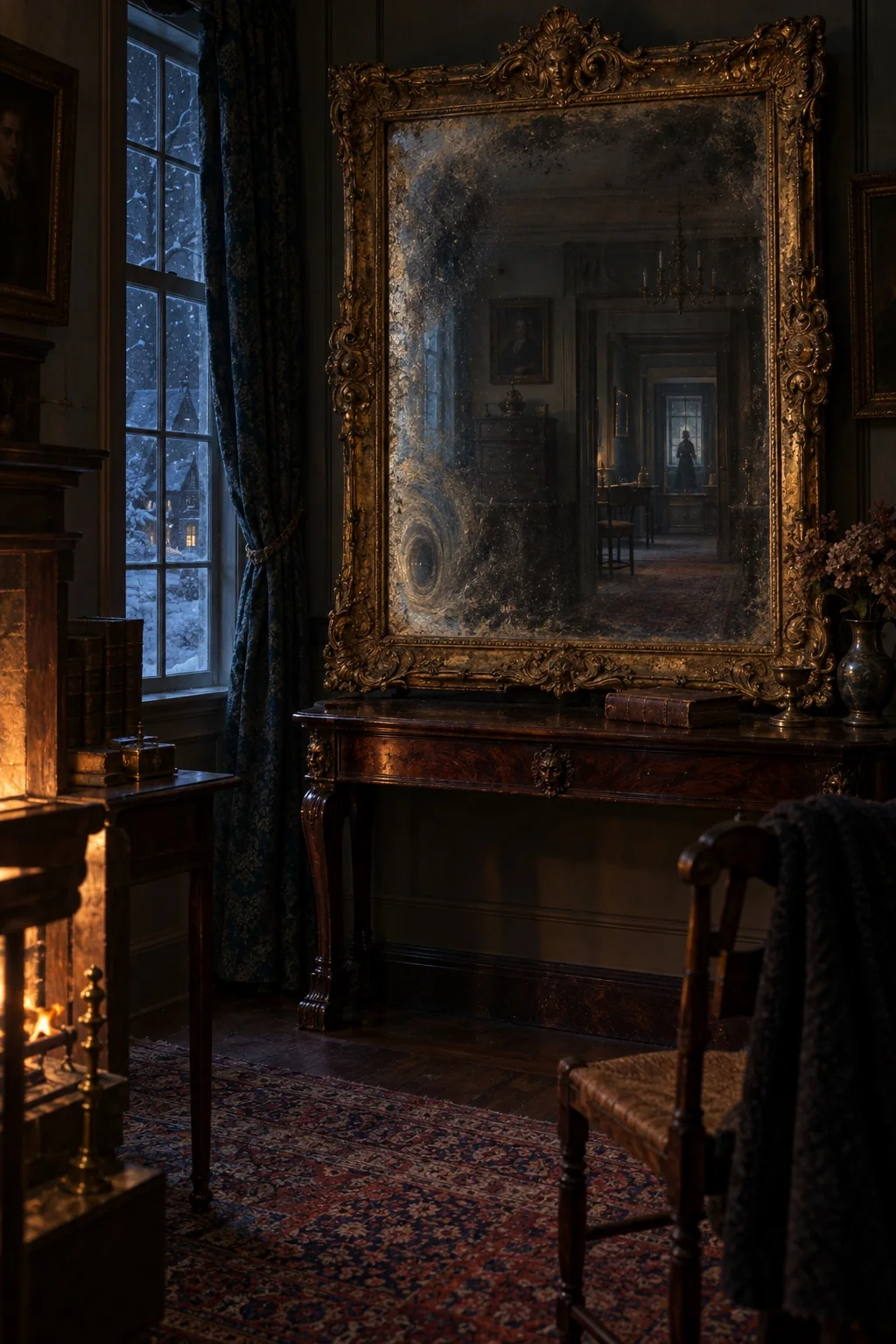
The large mirror is the work of Axel Holm, a skilled glassworker whose occult ambitions extend beyond his craft. Its valuable appearance is part of the design: an impressive furnishing is more likely to be preserved by future owners, protecting the smaller object embedded in it.
The older component is a small oval piece of polished, fusible material. Traditions discovered by Canevin call it Loki's Glass and attribute divinatory powers to it, including showing enemies and the immediate future. These are reported legends within the story, distinct from the dimensional effects experienced by Robert Grandison.
Holm is said to have obtained it from another practitioner who entrusted it to him for work. By incorporating it into his larger mirror, he develops a use beyond the powers described in the popular tales. The narrative does not establish an encounter with the Norse god Loki himself.
Sources: The Trap — original text
Ownership and the route to Connecticut
After Holm's disappearance in 1687, his possessions were dispersed. Much of the mirror's subsequent ownership is not traced in detail. By the time Canevin discovers it, it has spent roughly a century facing the wall of an outbuilding on a Santa Cruz estate.
Canevin restores damaged ornament on the gilded frame and brings the object to the United States. Several years later he installs it in his rooms at a Connecticut school. The surface is cloudy from age and exposure to a tropical environment.
Its placement opposite another mirror creates repeated reflections across two rooms and a hallway. This arrangement helps Canevin notice apparent movement before Robert identifies the more specific point at which the glass seems to draw a finger inward.
The long period facing a wall explains the absence of recent arrivals to the prison. It does not mean the mirror has ceased functioning or that its inhabitants have been released.
Sources: The Trap — original text
The entrance and its attraction
Fine irregularities in the glass appear to converge on a point near the lower left portion when viewed from suitable angles. The same location behaves differently when approached directly. Canevin perceives a movement that combines rotation with an apparent flow toward the interior.
Robert first experiences a pulling sensation while touching it. Later, under an impulse he finds difficult to resist, he presses the spot again and passes bodily through. The transition is painful and disorienting.
The later explanation associates the impulse with Holm's developed capacity to sense and influence nearby people. The mirror is therefore not only a passive opening that Robert happens to misuse. Its occupant can assist in attracting a new captive.
The entrance does not provide an equivalent route back. Ordinary passage into the apparatus and forced liberation from it are different operations, with different consequences for the traveler.
Sources: The Trap — original text
Reflected places and transported matter
The inner environment preserves places reflected by the mirror, especially those before which it remained for substantial periods. The scenes join in a discontinuous landscape with blurred passages and regions of gray uncertainty.
Represented furniture and architecture are intangible. The occupants cannot generally use objects merely because those objects appear in a reflected room. Holm therefore sends actual furniture, books and writing materials through the entrance to provision his stay.
The same distinction applies to people. Robert is physically present in the prison; he is not simply a recorded image left by exposure to the glass. He can move, speak and communicate, although the changed conditions initially disrupt those abilities.
The narrative further proposes that each scene has a spatial connection with the corresponding terrestrial place. The prison is consequently more elaborate than a hollow space inside a frame. Robert's emergence in the actual bedroom from its projected equivalent provides an important illustration of that rule.
Sources: The Trap — original text
Preservation and reversal
Aging and ordinary requirements such as food are suspended. Holm's original goal is continued bodily and conscious existence, dependent on the mirror remaining intact. The other prisoners share the suspension without necessarily having chosen it.
Colors, perspective and bodily orientation change in the inner world. These effects supply the story with a pattern of reversals that Canevin uses to reason about the apparatus. They are fictional properties, not a practical description of higher-dimensional physics.
Continued preservation comes at a severe cost. People whose normal lifetimes have elapsed cannot simply return to the contemporary world and begin again. When the apparatus is destroyed, the old prisoners dissolve rather than emerge as living survivors.
The mirror thus combines an answer to mortality with confinement, monotony and dependence on an object that its occupants cannot fully control from within.
Sources: The Trap — original text
Dismantling the trap
Canevin uses magnification to estimate the ancient oval's boundary and marks it before cutting. He chooses an early-morning hour partly as a reversal of Robert's afternoon entrance, while acknowledging that this numerical symmetry may have no actual importance.
He removes the back boards and taps out the isolated section. The operation destroys the inner arrangement. Robert returns, while the older inhabitants disappear and a powerful dusty odor fills the room.
The rescue restores Robert's normal colors but leaves his body and clothing reversed. Canevin interprets the uneven restoration as a consequence of dismantling the apparatus while the boy is passing out. The result is observed; the narrator's exact explanation remains an inference.
The story therefore gives no safe, repeatable procedure for transporting people. The successful intervention depends on partial knowledge and produces a lasting change even for the person it saves.
Sources: The Trap — original text
The final paperweight and related traditions
Canevin has the large mirror patched and treats it as harmless. The removed oval survives on his writing table in St. Thomas as a paperweight, sometimes mistaken by collectors for an example of early American glass.
That survival should not be confused with proof that the dimensional prison remains available. The narration says that the inner world has been destroyed. It does not demonstrate renewed divination or another imprisonment after the component is removed.
The artifact can be compared with other objects and geometries that cross boundaries in Lovecraftian fiction, particularly the Silver Key and the angles associated with the Witch House. Such comparisons concern narrative functions. The sources do not establish common manufacture, interchangeable operating rules or a shared divine patron.
Sources: The Trap — original text
References
- The Trap — original text
The fictional narrative is evidence for what the story says, not proof of events in the real world.
- The Trap — publication data
At a glance
The Trap
Axel Holm of Copenhagen
Loki’s Glass; small oval object
Canevin
Robert Grandison
Dimensional prison destroyed; oval retained as paperweight