

“Till A’ the Seas”
Till A’ the Seas follows humanity’s retreat across a drying future Earth and the final journey of Ull, its last survivor. Credited to R. H. Barlow and H. P. Lovecraft, it moves from immense spans of environmental change to the bodily needs of one thirsty traveler. Its catastrophe requires no invading god: the species disappears while the wider universe continues without acknowledgment.
7 min read · 1,342 words
Composition and publication
The Archive dates composition to January 1935 and credits R. H. Barlow and H. P. Lovecraft. The first publication was in the Summer 1935 Californian, volume 3, number 1, on pages 3–7.
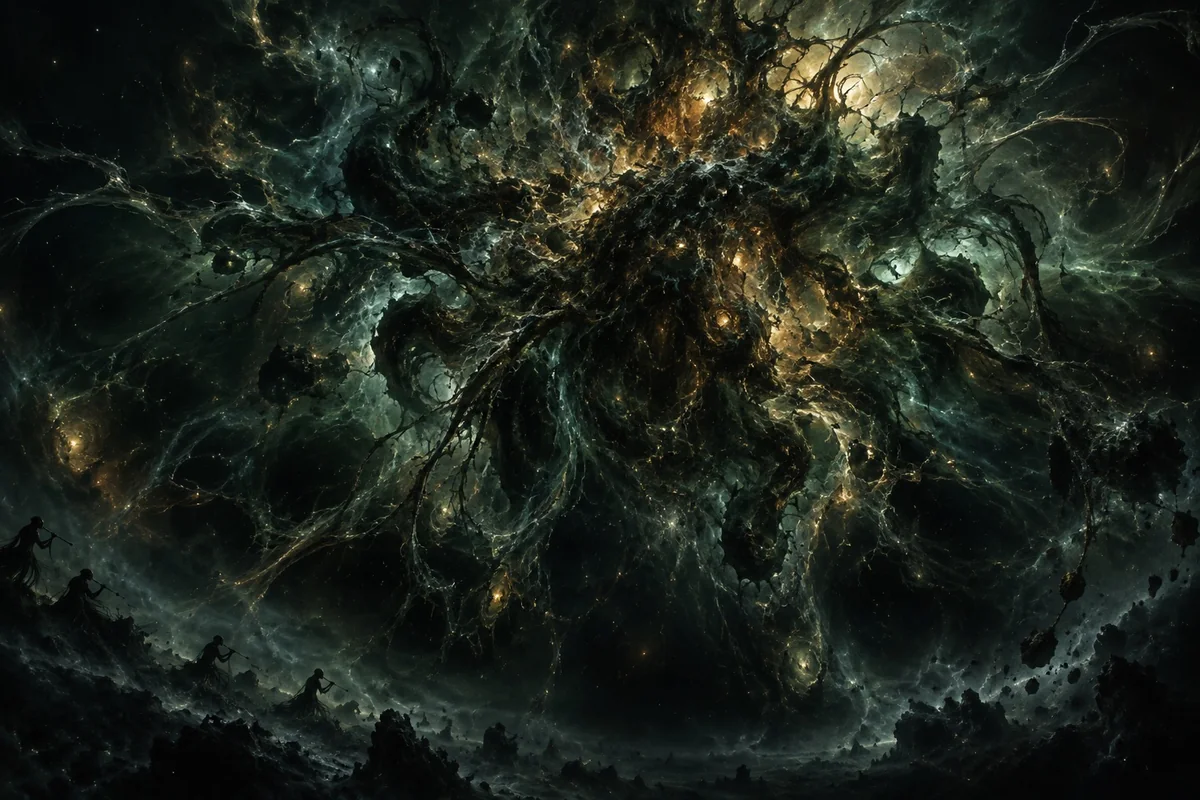
The story has two numbered parts. The first summarizes the long contraction of human civilization; the second follows Ull after the death of his remaining companion. An image of a man resting above a valley links the opening overview to the later personal narrative.
The scope is planetary, but the text does not offer a calendar that converts the entire future history into a precise date. Its vast durations establish scale and attrition rather than a complete chronological table.
Sources: “Till A’ the Seas” — original text, H. P. Lovecraft Archive — fiction in composition order, Till A’ the Seas — publication data
The retreat from the equatorial cities
In the story's imagined physical history, Earth draws progressively closer to the sun. Increasing heat and dryness eventually exceed both biological adaptation and the defenses devised by civilization.
Some inhabitants initially remain in the equatorial cities, using protective equipment and specially shielded buildings. These refuges allow a temporary continuation of familiar life, encouraging the belief that the earlier climate may return.
The failure of Yuanario provides a decisive example. When signals from Niyara receive no answer, an expedition finds the old city empty of human life. Its linked towers survive as a material structure after the community they sheltered has disappeared.
Other settlements are abandoned, and their populations move into regions that remain habitable. The first losses do not immediately end civilization: the refugees are absorbed into newer societies that can still experience long periods of prosperity.
Sources: “Till A’ the Seas” — original text
Successive refuges and the loss of memory
The affected zone continues expanding. Yarat, Perath, Baling and Loton appear in the account as parts of a world progressively surrendered to heat and desertion.
Agricultural failure initially produces technological substitution rather than immediate starvation. Yet successive migrations leave less room for the preservation of institutions, collections and the material record of earlier achievements.
The narrative's language of decline is often judgmental, but the causal pressure is environmental and prolonged. The survivors cannot simply choose to recover the stable conditions under which the abandoned cultures flourished.
Eventually the remaining populations move toward the polar regions. There they develop smaller agricultural communities under conditions that temporarily resemble the former temperate world. Over generations, memories of the old cities vanish, and lost technologies cease to be part of everyday possibility.
This interruption of memory is central to the story. The people living through the last phases cannot draw on a continuous historical understanding of how their situation arose.
Sources: “Till A’ the Seas” — original text
The disappearance of water
The polar refuge is temporary. The oceans diminish over durations so long that individual generations struggle to perceive the change. The account makes the mismatch between human experience and planetary processes part of the disaster.
Later inhabitants doubt ancestral reports of more plentiful water or milder conditions. Their immediate surroundings become the standard against which they judge what is possible, even while those surroundings continue deteriorating.
Ultimately accessible water survives chiefly in deep places. The remaining population contracts from hundreds to tens, with movement constrained by the very lack of water that might otherwise make migration necessary.
The fictional mechanism should be distinguished from a present-day scientific projection. The article records the story's inward-moving Earth and vanishing seas as narrative premises; it does not present them as a validated model of contemporary climate change or the sun's actual future.
Sources: “Till A’ the Seas” — original text
Ull and Mladdna
Ull's personal history begins within a community already reduced to a handful of people. In his eleventh year, the hunters leave in search of food and fail to return. The remaining group contracts further through death.
Mladdna arrives as a stranger during this period and eventually becomes his only companion. She and Ull gather roots and adapt their preparation to her failing teeth. Their daily life consists largely of securing enough food and maintaining the companionship that keeps absolute isolation at bay.
The narrative describes Mladdna harshly as an aged body, yet her practical and emotional importance is unmistakable. Her death leaves Ull without anyone to speak to or any reason, as he sees it, to remain.
Now in his nineteenth year, he decides to cross the mountains toward a settlement known through old accounts. His hope is social before it is historical: he seeks other living people, not the recovery of the great civilizations described in the first part.
Sources: “Till A’ the Seas” — original text
The journey without a container
Ull leaves the dead woman in their dwelling and closes its door, although there are no animals nearby to make the gesture useful. The ordinary action preserves a trace of domestic habit after the household itself has ended.
He travels with no stored water. His own small community has lived beside its supply and has not made vessels for carrying it. The absence of so basic an object becomes decisive when he attempts a journey outside that settled routine.
This detail should not be generalized to every survivor community. At his destination, Ull later finds clay containers. The difference shows that the scattered remnants have not retained exactly the same practices.
He initially expects to arrive quickly enough to avoid serious thirst. The terrain defeats that expectation. Night travel provides relief from the sun, but successive ridges continue separating him from the hoped-for settlement.
Sources: “Till A’ the Seas” — original text
The empty village
After exhausting travel, Ull sees a cluster of buildings beneath a cliff. He imagines movement among them and forces himself onward in the expectation of finding company.
Inside a dwelling he discovers a skeleton at a table. The dry conditions have preserved the settlement's structure long after its inhabitants died, allowing the appearance of a usable village to survive without the life that would make it a refuge.
His search through the remaining buildings reveals traces of work and containers holding dust. Human inheritance is everywhere around him, but almost none of it answers the immediate need for water or another person.
The great abandoned cities of the first part have therefore returned in miniature. Ull reaches a material remnant of community, repeating the earlier explorers' encounter with architecture that has outlasted its occupants.
Sources: “Till A’ the Seas” — original text
The well and the last death
Ull recognizes a well from Mladdna's descriptions. Water remains below, stagnant and shallow but sufficient to attract his desperate attention. The search has finally brought him within reach of the resource he needs.
Trying to grasp the chain and bucket, he slips across the edge and falls. His body strikes a stone in the shaft, and the disturbed water becomes still again.
The narrator identifies him as humanity's final survivor. The species ends through a small physical accident within a much larger, continuing catastrophe. The story does not stage a last battle or give Ull a complete intellectual grasp of his place in history.
That imbalance is part of the ending's force. The accumulated efforts of civilizations do not protect the individual whose survival has become their last possible continuation.
Sources: “Till A’ the Seas” — original text
What the final silence means
The closing passage widens from Ull's body to the universe. Stars and nebulae continue their cycles without responding to human extinction. The apparent importance of the species to itself has no corresponding guarantee of cosmic importance.
The text also leaves tough grasses and branches in its final landscape. Its declaration that Earth is dead should therefore be read in the context of the loss of humanity and the animal life it explicitly mentions, rather than as a carefully established claim that every biological organism has vanished.
No Mythos deity causes or attends the extinction. The named future cities are locations within this particular imagined history; the story does not explicitly locate them on a map of the Dreamlands or connect Ull to an earlier Lovecraftian dynasty.
The final return to sunlight on the broken body keeps the cosmic argument attached to one person. Immense scale does not eliminate the account of his thirst, hope or disappointment; it makes their disappearance possible without an answering change in the universe.
Sources: “Till A’ the Seas” — original text
References
- “Till A’ the Seas” — original text
The fictional narrative is evidence for what the story says, not proof of events in the real world.
- H. P. Lovecraft Archive — fiction in composition order
Composition dates; question marks and ranges retain the source uncertainty.
- Till A’ the Seas — publication data
At a glance
H. P. Lovecraft; R. H. Barlow
January 1935
1935, Summer
The Californian, 3, No. 1
Fiction