

What the Moon Brings
What the Moon Brings is a brief dreamlike account of a garden that opens onto a sea of the dead. Moonlight turns familiar beauty into a route toward knowledge the narrator finally cannot bear. The unnamed colossal image revealed offshore belongs to this particular vision and is not identified as Cthulhu or another established deity.
3 min read · 489 words
Date and form
Lovecraft wrote the piece on 5 June 1922. It appeared in the May 1923 National Amateur, volume 45, number 5, on page 9.
The work concentrates on a single succession of images rather than a conventional investigation with named characters and corroborating documents. Its first-person speaker describes an enduring fear of moonlight and then recalls the experience that explains it.
Sources: H. P. Lovecraft Archive — fiction in composition order, What the Moon Brings — publication data, What the Moon Brings — original text
The garden without an edge
The narrator walks beside a stream in a familiar garden. Under the moon, the current seems to lead beyond ordinary geography. Falling lotus blossoms resemble dead faces and appear to invite him onward.
The walls that normally bound the garden no longer stop his movement. Trees, paths, statues and bridges continue into an expanding landscape until the stream becomes a river and reaches a nameless sea.
The transformation is not accompanied by an explanation of a portal's mechanism. Familiar space becomes inexhaustible through the narrator's experience, and the pursuit of the faces carries him into its new extent.
Sources: What the Moon Brings — original text
The submerged city
As the tide recedes, towers and columns become visible beneath the water. The narrator understands the place as a destination for the dead and loses his earlier wish to question the passing faces.
His desire for contact briefly returns when he sees a distant black condor. He imagines asking it about people he once knew, but it remains too far away.
The city is then described through decomposition and the sea creatures feeding on the accumulated dead. Beauty, memory and curiosity have not led to a comforting reunion. They have brought the observer to a physical vision of mortality.
Sources: What the Moon Brings — original text
The apparent reef
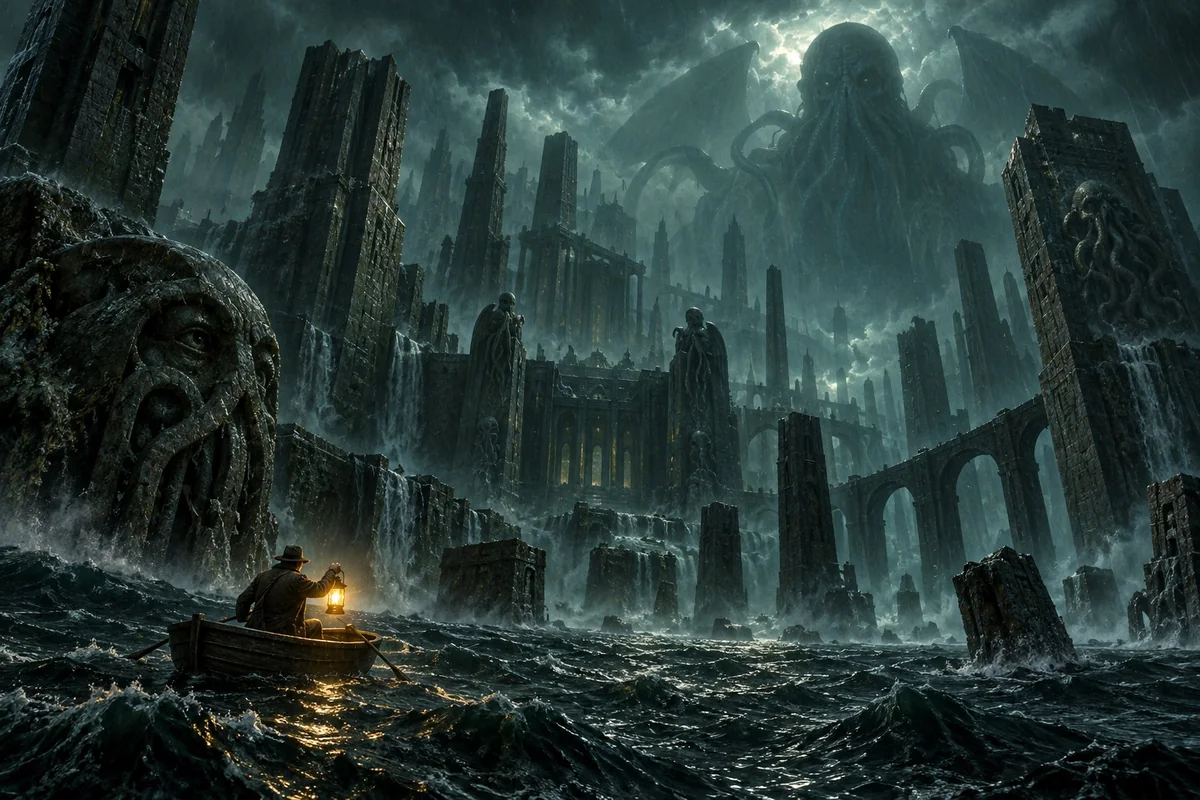
A formation offshore initially looks like a great reef. Further recession of the water reveals it as the upper part of a colossal basalt image, with a forehead rising into view and an imagined body extending far below.
The narrator fears the emergence of its face and eyes. He leaps into the shallow water among the dead to avoid confronting that greater revelation.
The account ends with the plunge. It does not narrate a rescue, a verified death or a later discovery of the narrator's body. Its decisive action is the choice of an already horrific refuge over the face that has not yet appeared.
Sources: What the Moon Brings — original text
Reading the unnamed image
The text does not give the image a personal name or connect it to R'lyeh. Its immense scale and marine setting permit thematic comparison with other Lovecraft stories, but they do not establish a shared creature identity.
The movement from garden to sea and from floating flowers to the world's dead enlarges both space and emotional consequence. The moon exposes relationships that daylight had concealed, making revelation itself the object of fear.
Sources: What the Moon Brings — original text
References
- H. P. Lovecraft Archive — fiction in composition order
Composition dates; question marks and ranges retain the source uncertainty.
- What the Moon Brings — publication data
- What the Moon Brings — original text
The fictional narrative is evidence for what the story says, not proof of events in the real world.
At a glance
H. P. Lovecraft
5 June 1922
1923, May
The National Amateur, 45, No. 5
Fiction