

Sea and submerged worlds
The sea in Lovecraft’s fiction can conceal a civilization, interrupt communication, carry a dream voyage or expose human knowledge as a narrow surface view. Its functions differ between stories. The submerged city in The Temple, R’lyeh in The Call of Cthulhu, the ancient seas reconstructed in At the Mountains of Madness and the navigable horizons of The Dream-Quest should be compared without treating them as a single mapped kingdom.
5 min read · 899 words
A boundary that makes evidence incomplete
Water separates an observer from what may exist below, while sometimes returning isolated objects or witnesses. This makes maritime settings particularly suited to narratives assembled from fragments rather than complete surveys.
The Temple offers a recovered manuscript whose writer cannot return to explain his discovery. The Call of Cthulhu combines documents and testimony from several places, with Johansen's account supplying an encounter unavailable to the final compiler himself.
In both cases, the reader's knowledge depends on transmission after danger. The existence of a record gives the discovery an apparent material foothold, but does not remove the limitations or assumptions of the person who produced it.
Sources: The Temple — Unspeakable Tales ebook, The Call of Cthulhu — Unspeakable Tales ebook
R’lyeh: temporary exposure rather than conquest
The Call of Cthulhu gives R'lyeh a history of submergence and a brief period in which sailors can reach its exposed structures. Their landing is accidental in the wider investigation, and their encounter does not establish a permanent human presence.
The city's unfamiliar angles make movement and distance difficult to interpret. The exposed architecture therefore remains resistant even when the sea has temporarily withdrawn as a barrier.
Johansen's escape supplies evidence of contact, not an exhaustive description of the city. The surviving testimony does not identify every building, chart a surrounding empire or settle the subsequent condition of all its inhabitants.
Water and the reach of dreams
The cult account assembled in The Call of Cthulhu associates the submerged condition of the ancient beings with an interruption of their influence upon human minds. The episode of widespread dreams occurs in relation to a change in those conditions.
This explanation is transmitted through the narrative's sources, including cult testimony. It is not a scientific rule measured by an independent observer.
It also should not be exported to every other story. Lovecraft does not establish that all seawater blocks every form of supernatural communication, nor that every dream about the ocean originates in Cthulhu.
The Temple and the temptation to name the unknown
Karl, the submarine commander in The Temple, interprets the ancient city he discovers as Atlantis. His identification draws on the appearance and apparent age of the architecture. No recovered inscription independently confirms the name.
The distinction matters because an encyclopedia can easily convert a character's hypothesis into an apparently settled location. The same risk arises when the temple's youthful figure is assigned the name of a better-known Mythos god.
The ivory head and the architectural image establish a disturbing correspondence within Karl's testimony. They do not identify the city as R'lyeh or make its inhabitants part of Cthulhu's cult. Comparison between the stories is useful precisely because their unknowns remain different.
Sources: The Temple — Unspeakable Tales ebook
The ocean as an earlier center of civilization
At the Mountains of Madness reverses the assumption that civilization begins with humanity on dry land. Dyer and Danforth interpret sculptures as records of the Elder Things' immense prehuman history, including marine settlements and the creation and employment of shoggoths.
Those carvings make the sea part of a political and biological history extending far beyond the expedition. Water is not merely an empty space surrounding human continents; it once contained societies whose activities helped shape the world humans inherited.
The history remains mediated through the explorers' reading of images. They infer a sequence from surviving art rather than receive an unbroken archive with every event explicitly dated and explained.
Retreat into lower waters
The Antarctic narrative also associates environmental change with the Elder Things' withdrawal toward a subterranean sea. The great surface city becomes a remnant of a civilization whose later activities continued below the explorers' initial field of view.
The tunnels encountered by Dyer and Danforth connect architecture, movement and survival under changing conditions. Their descent reveals that apparent abandonment at one level need not mean total absence at another.
This is a different structure from the brief emergence of R'lyeh. One story exposes a submerged site to a passing crew; the other reconstructs a movement from surface settlement toward protected lower environments.
Dream seas as routes
In The Dream-Quest of Unknown Kadath, maritime travel connects inhabited places and carries practical risks involving merchants, captains and unfamiliar passengers. Ports such as Dylath-Leen and Celephaïs are social centers as well as atmospheric settings.
The black galley that takes Carter from Dylath-Leen reveals how an apparently ordinary passage can conceal another destination and purpose. His insufficient knowledge of the vessel's trade makes him vulnerable before the larger danger becomes visible.
Dream geography also permits voyages beyond ordinary horizons. These transitions should be described through the journeys that establish them rather than forced onto a modern terrestrial nautical chart.
A shared image without a universal system
Across these narratives, the visible surface of the water becomes a useful image for the limits of human access. Yet the things beyond it have different histories, inhabitants and relations to the observer.
The comparison supports a broad theme of concealed depth. It does not prove that every submerged city belongs to one culture, that every sea creature serves the same power or that all maritime horror represents punishment for a particular offense.
Keeping those distinctions allows individual stories to retain their effects: the military commander's collapse of authority, the compiler's accumulation of frightening connections, the Antarctic explorers' historical disorientation and Carter's precarious movement through a populated dream world.
Sources: The Temple — Unspeakable Tales ebook, The Call of Cthulhu — Unspeakable Tales ebook, At the Mountains of Madness — original text, The Dream-Quest of Unknown Kadath — original text
Related music
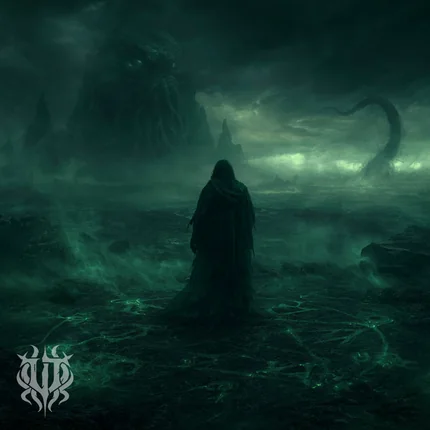
The Dead But Dreaming is a dark folk metal song inspired by The Call of Cthulhu, evoking R’lyeh, forbidden worship and the ancient dream beneath the sea.
References
- The Temple — Unspeakable Tales ebook
The fictional narrative is evidence for what the story says, not proof of events in the real world.
- The Call of Cthulhu — Unspeakable Tales ebook
The fictional narrative is evidence for what the story says, not proof of events in the real world.
- At the Mountains of Madness — original text
The fictional narrative is evidence for what the story says, not proof of events in the real world.
- The Dream-Quest of Unknown Kadath — original text
The fictional narrative is evidence for what the story says, not proof of events in the real world.
At a glance
Source-based editorial synthesis
Examples are illustrative, not an exhaustive occurrence list