

Black Stone
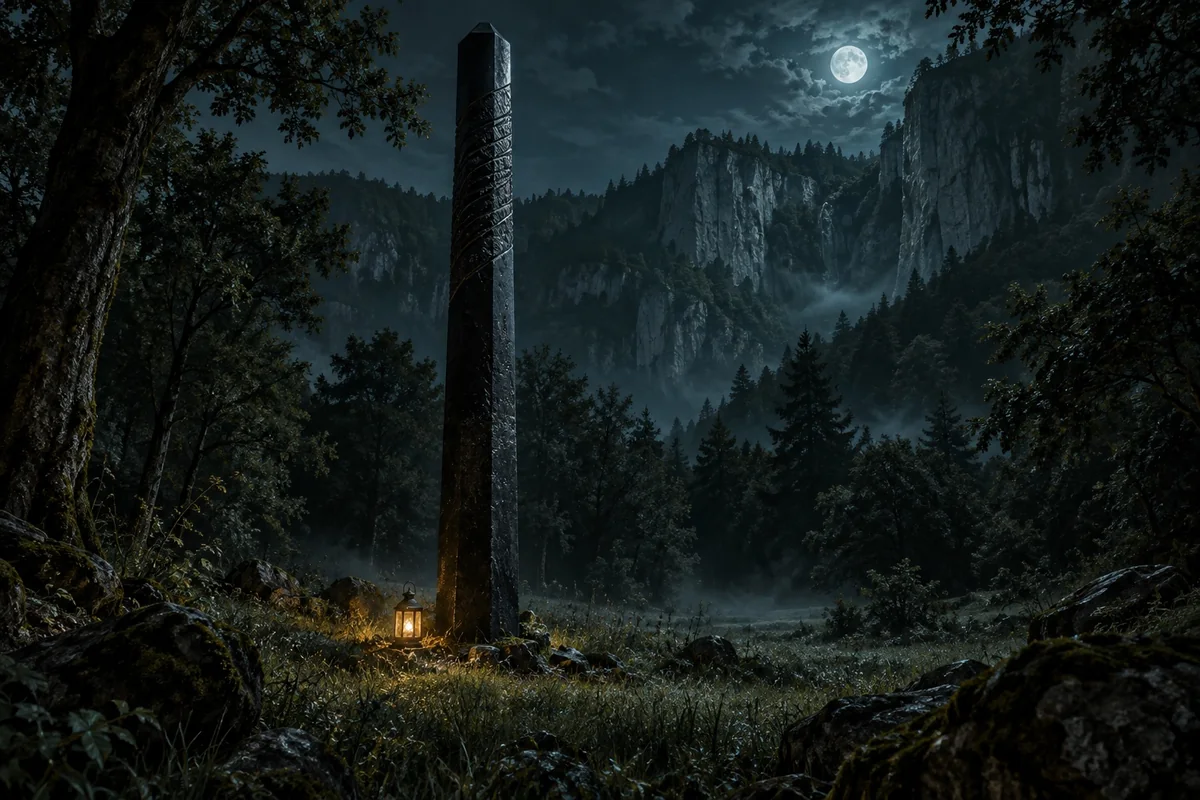
The Black Stone is the slender octagonal monolith at the center of Robert E. Howard’s story of the same name. Standing near the fictional Hungarian village of Stregoicavar, it attracts dreams, scholarly speculation and a vision of an extinguished cult. Its designation as a key suggests a larger function that the story never completely explains.
4 min read · 837 words
Origin and location
Howard introduced the monument in The Black Stone, published in Weird Tales in November 1931. It belongs to his contribution to the shared weird-fiction tradition, especially the network surrounding Friedrich von Junzt and Nameless Cults.
The story places it in woodland near Stregoicavar, with cliffs rising nearby. The narrator approaches the area through recognizable Central European geography, but the village and its occult history are fictional. An apparent place-name translation inside the story does not establish an authentic Hungarian etymology.
The monument remains accessible to travelers. Its danger is not protected by a permanently guarded temple or an openly functioning priesthood. Local avoidance and fear do more to separate it from ordinary life than a physical barrier.
Material, shape and markings
The stone is approximately sixteen feet high and a foot and a half thick, with an octagonal cross-section. It is a narrow standing shaft rather than a broad rectangular tablet. Its black surface has a partly polished appearance.
Damage has obscured much of the inscription. Higher markings survive more clearly and run in a spiral arrangement. The text does not provide a complete alphabet or an authenticated translation that a reader could reproduce.
The narrator compares the marks with examples associated with Yucatán. This is a resemblance proposed by a fictional observer. It does not independently demonstrate a common civilization or authorize a modern illustrator to replace the marks with recognizable Maya glyphs.
Sources: [1]
Why scholars call it a key
Von Junzt's account places the object among things described as keys. The narrator is drawn to that category because it suggests that the monument has significance beyond its visible shape.
Other sources offer less persuasive explanations, including an attribution to the Huns. The story's imaginary scholarship does not speak with one voice: conflicting interpretations form part of the mystery.
A key could imply access, connection or a role in a larger arrangement, but the story never supplies a simple mechanical demonstration. No scene shows a conventional door opening when a particular inscription is read. The term should remain suggestive where the narrative leaves it so.
Sources: [1]
Dreams, poetry and the midsummer encounter
The stone affects several observers in different ways. The innkeeper's nephew reports recurring distress after sleeping near it as a child. Justin Geoffrey responds through the invented poem People of the Monolith. Neither case supplies a controlled explanation of the phenomenon.
The unnamed narrator's own midsummer visit leads to sleep and then to a vivid ritual scene. Worshippers, a masked priest and captives gather around the monument, and a toadlike being manifests during the ceremony. The god is not personally named.
Daylight reveals no matching traces on the ground. This absence matters: the account cannot simply be summarized as a modern traveler discovering an active local cult. Its later explanation places both worshippers and deity in the past.
Sources: [1]
The dead god and the surviving vision
A recovered Turkish manuscript describes soldiers destroying the earlier cult and killing its creature. A gold image resembles the being in the narrator's experience, and a detail involving the priest's pendant provides another apparent correspondence.
The narrator treats these discoveries as evidence that he witnessed an enactment by revenants. The monument's continuing power therefore does not depend on the god still being alive in the ordinary sense.
The modern inhabitants of Stregoicavar are distinguished from the earlier population. Their fear and avoidance are not proof of secret membership. Preserving that distinction prevents the village's witnesses from being transformed into adversaries the story never makes them.
Sources: [1]
A buried architecture
The final interpretation enlarges the object from a solitary stone to a possible projection of an enormous buried structure. The adjacent cliffs may conceal architecture on a scale that makes the visible shaft only a small surviving part.
This remains the narrator's reading of what he has encountered. The story does not provide a plan of the structure, a confirmed builder, a construction date or a complete inventory of connected sites.
Its unsettling effect comes from the change in scale: an object that can be measured and walked around may be the exposed tip of something whose extent the investigator cannot establish. The local discovery does not close the wider problem.
Sources: [1]
Evidence, attribution and visual interpretation
The narrator sinks the recovered evidence in the Danube. His written account consequently asks the reader to accept corroborating objects that he has deliberately placed beyond ordinary examination.
The monolith is distinct from the unnamed toadlike god, the smaller gold image, and von Junzt's book. Their roles connect, but they are not alternate names for one artifact or being. Nor should the god automatically become Tsathoggua on the basis of a shared toadlike appearance.
The accompanying artwork follows the slender octagonal form and woodland setting. Lighting, exact marks and the arrangement of the cliffs are artistic choices. They do not add a decoded inscription, a proven map or new events to Howard's account.
Sources: [1]
References
At a glance
Robert E. Howard
The Black Stone (Weird Tales, November 1931)
Black octagonal monolith
Approximately sixteen feet high; one and a half feet thick
Woodland near fictional Stregoicavar, Hungary
Called a key; exact mechanism unresolved