

Mythos and canon
The Cthulhu Mythos is a developing network of stories, names, fictional books, places and recurring ideas. Its connections are real, but its authors do not always agree about the beings they share. This encyclopedia treats canon as a question of source and continuity: what a particular work establishes, what another work borrows, and what later writers or adaptations add.
5 min read · 969 words
How the shared tradition grows
Lovecraft's fiction supplied many of the best-known names and settings, while writers around him contributed their own. The Encyclopedia of Science Fiction identifies Bloch, Derleth, Howard, Long and Smith among the early participants and distinguishes Lovecraft's treatment from Derleth's more systematic development.
The resulting tradition is collaborative in the broad literary sense. Shared references connect works without proving that every writer accepted a common master chronology or a complete set of rules.
Sources: The Encyclopedia of Science Fiction — Cthulhu Mythos
A connection can be smaller than a shared universe
The Haunter of the Dark places several invented books on the same shelf. De Vermis Mysteriis points toward Bloch's Ludvig Prinn; the Liber Ivonis points toward Smith's Eibon; Unaussprechlichen Kulten points toward Howard's von Junzt.
That shared collection is a direct textual connection. It does not independently confirm every event in the source stories, identify every creature with a known deity or eliminate contradictions between manuscript histories.
The strongest encyclopedia statement is often the narrowest one supported by the text: a book is named, a passage is quoted, a character recognizes an object, or an event is narrated. Broader continuity should be demonstrated rather than assumed.
Sources: The Haunter of the Dark — Unspeakable Tales ebook, Robert Bloch — The Shambler from the Stars (1935), Clark Ashton Smith — Ubbo-Sathla (1933), Robert E. Howard — The Black Stone (1931)
Levels of evidence inside a story
A narrative can include direct observation, documents, testimony, dreams, inference and rumor. These forms do not all carry the same immediate authority.
The Call of Cthulhu combines Wilcox's experiences, Angell's papers, Legrasse's investigation and Johansen's account. The reader encounters a reconstruction assembled after many of the participants have died. Statements made by a captive cultist belong first to that testimony, even where other evidence makes them more persuasive.
At the Mountains of Madness similarly depends on Dyer's interpretation of carvings and damaged remains. Its long history of the Elder Things is a reasoned reading of an alien record, not an omniscient narrator's independently verified textbook.
Sources: The Call of Cthulhu — Unspeakable Tales ebook, At the Mountains of Madness — original text
Names are not stable taxonomic labels
Old Ones, Elder Things, Great Ones and Other Gods can resemble one another on a list while referring to different groups in different stories. Their surrounding context is essential.
In The Dream-Quest of Unknown Kadath, the Great Ones are connected with the gods of Earth and their protected position in the dream world. In At the Mountains of Madness, the star-headed beings are organisms with a material civilization and a recoverable history.
The shared language of age and divinity does not erase that difference. An entry should identify the actual group being discussed before assigning relations, moral qualities or a place in a hierarchy.
Sources: The Dream-Quest of Unknown Kadath — original text, At the Mountains of Madness — original text
A clear example of differing cosmology
The Horror from the Depths explicitly presents a conflict in which Elder Gods have defeated hostile powers and confined them. Its protagonists use sacred star-shaped stones, then receive a destructive intervention against the creatures threatening Chicago.
The Call of Cthulhu supplies a different account of R'lyeh, the stars and the conditions under which Cthulhu may act. Its climactic shipboard escape is not described as the arrival of the same rescuing gods.
Both stories belong to the larger tradition, but the later explanation should not silently replace the earlier one. A reader needs to know whether an imprisonment story comes from Derleth and Schorer or from the particular Lovecraft text under discussion.
Sources: August Derleth and Mark Schorer — The Horror from the Depths (1940), The Call of Cthulhu — Unspeakable Tales ebook
Separate authors can retain separate imaginative worlds
Smith's Hyperborea has its own cities, religious rivalries, gods and comic reversals. Eibon's successful exile on Cykranosh is part of that world even though his attributed book appears in Lovecraft's fiction.
Howard's fictional bibliography gives von Junzt a publication history whose mistranslations and missing passages become essential clues in The Thing on the Roof. Bloch's De Vermis Mysteriis has a different author, transmission and dangerous encounter.
Their individuality is part of the value of the Mythos. Cross-linking these worlds should help readers discover the distinctions as well as the recurring names.
Sources: Clark Ashton Smith — The Door to Saturn (1932), Robert E. Howard — The Thing on the Roof (1932), Robert Bloch — The Shambler from the Stars (1935)
A mentioned entity has not necessarily appeared
An invocation, book list or character's recollection can introduce a name without bringing the named being into the action. Conversely, a described creature may remain unnamed even when later reference works assign it a familiar label.
The difference affects occurrence lists. The Haunter of the Dark names numerous books, but that does not make their fictional authors living participants in Blake's investigation. The Book of Eibon can preserve an account of Zon Mezzamalech without making Eibon himself the person who performs that experiment.
Useful relationship labels therefore include mentioned, described, worshipped, attributed to and directly encountered. A single undifferentiated list of appearances would conceal information that matters to a careful reader.
Sources: The Haunter of the Dark — Unspeakable Tales ebook, Clark Ashton Smith — Ubbo-Sathla (1933)
Literary tradition and adaptation continuity
Films, games and later fiction may require explicit designs, repeated rules or a more definite chronology. Those choices can be coherent and effective within the version that makes them.
In this encyclopedia, adaptation-specific claims belong beside their adaptation credit. An image created for this site is identified as an interpretation; its architecture or anatomy cannot become evidence for a detail absent from the written source.
The editorial distinction works in both directions. A later work should receive credit for its original contribution instead of being treated merely as an imperfect reproduction of Lovecraft.
Sources: The Encyclopedia of Science Fiction — Cthulhu Mythos
How to read conflicting accounts here
Begin with the source named in the section. Determine whether the statement concerns that story's events, a character's belief, publication history or a comparative interpretation. Then follow the related entries to see how the same name functions elsewhere.
When accounts conflict, the discrepancy can remain visible. A forced reconciliation would be another creative addition and would require attribution of its own. Preserving the difference is often more informative than choosing an unsupported answer.
This method also explains why article length varies. A being described in several substantial scenes can support a long account; a name used only once cannot acquire a biography simply to meet a numerical target. The goal is depth proportional to the available evidence.
Sources: The Call of Cthulhu — Unspeakable Tales ebook, At the Mountains of Madness — original text, Clark Ashton Smith — The Seven Geases (1934)
Related music
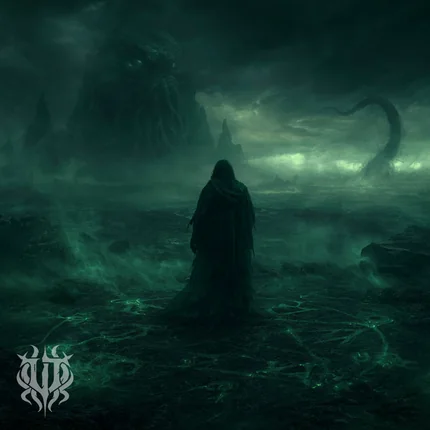
The Dead But Dreaming is a dark folk metal song inspired by The Call of Cthulhu, evoking R’lyeh, forbidden worship and the ancient dream beneath the sea.
References
- The Encyclopedia of Science Fiction — Cthulhu Mythos
- The Haunter of the Dark — Unspeakable Tales ebook
The fictional narrative is evidence for what the story says, not proof of events in the real world.
- Robert Bloch — The Shambler from the Stars (1935)
Fictional history and events; not documentary evidence about real occult books.
- Clark Ashton Smith — Ubbo-Sathla (1933)
Original story; the host identifies these texts as believed to be in the public domain.
- Robert E. Howard — The Black Stone (1931)
Fictional history and events; not documentary evidence about real occult books.
- The Call of Cthulhu — Unspeakable Tales ebook
The fictional narrative is evidence for what the story says, not proof of events in the real world.
- At the Mountains of Madness — original text
The fictional narrative is evidence for what the story says, not proof of events in the real world.
- The Dream-Quest of Unknown Kadath — original text
The fictional narrative is evidence for what the story says, not proof of events in the real world.
- August Derleth and Mark Schorer — The Horror from the Depths (1940)
The story’s moral cosmology is attributed to Derleth and Schorer, not retroactively to Lovecraft.
- Clark Ashton Smith — The Door to Saturn (1932)
Original story; the host identifies these texts as believed to be in the public domain.
- Robert E. Howard — The Thing on the Roof (1932)
Fictional history and events; not documentary evidence about real occult books.
- Clark Ashton Smith — The Seven Geases (1934)
Original story; the host identifies these texts as believed to be in the public domain.
At a glance
Source-based editorial synthesis
Which work establishes this claim?
Preserved and attributed
Discussed within their own continuities
Interpretations, not textual evidence