

The Black Stone
The Black Stone follows an unnamed investigator from a forbidden book to a Hungarian monolith, an apparent vision of an extinguished cult, and a buried account that seems to confirm what he has witnessed. Howard connects invented bibliography, local testimony and material evidence while leaving the larger significance of the monument unresolved.
6 min read · 1,099 words
Publication and narrative form
Robert E. Howard's story appeared in Weird Tales in November 1931. Its narrator is an investigator with access to rare books rather than a warrior confronting an enemy openly. The account proceeds through reading, travel, an extraordinary experience and a subsequent attempt at verification.
The Hungarian setting is presented through fictional places, documents and local history. Real geographical and historical references give the investigation an appearance of precision, but the cult, its alleged ancestry and the supernatural episode are inventions. The narrative must not be used as evidence for actual Hungarian religious practices.
Sources: The Black Stone — source and publication reference, Robert E. Howard — The Black Stone
Von Junzt and an unstable bibliography
The investigation begins with Friedrich von Junzt's Nameless Cults. The narrator distinguishes an original 1839 Düsseldorf edition from an inaccurate English version and a later expurgated publication. These editions belong to Howard's fictional bibliography. Their stated defects make access to the purported original important within the story.
Von Junzt's violent death and the destruction of another manuscript introduce a pattern in which dangerous knowledge survives only incompletely. His friend Alexis Ladeau reconstructs torn papers, burns what he has assembled and kills himself. The account establishes the cost of reading without recovering the destroyed text for the reader.
The Black Stone interests the narrator because von Junzt treats it as a key. That word is suggestive rather than explanatory: at this stage the investigator does not know what the monument could open, signify or connect.
Sources: Robert E. Howard — The Black Stone
Competing explanations and a troubled poet
Other writers offer partial or mistaken interpretations. Otto Dostmann associates the monument with the Huns, an attribution the narrator disputes. A folklore collection supplies another route into its local reputation. Scholarship thus appears as a field of disagreement, not a single authoritative account of the object.
The poet Justin Geoffrey supplies a different kind of testimony through People of the Monolith. His response suggests that art can preserve an encounter which conventional scholarship cannot explain. Geoffrey and his poem are fictional, despite their placement among bibliographical references.
The narrator also qualifies a tempting causal story. Geoffrey's later institutionalization and death do not prove that his visit first caused his mental disturbance. The account places signs of instability earlier. This distinction matters because the story repeatedly assembles ominous associations without making all of them equally demonstrable.
Sources: Robert E. Howard — The Black Stone
Stregoicavar and the monument
The investigator reaches Stregoicavar after traveling through Temesvar. Local testimony separates the present inhabitants from an earlier population destroyed during a Turkish raid. The contemporary villagers fear the monument; they are not secretly identified as the surviving cult.
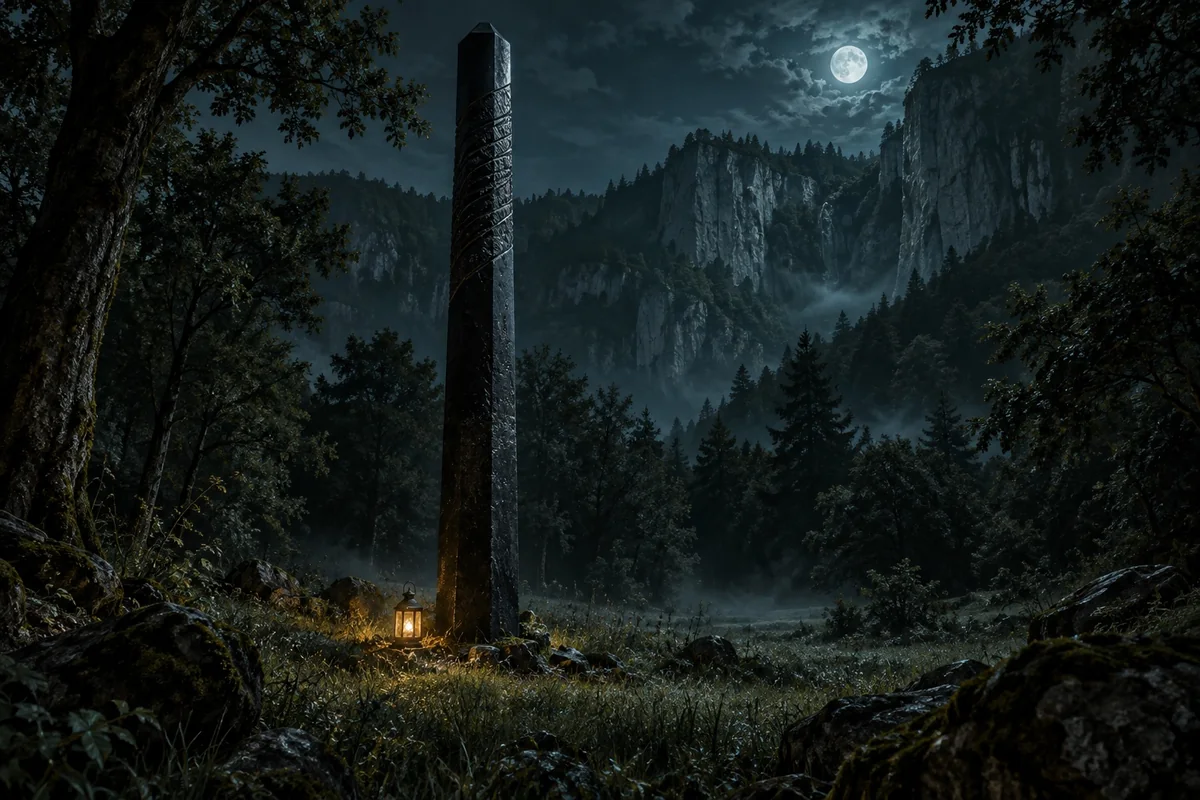
The stone stands in a wooded area near cliffs. It is black, octagonal, approximately sixteen feet high and about a foot and a half thick. Defaced markings remain more legible toward the upper part and follow a spiral arrangement. A resemblance to markings associated with Yucatán is the narrator's comparison, not proof of a documented transatlantic civilization.
Its effects are reported through dreams and individual experiences. The innkeeper's nephew was troubled after sleeping nearby as a child. A schoolteacher offers an explanation in terms of an abandoned cult and supplies the old name Xuthltan. Neither witness provides an exhaustive account of the stone's origin.
Sources: Robert E. Howard — The Black Stone
The midsummer vision
The narrator visits at midsummer and falls asleep. What follows begins with distant impressions before becoming a scene of assembled worshippers, drums, a brazier and a masked priest. Captives are brought into a ritual that culminates in killing and the manifestation of a monstrous, toadlike being.
The violence establishes the horror of the ceremony, but the creature receives no secure personal name. Its resemblance to another writer's toadlike deity is not enough to identify it as Tsathoggua. Howard's account should retain its unnamed god unless a later attribution is separately specified.
The narrator loses consciousness. In daylight the ground shows no physical aftermath matching the ceremony. This absence makes a present-day gathering difficult to sustain and leaves dream, hallucination or a vision of the past as possible explanations. His next actions are directed toward testing the experience rather than simply accepting it.
Sources: Robert E. Howard — The Black Stone
The buried case and Selim’s account
An earlier historical anecdote supplies the next lead. Count Boris Vladinoff was said to have received a Turkish manuscript from the belongings of Selim Bahadur shortly before a collapsing wall killed him. The narrator searches the ruins and finds a case associated with the count's remains.
Inside are a manuscript and a small gold idol. The narrator struggles with the archaic Turkish account rather than understanding it effortlessly. Its story concerns soldiers who encountered the old cult and killed a physical creature using fire, specially blessed weapons and incantations, suffering losses in the attempt.
The idol resembles the being seen at the stone. A pendant associated with the earlier priest also corresponds to an absence noticed during the vision. These convergences persuade the narrator that the ceremony involved revenants of both worshippers and a god already slain. The being in the vision is therefore not simply a still-living monster waiting beside the modern village.
Sources: Robert E. Howard — The Black Stone
Evidence destroyed, implications enlarged
The narrator disposes of the case and its contents in the Danube. This act removes the objects that might have allowed another investigator to examine his conclusion. The reader receives an account of corroboration, but the narrator himself prevents its public repetition.
His final interpretation also changes the monument's scale. The cliffs may conceal an immense ancient structure, with the visible stone only a surviving projection of something buried. The speculation transforms an isolated object into a fragment of a much larger architecture.
The story does not show the stone opening a literal doorway. The meaning of key remains bound to inference and to the possibility that other such sites retain active dangers. Destruction of this particular cult and its god cannot guarantee that the wider world is safe.
Sources: Robert E. Howard — The Black Stone
Narratorial prejudice and Mythos connections
The account combines genuine uncertainty about supernatural evidence with confident, prejudicial claims about ancestry and collective character. Those claims belong to the narrator and his reported sources. They should not be repeated as neutral ethnography, nor should the destruction of a population be endorsed because the narrative associates it with a cult.
The principal literary connections run through von Junzt, his forbidden volume and the fictional poet Geoffrey. They allow later stories to refer back to a suggestive network without providing a complete theology. Read beside The Call of Cthulhu, the story offers another investigator assembling scattered testimony; its distinctive turn is the apparent survival of a ritual after both its human participants and its god have died.
Sources: Robert E. Howard — The Black Stone, The Call of Cthulhu — Unspeakable Tales ebook
References
- The Black Stone — source and publication reference
- Robert E. Howard — The Black Stone
- The Call of Cthulhu — Unspeakable Tales ebook
The fictional narrative is evidence for what the story says, not proof of events in the real world.
At a glance
Robert E. Howard
November 1931
Short story
Weird Tales