

Hounds of Tindalos
The Hounds of Tindalos are predatory beings introduced by Frank Belknap Long in The Hounds of Tindalos, published in Weird Tales in March 1929. They detect Halpin Chalmers during an experiment in perceiving remote time and pursue him toward the present. The story associates their access with angles, but leaves their exact bodies and ultimate origin uncertain. Lovecraft later mentions the name in The Whisperer in Darkness.
6 min read · 1,111 words
Creator and primary setting
Long's original story places the encounter in the life of Halpin Chalmers, an occult writer whose speculations combine mathematics, mystical traditions and a rejection of conventional scientific explanations.
The first-person witness is called Frank. His conversations with Chalmers establish both the experiment and his skepticism. Later sections change form, presenting newspaper accounts, a laboratory report and an excerpt from Chalmers's writing.
The entities therefore enter the narrative through several kinds of evidence. Chalmers interprets what he sees; the witness observes his behavior and a disturbing odor; subsequent documents report physical effects without adopting all of Chalmers's explanation.
The experiment in temporal perception
Chalmers believes that past and future coexist within a larger reality that ordinary perception divides into time. He prepares mathematical diagrams and uses the fictional drug Liao as part of an attempt to perceive that reality.
His friend records the resulting speech. Chalmers describes human history, earlier forms of life and increasingly remote conditions until familiar organisms disappear from his account.
This is the story's speculative mechanism, not a validated extension of relativity or pharmacology. The narrative borrows the authority and vocabulary of intellectual traditions to stage an impossible experiment.
Angles, curves and the encounter
As Chalmers moves farther back, he distinguishes angular time from curved time. He associates ordinary humanity with curves and the threatening beings with angles outside familiar earthly geometry.
He initially describes moving things without bodies, then struggles to decide whether the entities he briefly observed possessed lean, hungry forms. His uncertainty is explicit. A rigid anatomical description would make his testimony more definite than it is.
The decisive moment comes when he believes they have detected him. The experiment has ceased to be observation at a distance: his act of looking has exposed him to something capable of following.
Why they are called hounds
The name suggests pursuit and the ability to follow a scent. Chalmers repeatedly says that the beings have scented him across time, and he experiences his retreat as a flight from predators.
The name does not establish that they are ordinary dogs with supernatural additions. Long withholds the sort of stable body plan that would settle their number of legs, facial structure or relation to terrestrial animals.
During the experiment Chalmers himself barks, bares his teeth and moves convulsively. Those actions belong to the endangered man. They should not be transferred without qualification into a zoological description of the pursuing entities.
The moral language of Chalmers’s explanation
Chalmers connects the beings with an obscure primordial act and with the distinction between purity and corruption. His speech invokes symbols of the Fall while suggesting that familiar religious stories preserve only distorted traces of an older event.
He also says that the entities exist beyond human morality. This complicates any simple summary that presents them as ordinary villains serving a clearly defined moral cause.
The article can describe his account of hunger and contamination without endorsing it as a complete cosmology. The story supplies no independent narrator who explains the primordial act, identifies every participant or confirms all of Chalmers's conclusions.
The attempted defense
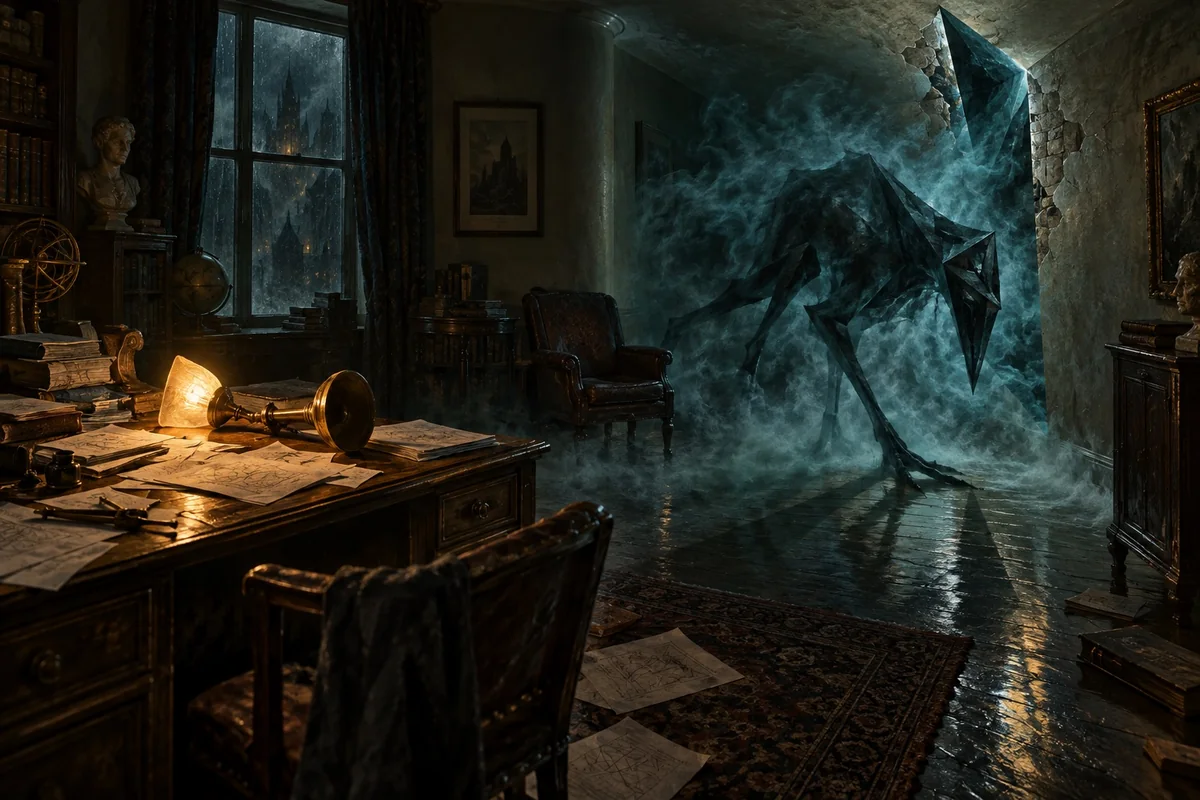
Chalmers asks Frank to bring plaster and help eliminate the room's corners. They cover intersections among the walls, floor and ceiling and round other angles, trying to make the interior resemble a sphere.
The procedure follows Chalmers's belief that the hounds can reach him only through angles. He hopes that a trail ending in curves will prevent their arrival and cause them to withdraw.
The text does not supply a precise numerical angle threshold. Rules that assign a particular number of degrees, formal range or guaranteed protective duration need attribution to the later work that states them.
The earthquake and the broken enclosure
A subsequent newspaper report describes a severe earth tremor. Another reports Chalmers's death in his altered room. Plaster has broken away, and fragments lie in a triangular arrangement near the body.
Notes found there describe the plaster falling after a shock, smoke entering through corners and the approach of tongues. The sequence gives a physical vulnerability to the attempted protection: the room's form cannot remain secure when the building itself is disturbed.
There is no complete witnessed combat in which the creatures display a catalog of abilities. The ending reconstructs an incursion through traces and a fragmentary last account.
The body and the blue substance
The newspaper describes Chalmers's body as mutilated and covered in a bluish substance, with an absence of blood. Investigators initially consider a chemical explanation and an unidentified visitor.
A laboratory report then states that the material resembles living protoplasm but lacks enzymes that the analyst expects life to require. The chemist speculates about extraordinary persistence or immortality.
This report strengthens the story's suggestion that the event involved an unfamiliar form of life. Its biological explanation remains fictional science. It does not establish that actual enzyme-free organisms have been discovered, or prove every claim Chalmers made about the entities' origin.
Doels and the final widening of the mystery
Chalmers's notes mention the Doels and other obscure agencies that he fears may assist an entry. An excerpt from his writing says that he has spoken with the Doels and seen their maker in dreams.
These references extend the unknown beyond the hounds. They do not furnish enough evidence for a complete hierarchy of species, servants and creators.
The final excerpt also places Chalmers's interest before the fatal experiment. His contact was not a single isolated idea invented on the day Frank arrived; his writings reveal an established fascination whose full history remains unavailable.
Lovecraft’s reference and later incorporation
The Whisperer in Darkness includes the Hounds of Tindalos among names associated with disturbing earlier knowledge. That reference connects Long's invention with Lovecraft's growing network of allusions.
It does not make Lovecraft the creator of the creatures or transfer the entire mechanism of Long's story into a newly narrated encounter. Attribution should run from Long's developed portrayal to Lovecraft's later reference.
The title The Hound belongs to a different Lovecraft story about grave robbery and an amulet. Similar wording does not establish that its pursuer is one of Long's temporal predators.
Sources: The Whisperer in Darkness — original text, The Hound — Unspeakable Tales ebook, Frank Belknap Long — The Hounds of Tindalos (1929)
Depiction and source limits
A visual interpretation can emphasize an intruding corner, smoke, unnatural movement and the impression of relentless pursuit. A canine silhouette is one artistic choice rather than a complete anatomical statement supplied by Long.
The primary story is unusually specific about the attempted geometry of protection and the evidence after the death, while remaining elusive about the beings themselves. A useful account retains that imbalance instead of replacing it with a later game's standardized monster profile.
References
- Frank Belknap Long — The Hounds of Tindalos (1929)
- The Whisperer in Darkness — original text
The fictional narrative is evidence for what the story says, not proof of events in the real world.
- The Hound — Unspeakable Tales ebook
The fictional narrative is evidence for what the story says, not proof of events in the real world.
At a glance
Frank Belknap Long
The Hounds of Tindalos, Weird Tales, March 1929
Halpin Chalmers
Through angles
Rounding the room’s angles with plaster
Odor, smoke in the final notes, blue substance
Named in The Whisperer in Darkness
Deliberately limited in the primary story