

The Whisperer in Darkness
A folklorist’s correspondence with an isolated Vermont resident becomes an invitation to abandon the human body and travel among the stars. The Whisperer in Darkness builds its mystery through letters, photographs and recorded voices, then makes the apparent reliability of every medium part of the trap.
12 min read · 2,449 words

Writing, publication and the narrator
Lovecraft wrote The Whisperer in Darkness between 24 February and 26 September 1930. The story first appeared in Weird Tales in August 1931. Its closing reference to the recently discovered Pluto places it in a specific moment of astronomical news, while its Vermont setting connects modern scientific speculation with older regional legends.
Albert N. Wilmarth narrates the events. He teaches literature at Miskatonic University and has an interest in folklore. His professional position matters: he is equipped to compare stories and traditions, but begins by treating claims of strange living beings as material for interpretation rather than as established zoology.
The story moves from public argument to private correspondence and finally to a personal visit. Each stage appears to bring Wilmarth closer to direct evidence. The ending complicates that progression by showing that proximity and face-to-face conversation do not necessarily make an encounter more trustworthy.
Sources: H. P. Lovecraft Archive — fiction in composition order, H. P. Lovecraft Archive — fiction in publication order, The Whisperer in Darkness — original text
Flood reports and the debate about the hills
After severe Vermont floods, reports circulate about unusual bodies seen in swollen rivers. Witnesses describe forms unlike ordinary animals. The accounts connect with older traditions of presences in remote hills, strange tracks, buzzing voices and occasional disappearances.
Wilmarth initially participates in the controversy as a skeptic. He regards the reports as possible examples of folklore shaping perception under unusual conditions. Their recurrence interests him without requiring him to accept every claimed sighting literally.
The landscape supports both sides of the uncertainty. Forested slopes and isolated places allow legends to persist because few people have examined them closely. The same lack of ordinary observation could also conceal actual activities. The story exploits that overlap between a plausible explanation for belief and a possible reason the belief might be true.
The flood is important as an accidental disclosure. Nothing in Wilmarth’s original work sets out to contact an alien civilization. Unusual water conditions bring supposed traces into human view, beginning a chain of attention that the visitors may wish to suppress.
Akeley enters the correspondence
Henry Wentworth Akeley writes from his family property near Townshend. He is knowledgeable, educated and familiar with local traditions, making him harder for Wilmarth to dismiss as a casual collector of rumors. His letters offer a sustained account of evidence accumulated around the hills and his farm.
Akeley describes unusual tracks, a carved black stone, photographs and a phonograph recording. Each item seems capable of extending the case beyond personal assertion. The correspondence gradually shifts from discussion of regional legend toward the possibility of beings with a physical presence and a deliberate interest in avoiding public scrutiny.
The two men develop a relationship through writing. Wilmarth’s sympathy for Akeley grows before they meet, and that bond later helps overcome his reluctance to visit. He comes to think he knows the writer’s character, even though the medium through which he knows him can be interrupted or imitated.
The letters are therefore both evidence and a means of recruitment. They teach Wilmarth what to expect, establish emotional credibility and provide instructions about the next step. When the tone changes, the reader must decide whether the same person is still controlling the correspondence.
The photographs, black stone and recording
Akeley’s material does not form a perfectly preserved archive. Photographs reveal or suggest traces, but the beings’ unusual substance is said to resist ordinary photographic reproduction. The black stone carries signs of great importance, yet an attempt to send it to Wilmarth fails when it disappears in transit. The object that might have been most useful for direct examination never reaches him.
The phonograph recording captures a ritual with a human voice and another voice whose buzzing quality seems difficult to explain. Its language invokes several Mythos names and connects the local case with a larger tradition. Wilmarth can replay the sound, but repetition alone does not establish who or what produced it.
The recording’s later importance is personal. At the farmhouse he learns that the man who drove him there, Noyes, is the human participant heard on it. A voice first treated as evidence from a distant event has become the voice of someone managing his current movements.
These devices make communication technology central to the horror. A record can preserve a sound accurately while concealing the speaker’s identity; a photograph can show a trace without showing its maker; a letter can supply information while moving its recipient toward danger.
The siege of the farmhouse
Akeley’s reports become more urgent. The beings approach his property, and human collaborators appear to assist them. His dogs provide a measure of protection, but he repeatedly loses animals and must acquire more. Purchases of ammunition and other supplies mark a sustained effort to defend the farm.
Telephone wires are cut, and correspondence is vulnerable to interference. The isolation is therefore actively intensified rather than merely a consequence of rural distance. Akeley cannot rely on ordinary communication to maintain a secure connection with the outside world.
Walter Brown is associated with the hostile activity. The mixture of human and nonhuman participants matters: the visitors are not confined to appearing in their own bodies in remote woods. They can work through people who understand local systems and can move within human society.
Wilmarth tries to advise and assist from a distance, but the letters increasingly make him an observer of a crisis he cannot control. The developing danger gives the later announcement of reconciliation a superficially welcome function. It offers relief at the exact moment when the previous situation seemed close to becoming intolerable.
The reassuring letter and the invitation
A sudden letter reverses the account. Akeley now claims to have misunderstood the visitors and describes contact with them as an extraordinary opportunity. He presents their intentions as compatible with friendship and proposes a personal meeting in which Wilmarth can learn what correspondence has not adequately conveyed.
The invitation includes a request to bring the accumulated evidence. That detail is significant because it would collect the scattered records in the very place where Akeley’s communications have been under pressure. What appears to be a practical convenience could also facilitate the removal of evidence from circulation.
The contrast with the earlier desperate letters creates the story’s decisive question of trust. A genuine change of understanding is possible within the proposed explanation, but the speed and completeness of the reversal make coercion or substitution equally pressing possibilities.
Wilmarth travels despite his doubts. His curiosity, concern for Akeley and desire for direct confirmation combine to make the visit persuasive. The same habits that encouraged him to examine the evidence now expose him to whoever controls the meeting.
Noyes and the approach to the house
Noyes meets Wilmarth and drives him through the Vermont countryside. He explains Akeley’s condition and manages the transition from public transport to the isolated property. His manner is reassuring, yet his voice produces a sense of familiarity that Wilmarth does not immediately place.
The landscape grows increasingly remote, with forested hills and a marked absence of ordinary animal activity near the destination. Wilmarth notices signs that do not fit comfortably with the invitation’s friendly account. These impressions accumulate without yet giving him a decisive reason to flee.
Noyes’s role demonstrates the effectiveness of a human intermediary. The journey does not require a visible alien to persuade the visitor or drive the car. Familiar social behavior carries him into the situation, making the later identification of Noyes on the recording particularly disturbing.
At the house, Wilmarth is left to encounter the supposed Akeley under conditions already explained in advance as consequences of illness. The preparation gives apparently ordinary reasons for features that would otherwise seem immediately suspicious.
The motionless host and the whispered explanation
The figure in the study sits in deep shadow, heavily wrapped and largely motionless. Its face and hands resemble the man Wilmarth expects to meet, while the voice is reduced to a penetrating whisper. Illness is offered as the explanation for this behavior.
The conversation provides an overwhelming account of alien life, cosmic geography and knowledge behind old legends. Wilmarth learns of Yuggoth, remote outposts and beings capable of journeys beyond familiar spatial limits. The quantity of revelation makes it difficult for him to test individual claims or focus on the physical oddness of the speaker.
He nevertheless notices a troubling mismatch. The whisper carries with more strength than its supposed weakness suggests, and the lips do not move as he expects. An unusual smell and a sense of vibration are concentrated around the chair. These observations remain secondary to the information until the ending changes their meaning.
The scene reverses the expectation that a personal meeting settles uncertainty created by letters. The most apparently direct encounter is also the most carefully staged. A familiar face can be a component of deception rather than a guarantee of identity.
The brain cylinders and the proposed journey
The host explains that whole human bodies need not travel through space. The visitors can remove a brain, preserve it in a special cylinder and connect it to apparatus supplying sight, hearing and speech. The body is said to remain safely maintained elsewhere, allowing eventual restoration.
Cylinders stand on a shelf, with different instruments suited to different kinds of occupants. The proposed network is cosmopolitan: the account includes humans, beings from other planets and organisms with forms of perception unlike familiar senses. Travel depends on compatible equipment at each destination.
Wilmarth connects a cylinder marked B-67 to the indicated devices. A mechanical voice identifies itself as a human collaborator who has traveled widely and praises the experience. It invites Wilmarth to accompany Akeley and mentions Noyes’s longstanding association with the visitors.
B-67 is distinct from the fresh cylinder bearing Akeley’s own name. The host directs Wilmarth not to disturb that newer container. The separation is important to the ending: the reassuring traveler’s testimony should not be confused with a demonstrated statement by Akeley himself.
The promises of painless extraction, bodily preservation and extraordinary travel remain claims made by interested participants. The story gives evidence that some form of communication occurs, but it does not provide an independent demonstration that the proposed procedure is voluntary, reversible or beneficial for everyone involved.
The voices during the night
Upstairs, Wilmarth resolves not to remain another night. His concern has shifted from proving a proposition to escaping a situation in which his own body and freedom may be at risk. He falls into an uneasy sleep and later hears movement and voices below.
The speakers differ in timbre and apparent manner of production. Noyes’s recognizable voice is among them. Wilmarth hears fragments concerning himself, Akeley, the plan and a fresh cylinder, but cannot recover a complete, reliably ordered conversation. The partial overhearing suggests an undertaking that differs from the friendly proposal he received.
He does not hear the expected whisper as a clearly identifiable participant. That absence, together with the other voices and the strange earlier behavior, encourages him to suspect that Akeley has been used as a lure. His interpretation develops from several observations rather than from one explicit confession of the whole scheme.
The nighttime sequence makes listening a dangerous form of knowledge. Wilmarth has enough information to recognize a need for flight, while remaining uncertain about the exact position and intentions of everyone in the house.
The empty chair and the final objects
Wilmarth goes downstairs and finds Noyes asleep on a couch. In the study, the supposed Akeley is no longer in the chair. The newer cylinder associated with Akeley has become a focus of his attention, linking the technological demonstration with the possibility that the absent man has already undergone the proposed separation.
The chair still holds the clothing and, in a way that cannot be reconciled with an ordinary departure, the recognizable face and hands. The final disclosure makes those human features the objects on which the impersonation depended. The story does not need to show the wearer changing shape in front of the narrator; the abandoned components retrospectively explain the immobility, darkness and whisper.
Wilmarth flees in Akeley’s old car and eventually reaches Townshend. His survival is an escape from the immediate setting, not the exposure or defeat of the visitors’ entire operation. He has left behind much of the material that might have supported his account.
The exact fate of Akeley remains a subject of inference. The named cylinder and the staged body strongly suggest what has happened, but Wilmarth does not recover Akeley and obtain a complete testimony from him. The distinction preserves the ending’s combination of powerful implication and incomplete verification.
The investigation afterward and Pluto
A sheriff’s party finds the farmhouse without Akeley, the cylinders, the apparatus or the evidence Wilmarth brought. Clothes remain, along with some signs of disturbance, but the extraordinary objects have disappeared. The case is once more vulnerable to explanations involving deception or illness.
Wilmarth stays in the region long enough to question people who knew Akeley. Purchases, damaged communications and local reports support parts of the earlier correspondence. Other witnesses dismiss the case as an elaborate hoax. The investigation confirms a troubling pattern without restoring the missing central evidence.
He resolves never to return to Vermont. The later discovery and naming of Pluto gives him another reason to connect the affair with Yuggoth. This is Wilmarth’s interpretation within the narrative, reflecting astronomical news available during composition. It is not a modern claim that Pluto contains the visitors’ actual civilization.
The account ends by withholding ordinary closure. The operation has withdrawn its most conspicuous traces, human agents may remain active, and the narrator has learned enough to fear continued contact without learning how to prevent it.
Technology, consent and adaptation
The story repeatedly separates a channel from the authority of its message. A voice on a record, a voice from a machine, a whisper behind a familiar face and words in a letter each demand interpretation. More media do not automatically produce greater certainty when the same interested agents may control them.
The brain-cylinder proposal joins wonder to dependence. It promises access to places no intact human body could reach, but the traveler would rely on alien custodians for movement, sensation and speech. The question is therefore not only whether the technology works. It is also who controls the conditions under which the mind can experience or communicate anything at all.
The Mi-Go are the central alien visitors. The text’s references to Nyarlathotep, Shub-Niggurath, Azathoth, Tsathoggua and other names enlarge the background without placing all those beings physically in Akeley’s study. The entity pages distinguish their actual narrative roles from mere mention.
Sean Branney’s 2011 film The Whisperer in Darkness expands and changes the literary plot. Its own entry records the production and adaptation choices. For reading the original, the linked pages on Wilmarth, Akeley, the Mi-Go, Yuggoth and brain cylinders develop the people, civilization, geography and technology whose apparent convergence makes the farmhouse encounter so unsettling.
Sources: The Whisperer in Darkness — original text, The Whisperer in Darkness (2011) — credits, synopsis and release history
Related music
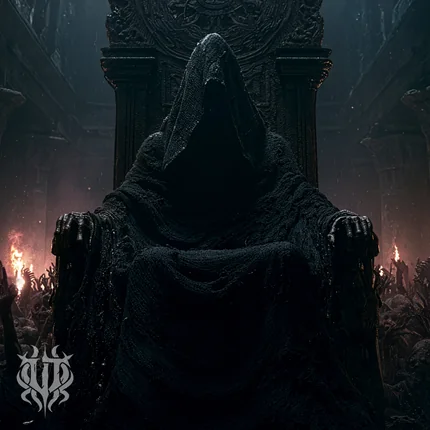
A Thousand Masks is a dark metal song inspired by Nyarlathotep, the Crawling Chaos who walks among humanity, hiding behind countless faces and whispered lies.
References
- H. P. Lovecraft Archive — fiction in composition order
Composition dates; question marks and ranges retain the source uncertainty.
- H. P. Lovecraft Archive — fiction in publication order
First publication dates and venues; issue dates can differ from actual release dates.
- The Whisperer in Darkness — original text
The fictional narrative is evidence for what the story says, not proof of events in the real world.
- The Whisperer in Darkness (2011) — credits, synopsis and release history
At a glance
H. P. Lovecraft
24 February–26 September 1930
1931, August
Weird Tales, 18, No. 1
Fiction