

The Hounds of Tindalos
The Hounds of Tindalos is Frank Belknap Long’s story of a temporal experiment that makes its observer detectable to predators outside ordinary human experience. Halpin Chalmers believes a room without angles can prevent their arrival. Personal testimony gives way to newspaper reports, a chemical analysis and a passage from his own writing, so that the final horror extends beyond anything his skeptical friend directly witnesses.
6 min read · 1,061 words
Publication and narrative organization
The story appeared in Weird Tales in March 1929. The primary text used here is Project Gutenberg's transcription of that issue, credited to Frank Belknap Long, Jr. The story should be distinguished from later books that reuse its title as the name of a collection.
Its five numbered divisions change the reader's access to evidence. The first two belong to Chalmers's friend, addressed as Frank. The third presents newspaper notices; the fourth a laboratory report; and the fifth an excerpt from Chalmers's earlier writing.
Those changes matter because no single narrator sees the entire sequence. The friend observes the experiment and helps prepare the room, while the fatal conclusion reaches the reader through physical traces and documents.
Sources: Frank Belknap Long — The Hounds of Tindalos, Weird Tales March 1929
Chalmers and his skeptical visitor
Chalmers combines occult reading with mathematical speculation. His apartment contains older religious and magical works alongside modern diagrams. The visitor finds the mixture intellectually suspect, particularly when Chalmers treats scientific ideas as support for an intuitive route beyond ordinary perception.
Their disagreement is not simply science opposed to ignorance. Chalmers claims modern research has stopped too early, while Frank insists on demonstration and warns against unsupported inference. Chalmers wants both the prestige of mathematics and freedom from its ordinary evidentiary limits.
The narrative attributes these claims to its character. It does not establish that relativity proves occult time travel, that drug experiences reveal objective history or that Chalmers's description of Tao accurately represents a religious tradition.
Sources: Frank Belknap Long — The Hounds of Tindalos, Weird Tales March 1929
The experiment and the observer’s task
Chalmers prepares to use a fictional substance called Liao together with intense attention to mathematical diagrams. He asks Frank to record his speech and interrupt if the experience becomes intolerable. The friend therefore supplies both a recorder and a possible means of recall.
As the experience begins, Chalmers reports the disappearance of the familiar room. His account then ranges through human history and beyond it, treating many lives and periods as simultaneously present. The perspective becomes less personal and less securely human as he pushes farther back.
The specific risk emerges when looking becomes reciprocal. Chalmers encounters beings associated with unfamiliar angles and realizes that they have detected him. Frank notices a sickening odor in the room, a small but consequential sign that the experience may exceed a private hallucination.
Sources: Frank Belknap Long — The Hounds of Tindalos, Weird Tales March 1929
Return without safety
Chalmers collapses into extreme distress and animal-like behavior. Frank finally shakes him back toward ordinary awareness. Ending the altered state, however, does not persuade Chalmers that the contact has ended.
He says the beings have acquired his scent across time. The designation Hounds of Tindalos describes their pursuit and hunger more clearly than it establishes ordinary canine anatomy. His own report is uncertain about whether what he saw should even be called bodies.
He also offers an elaborate account of primordial purity, corruption, curves and angles. This doctrine belongs to his explanation under extraordinary strain. An encyclopedia should distinguish it from a narrator-independent theological history, particularly because he explicitly complicates ordinary labels of good and evil.
Sources: Frank Belknap Long — The Hounds of Tindalos, Weird Tales March 1929
A room made safe by geometry
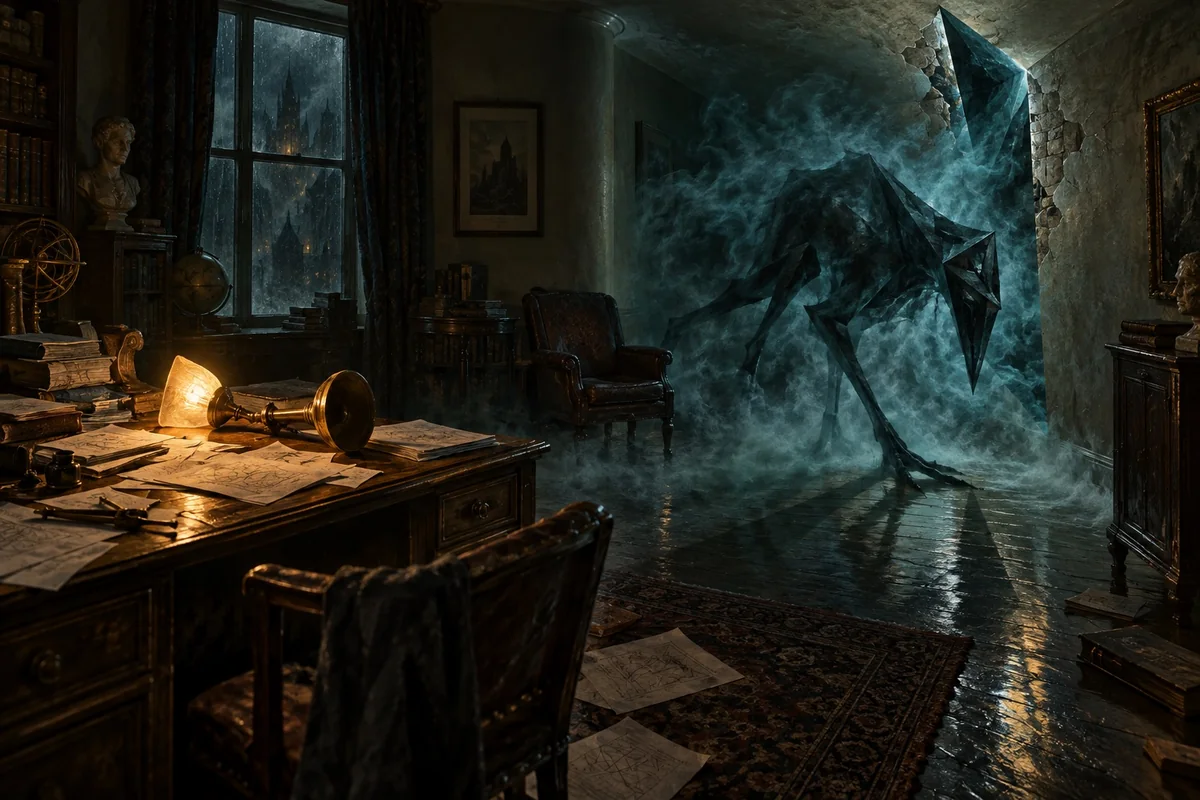
The following day Chalmers asks Frank to bring plaster. His proposed defense is architectural: remove angles through which the pursuers can enter. They fill corners and round the intersections of walls, floor, ceiling and other surfaces until the room approximates the interior of a sphere.
This gives an abstract cosmology a practical and fragile embodiment. Protection depends on the condition of a real room, not merely on Chalmers's confidence in his theory. Frank helps because his friend's suffering is unmistakable, while continuing to regard medical intervention as necessary.
Chalmers intends to wait until the pursuers abandon the trail. The story does not establish a universal safe period after which every hunted person can emerge, nor does it provide a tested formula for protection in other circumstances.
Sources: Frank Belknap Long — The Hounds of Tindalos, Weird Tales March 1929
Earthquake, death and newspaper interpretation
The documentary section presents two notices dated 3 July 1928. One reports an earthquake; the other describes the discovery of Chalmers's body. The proximity of the reports supplies the event that defeats the plastered defense.
The room contains cracked and fallen plaster, strange blue residue and severely mutilated remains without the expected blood. Burned papers include Chalmers's account of the protective surface failing and smoke entering through exposed corners. These traces correspond to his fear without giving a conventional witness's description of the whole attack.
The police instead consider poisoning and an unidentified visitor. Their framework is appropriate to an ordinary crime but does not absorb the reader's preceding knowledge. The newspaper account also contains details about the room's history that sit awkwardly beside the earlier immediate preparations; the article preserves the text's reported sequence rather than inventing a harmonized tenancy chronology.
Sources: Frank Belknap Long — The Hounds of Tindalos, Weird Tales March 1929
The laboratory report and the last document
A chemist examines the blue substance and describes living material apparently lacking enzymes. He infers a form of enduring vitality and becomes excited by its implications. The scientific vocabulary lends a second institutional voice to evidence that the police cannot explain.
The proposed biology is fictional and should not be treated as a valid account of how cells function or age. What matters narratively is the movement from a frightened individual's assertion to material that another observer finds extraordinary.
The closing extract from Chalmers's The Secret Watchers concerns other life, the Doels and a maker encountered beyond ordinary time and matter. It suggests that his interests and contacts preceded the witnessed experiment. The passage is an additional fictional document, not a comprehensive taxonomy of every being named in the story.
Sources: Frank Belknap Long — The Hounds of Tindalos, Weird Tales March 1929
Its place in the shared tradition
Long's hounds have their own mechanism of danger: temporal observation produces a trail, and angles become points of access. That mechanism differs from simply summoning a monster with a spoken name or awakening a creature in a tomb.
Lovecraft later alludes to the Hounds of Tindalos in The Whisperer in Darkness. The allusion demonstrates exchange between authors; it does not make Long's story an adaptation of Lovecraft's earlier The Hound, whose central threat and artifact belong to a different narrative.
The story's lasting conceptual force comes from the failure of distance to provide refuge. Returning to the present leaves the observer within reach, while the apparently safe room relies on material conditions that an unrelated physical shock can undo.
Sources: Frank Belknap Long — The Hounds of Tindalos, Weird Tales March 1929, The Whisperer in Darkness — original text
References
- Frank Belknap Long — The Hounds of Tindalos, Weird Tales March 1929
Project Gutenberg transcription of the March 1929 publication; fictional science is not a scientific source.
- The Whisperer in Darkness — original text
The fictional narrative is evidence for what the story says, not proof of events in the real world.
At a glance
Frank Belknap Long
March 1929
Short story
Weird Tales