

The Silver Key
The silver key is Carter’s inherited means of passing beyond the limits of his present life. The Silver Key introduces it as an object associated with ancestry and the recovery of childhood dream. Through the Gates of the Silver Key gives its operation and limitations a more elaborate account, in which the accompanying parchment proves as important as the key itself.
6 min read · 1,054 words
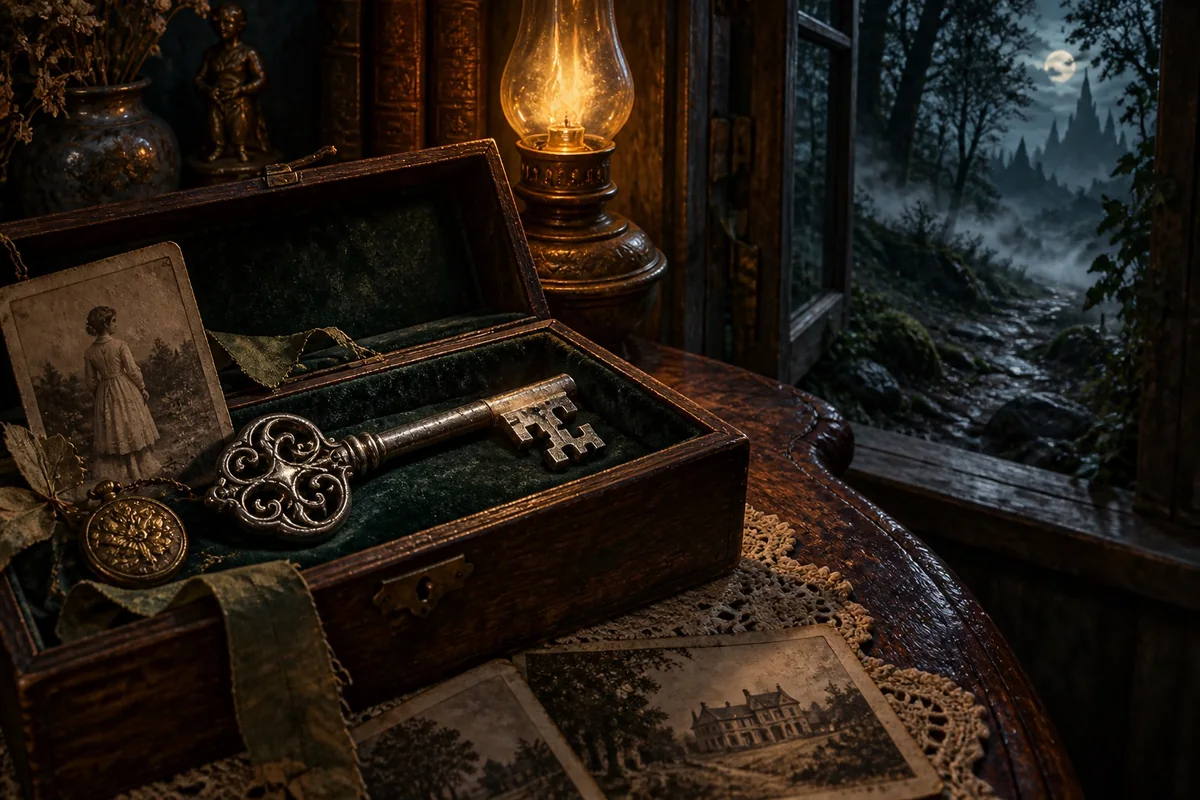
The object and its container
The Silver Key describes a large key of tarnished silver covered with cryptic ornament. It lies inside an old oak box bound with rusted iron and carved with disturbing Gothic figures. The box is about a foot square and retains an unfamiliar aromatic scent.
The key is wrapped in a parchment written in characters Carter cannot read. The box’s lid must be forced by a servant because its fastening offers no ordinary means of access. Carter then cleans the key and keeps it near him at night.
The sequel adds a measurement of nearly five inches when the visitor produces it at the estate meeting. It is a handheld artifact, not a towering architectural key. Its elaborate markings should not be rendered as a supposedly recovered real alphabet whose signs the story reproduces in full.
Ancestral transmission
A dream of Carter’s grandfather directs him to the attic hiding place. The grandfather connects the family with earlier encounters and occult interests, including a crusader, an Elizabethan magician and Edmund Carter, who avoided the Salem witchcraft danger.
Edmund is said to have placed the inherited key in the box. That family transmission is the initial history available to Carter. His father did not know the box existed, and the artifact has remained inaccessible across generations.
Through the Gates later connects the key’s making with Hyperborea. These are different levels of history: an ancient origin inferred during Carter’s alien research and a much later family chain through which the object reaches him. The first story does not itself narrate a Hyperborean workshop scene.
The first return through time
In The Silver Key, the artifact accompanies Carter’s renewed dreams and journey toward the ancestral home. The narrative does not initially explain every gesture of its use. The adult’s perspective gives way to a child’s, with the key still in his pocket.
The sequel supplies the missing ritual at sunset and identifies the return as a passage from 1928 to 1883. Near a suitable threshold, Carter has learned to turn the key and use ceremonial words. The object does not work like an ordinary lockpick applied to any door.
Its first effect changes the traveler’s relation to his own life. It brings the adult quest into contact with childhood rather than simply transporting an unchanged body to another geographical location.
The cave and the Ultimate Gate
The child takes the key into the inner chamber of the Snake-Den. The sequel describes a further passage that removes ordinary age and bodily stability while leaving Carter’s sense of individual identity initially intact.
Beyond that first threshold, ’Umr at-Tawil and the assembled Ancient Ones prepare the Ultimate Gate through directed dreaming and an unfamiliar rhythm. Carter uses the key in the crossing, but the Guide and the assembly are active participants in making the passage possible.
The two stages should remain distinct. The key reaches beyond physical space, but its use does not by itself establish that its holder controls every entity or every destination encountered there. Carter can be admitted to a realm whose consequences he does not understand.
Sources: [2]
Why it cannot simply restore Carter on Yaddith
Carter asks the informing Being beyond the gates to place him in an alien form that has appeared in his dreams. He assumes he possesses the symbols needed for return. Once entangled with Zkauba on Yaddith, he discovers that the key alone cannot restore his human body.
His later study indicates that the artifact’s unaided power over personal consciousness-angles applies to human beings. It can still alter the temporal relation of a traveler in an unchanged body. That distinction allows a journey through time without solving the problem of bodily form.
A supplementary spell would give the key the broader capacity required. It was recorded on the parchment he left behind in his car. The failure therefore arises from incomplete knowledge and an omitted document, rather than from a simply broken or exhausted object.
Sources: [2]
The parchment’s writing
The men at the estate meeting cannot read the recovered parchment. De Marigny recalls similarities with writing in Warren’s book, but a proposed identification with Naacal is rejected.
Chandraputra later identifies the text as R’lyehian, brought to Earth in the story’s remote history by Cthulhu’s spawn. He says it translates an older Hyperborean original in Tsath-yo. Those explanations are supplied within the visitor’s account and form part of its fictional linguistic history.
On returning to Earth, Carter obtains a copy and works to decipher it with knowledge acquired on Yaddith. A book from Nepal assists his progress, but the restoration remains unfinished when the estate conference takes place. The story never demonstrates the completed spell for the reader.
Sources: [2]
Evidence at the conference
The supposed Swami produces the key as support for his claim that Carter lives. De Marigny and Phillips recognize it from photographs. Aspinwall points out that possession could also fit theft or murder, turning the same object into an accusation.
The final retrospective allows another possibility: a copy made from the circulated photographs. Thus even a close material resemblance does not settle the identity of the bearer. The artifact’s evidentiary role is narrower than the supernatural role the visitor describes.
The key is restored to the visitor’s pocket before the violent unmasking and disappearance into the clock. No subsequent recovery is reported. The story ends with uncertainty about the traveler and the truth of the account, rather than with the key safely returned to a collection.
Sources: [2]
Desire, knowledge and a costly omission
The artifact first seems to promise access to exactly what Carter most wants: the imaginative freedom of childhood. His desire then grows beyond restoration into a demand for ultimate knowledge and an experience of alien life.
The same key remains present while the scale of the wish changes. It is not a guarantee that the traveler understands what he requests. The warning to know the necessary symbols exposes the gap between possession and competence.
That distinction gives the object more narrative force than a general label such as universal portal key. Its powers are extraordinary, but its limits shape the plot. Carter’s inability to return is as important to its definition as the thresholds it opens.
Related music
The Key and the Gate is a dark metal retelling of The Dunwich Horror, following Wilbur Whateley’s doomed search for forbidden knowledge and the power of Yog-Sothoth.
References
- The Silver Key — Unspeakable Tales ebook
The fictional narrative is evidence for what the story says, not proof of events in the real world.
- Through the Gates of the Silver Key — original text
The fictional narrative is evidence for what the story says, not proof of events in the real world.
At a glance
The Silver Key
Randolph Carter
Tarnished silver
Nearly five inches
Carved oak box, approximately a foot square
A parchment containing an additional spell
Hyperborea
The key alone cannot restore Carter’s human form from Zkauba’s body