

Martense descendants
The Martense descendants are the subterranean, human-derived creatures revealed at the end of The Lurking Fear. Their colony occupies burrows radiating from the abandoned mansion on Tempest Mountain. The narrator initially mistakes their attacks for the work of a single supernatural pursuer before their numbers, tunnel system and inherited mismatched eyes disclose a different origin.
4 min read · 826 words
Naming and source
Lovecraft supplies no formal species name. This entry uses Martense descendants as a descriptive label drawn from the final identification. The lurking fear can refer to the whole phenomenon, including attacks, legends and the initially unknown threat, rather than one uniquely named being.
They belong to The Lurking Fear and should not automatically be placed within another creature population from a different story. Their resemblance to apes is part of the narrator's description; it does not establish an ordinary zoological classification.
Visible anatomy
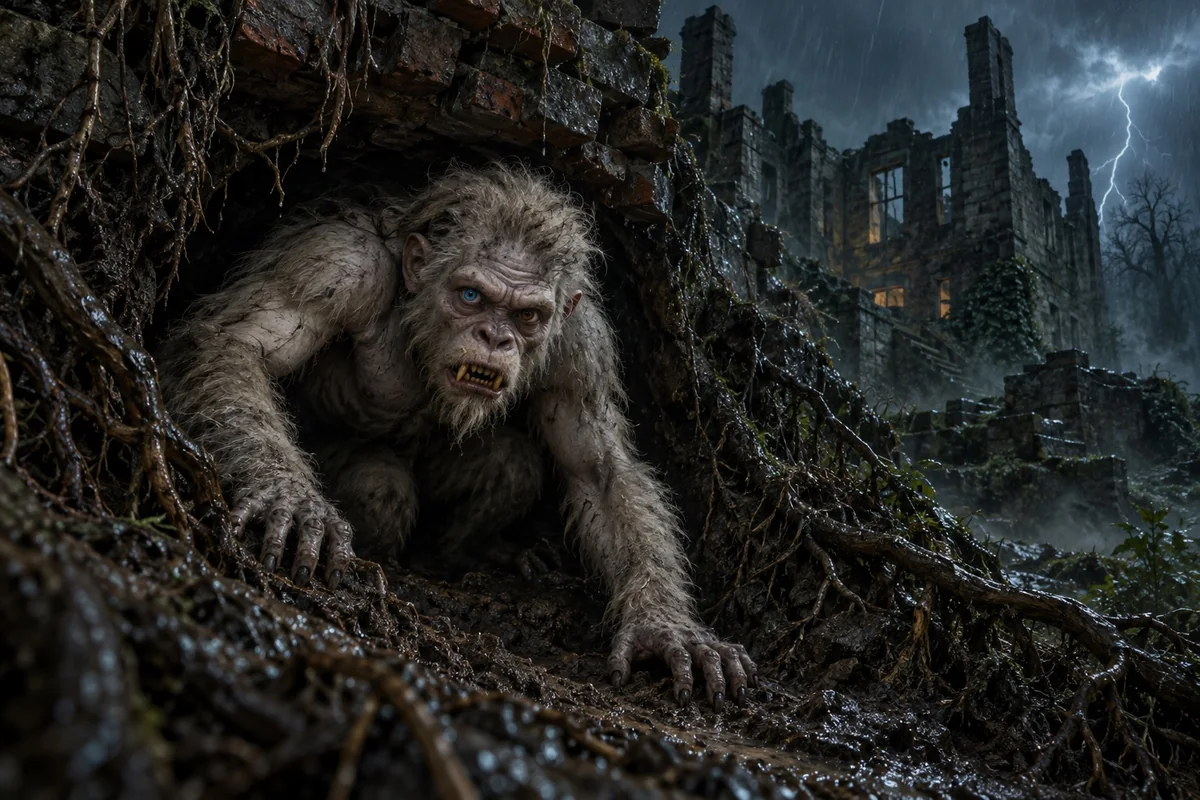
The clearest specimen appears only when the narrator shoots a straggler and examines it by flashlight. He describes a whitish, hairy, gorilla-like body with sharp yellow fangs and matted fur. The emerging group is characterized as small and deformed rather than as a single giant.
Its most important feature is the difference between its eyes: one blue and one brown. The same inherited trait appeared in the recorded Martense family and in the eyes the narrator saw in the tunnel. This recurrence supports the final connection.
Earlier references to a giant, snake, bat or walking tree belong to confused reports. The landscape's apparent tentacles are lines of mounds and tunnels. Neither set of imagery establishes tentacles or wings on the finally observed creatures.
Population and underground routes
The creatures occupy a network of burrows extending outward from the mansion's vicinity. Low mounds on the surface indicate routes that the narrator initially takes for natural formations. One passage is reached beneath Jan Martense's grave, and another opens at the base of the cellar chimney.
The colony is numerous enough for its emergence to appear like a continuous flood. The narrator estimates that there may be thousands, but conducts no count. The scale explains why isolated attacks across the region had seemed incompatible with the movements of one animal.
Their underground travel also explains the absence of ordinary surface trails at major attack sites. Trees provide another route of concealment: one attacker is reported descending from an overhanging tree onto a cabin.
Storms and patterns of attack
Local traditions associate the danger with summer thunderstorms, and the narrator's principal encounters occur during electrical weather. Reports suggest reduced activity in winter. These are observations within the story, not a complete statement of seasonal biology.
The creatures can attack in extreme darkness and use the storm's noise to conceal movement. Arthur Munroe is killed at a cabin window while the narrator remains close by, unable to distinguish the attack from the surrounding weather.
Their behavior is not uniformly noisy. The final emergence includes panting and grunting but is disturbingly quiet for its scale. The story's emphasis on silence concerns the difficulty of detecting danger before contact, not a categorical claim that the animals are incapable of sound.
Predation and cannibalism
The creatures prey on inhabitants of the mountain settlements and on the narrator's companions. Missing victims and the absence of nearby wild animals are connected with the long history of attacks. The story does not provide an exhaustive diet or a measured range for individual hunters.
The narrator also observes one creature attack a weaker member as the group leaves the cellar, with others taking part afterward. Cannibalism is therefore shown within the colony as well as inferred in the account of its development.
These observations identify predatory behavior without establishing a political hierarchy, language, organized religion or named leader. Such additions would require a later source and should be attributed to it.
The Martense connection
The mansion's occupants had become increasingly isolated after Gerrit Martense founded the estate in 1670. Jan's murder and Jonathan Gifford's accusation further separated the family from the surrounding community. Lights eventually ceased, and an 1816 visit encouraged the belief that the household had left.
The mismatched eyes reveal that the creatures are the outcome of the family's continued existence below ground. The narrator explains their condition through the story's fantasy of hereditary degeneration, isolation and cannibalism.
That proposed transformation is not valid human biology. The source relies on dehumanizing ideas about class and ancestry, and the wiki identifies them as part of the fiction's historical assumptions rather than as an explanation of real people.
Known losses and uncertain survival
One creature is encountered in the tunnel during a lightning-induced collapse; another is trapped in a burning cabin at the same time. The narrator later shoots a straggler. These separate episodes progressively establish physical vulnerability and multiplicity.
He orders destruction of the mansion and summit and the closure of discoverable burrows. The operation is substantial but does not include a demonstrated count of all inhabitants. His account ends without proof of complete extermination.
The further fear that comparable populations might exist elsewhere belongs to the narrator's anxiety. The story reveals this colony and leaves his imagined worldwide extension unverified.
References
- The Lurking Fear — Unspeakable Tales ebook
The fictional narrative is evidence for what the story says, not proof of events in the real world.
At a glance
The Lurking Fear
Descriptive label; no formal species name supplied
Descendants of the isolated Martense family
Burrows around Tempest Mountain and its mansion
One blue eye and one brown eye
Small, hairy, ape-like; pale specimen with yellow fangs
Very large; narrator’s estimate is not a census
Destruction attempted; complete extinction unconfirmed