

Ancestry and transformation
Ancestry and transformation repeatedly turn Lovecraftian investigation back upon the investigator. A family record, portrait, inherited object or bodily change can reveal that the apparent outsider belongs to the history being uncovered. The stories use this reversal in different ways: as horror of descent, recognition of another identity, repetition of violence or a problem of distinguishing inheritance from possession.
6 min read · 1,064 words
A family history becomes personal evidence
The Shadow over Innsmouth begins with a traveler looking at a town's buildings and inhabitants. He treats the community's differences as something outside himself. Later research places his own family within the same history.
Names, portraits and jewelry become evidence that the distinction between observer and observed cannot be maintained. The clues work retrospectively, changing the meaning of what he has already seen and survived.
The horror is therefore more than discovering an unusual ancestor. It is the collapse of the secure position from which the narrator had classified the town and imagined himself separate from it.
Sources: The Shadow over Innsmouth — Unspeakable Tales ebook
The body as a delayed revelation
The Innsmouth narrator's physical changes follow the genealogical discovery. Traits that once seemed to identify a threatening population begin to appear in his own body.
The sequence gives ancestry an active future. A connection in the past can determine changes still to come, including the possibility of life beneath the sea. The family record becomes a prediction as well as an explanation.
The tale's imagined biology must remain distinct from real human heredity. Its supernatural transformation cannot validate the prejudices through which the narrator initially describes actual social or ethnic difference.
Sources: The Shadow over Innsmouth — Unspeakable Tales ebook
Belonging changes the ending
By the conclusion of The Shadow over Innsmouth, the narrator no longer responds to the marine world only with revulsion. Dreams and bodily change alter his expectations, and he plans to free a confined relative and descend to Y'ha-nthlei.
The plan remains a plan at the end of the account. The story does not narrate the completed rescue and subsequent underwater life.
Its emotional change supports several readings: surrender to an influence, recognition of suppressed belonging, or an unstable combination of both. Whatever interpretation is preferred, it must account for the shift rather than preserve the opening fear unchanged through the final paragraph.
Sources: The Shadow over Innsmouth — Unspeakable Tales ebook
Arthur Jermyn and the inherited image
Facts concerning the Late Arthur Jermyn and His Family connects a British family history with a reported African city and a preserved body. Arthur seeks evidence that might vindicate an ancestor's discredited accounts.
The received object instead becomes evidence about his own descent. A family emblem on a locket and a resemblance between faces connect the distant account with the Jermyn line. The discovery leads to Arthur's death and the destruction or concealment of the evidence by others.
The story does not describe Arthur undergoing a new physical metamorphosis at that moment. What changes is the explanation attached to a body and family already present. This is transformation of knowledge and identity through ancestry, rather than the staged biological change found at Innsmouth.
Sources: Facts Concerning the Late Arthur Jermyn and His Family — Unspeakable Tales ebook
The Rats in the Walls and repetition
The narrator of The Rats in the Walls restores Exham Priory partly to recover a family past. The architectural descent reveals an institution of captivity and consumption maintained beneath successive historical layers.
The final violence appears to repeat the appetite uncovered by the investigation. The narrator's speech breaks into changing registers and languages, while the distinction between his personal losses, ancestral history and present action collapses.
He subsequently denies responsibility and blames the rats. The story leaves the reader with reported evidence of his act alongside his refusal to accept it. Ancestry becomes a framework for recurrence and self-exculpation, without supplying a scientifically established mechanism of inherited memory.
The Whateleys: related bodies, different forms
The Dunwich Horror gives Lavinia Whateley two sons whose development differs dramatically. Wilbur moves through the human community with difficulty, while his twin becomes an enormous concealed presence whose needs transform the farmhouse.
The final revelation identifies the escaping creature as a member of the family. The monster is not an unrelated visitor summoned only after Wilbur's death. Its place in the household has been part of the hidden history all along.
The difference between the twins also warns against reducing the story to an exact arithmetic of human and divine traits. The text narrates distinctive bodies and a shared parentage; it does not provide a complete genetic model.
Resemblance and substitution
The Case of Charles Dexter Ward makes the resemblance between Ward and Joseph Curwen significant, but the later impersonation should not be described as an ordinary inherited transformation. Curwen's return and substitution involve deliberate acts, recovered knowledge and deception.
A family connection creates opportunity: it helps the returned ancestor pass within circumstances already prepared by his descendant. The mechanism nevertheless differs from a body gradually expressing an inherited marine nature.
Distinguishing resemblance, reanimation and replacement is essential to understanding the plot. A broad theme of ancestry can connect the works without making their events interchangeable.
From one individual to multiple forms of existence
Through the Gates of the Silver Key extends questions of identity beyond a single family line. Carter encounters an account in which apparently separate beings can be expressions of a larger identity across space and time.
His later predicament in Zkauba's body is consequently not explained simply by tracing a conventional parent-child genealogy. It concerns the relation between individual manifestations and the conditions under which consciousness can move among them.
Placed beside the family stories, this narrative broadens the recurring problem: how much of the self is chosen, remembered, inherited or imposed by structures larger than an individual life?
Sources: Through the Gates of the Silver Key — original text
Prejudice and the shape of the revelation
Several of these stories make the disclosure frightening through assumptions about purity, inherited character and the supposed degradation of mixed or unfamiliar ancestry. Arthur Jermyn and The Shadow over Innsmouth are especially explicit examples.
Those assumptions belong to the writing and its historical outlook. An encyclopedia can explain how they generate the plot's fear while refusing to present them as factual accounts of real populations.
The critical distinction also improves literary accuracy. It reveals that the catastrophe may depend not only on what the protagonist learns, but on the values through which the protagonist interprets that knowledge.
Sources: Facts Concerning the Late Arthur Jermyn and His Family — Unspeakable Tales ebook, The Shadow over Innsmouth — Unspeakable Tales ebook
Following the evidence across entries
For each case, the useful questions differ slightly. At Innsmouth, the sequence joins genealogy to later bodily change. At Exham, the surviving institution and the narrator's act matter most. In the Jermyn account, an object and a resemblance transform a family history. In Ward's case, resemblance enables a returned person's deception.
The related character, place and artifact entries preserve those mechanisms in detail. This theme page links them as recurring problems of self-knowledge, rather than supplying one hereditary law for the whole Mythos.
Sources: The Shadow over Innsmouth — Unspeakable Tales ebook, The Rats in the Walls — Unspeakable Tales ebook, Facts Concerning the Late Arthur Jermyn and His Family — Unspeakable Tales ebook, The Case of Charles Dexter Ward — original text
Related music
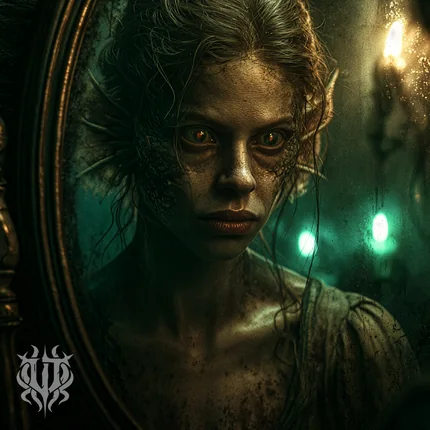
The Esoteric Order of Dagon is a dark metal descent into the world of Innsmouth, where ancient bloodlines, forgotten covenants and the call of the sea endure through countless generations.
References
- The Shadow over Innsmouth — Unspeakable Tales ebook
The fictional narrative is evidence for what the story says, not proof of events in the real world.
- Facts Concerning the Late Arthur Jermyn and His Family — Unspeakable Tales ebook
The fictional narrative is evidence for what the story says, not proof of events in the real world.
- The Rats in the Walls — Unspeakable Tales ebook
The fictional narrative is evidence for what the story says, not proof of events in the real world.
- The Dunwich Horror — Unspeakable Tales ebook
The fictional narrative is evidence for what the story says, not proof of events in the real world.
- The Case of Charles Dexter Ward — original text
The fictional narrative is evidence for what the story says, not proof of events in the real world.
- Through the Gates of the Silver Key — original text
The fictional narrative is evidence for what the story says, not proof of events in the real world.
At a glance
Comparative reading of primary fiction
Descent; bodily change; recognition; repetition; substitution
Genealogies, portraits, artifacts, documents and physical changes
Fictional heredity and identity, not scientific anthropology