

Tempest Mountain
Tempest Mountain is the remote Catskill elevation crowned by the abandoned Martense mansion in The Lurking Fear. Frequent thunderstorms, apparently natural earth mounds and a long history of attacks make it the center of a 1921 investigation. Its true geography is partly underground: a colony’s burrows connect the summit with the surrounding country.
4 min read · 674 words
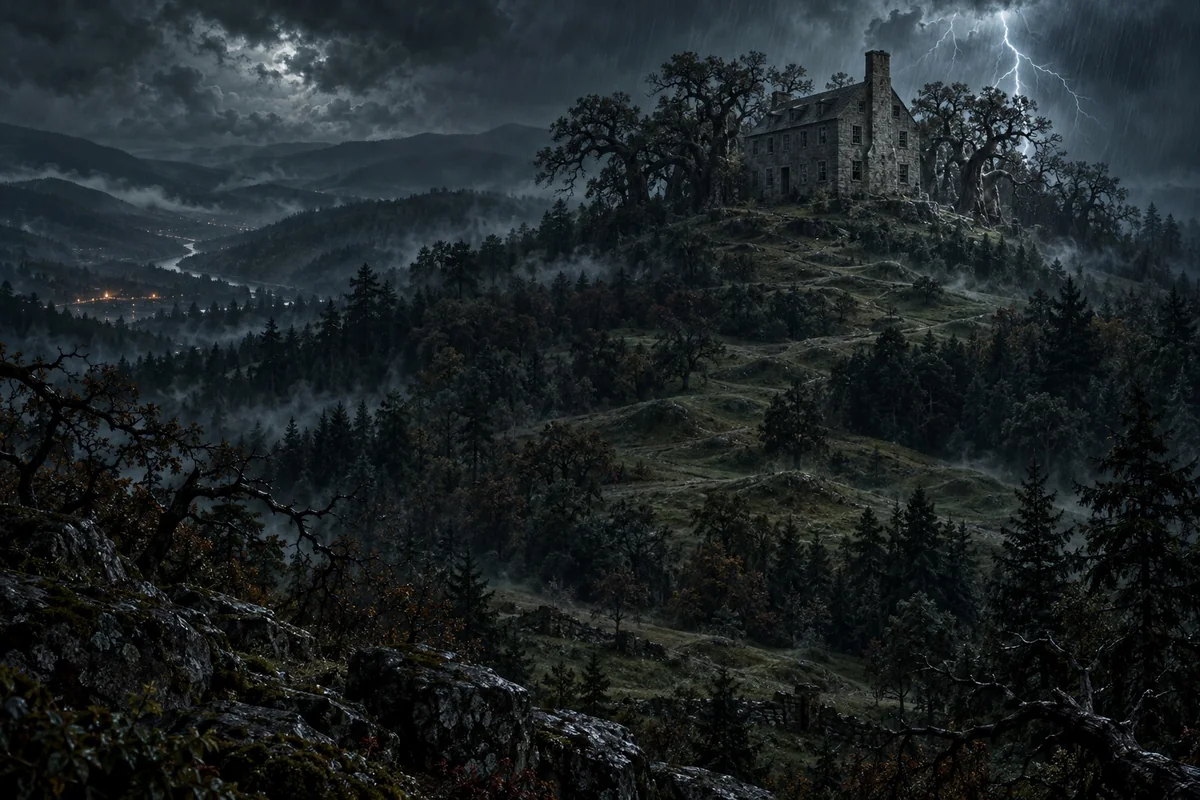
Regional setting
The narrator approaches through forests and hills from Lefferts Corners, where reporters have gathered after a recent disaster. The locality contains poor, isolated settlements and the remains of an older Dutch colonial presence.
Sources: [1]
The name derives from the frequency of severe thunderstorms. Gerrit Martense initially mistakes the storms for an unusual season when choosing the site, then discovers that they are characteristic of the place. His descendants develop their own intense relationship with that weather.
The mountain is a fictional setting within the real Catskills. The story's geographical details locate its internal action; they do not provide a reliable route to a real haunted summit.
The mansion on the summit
Gerrit Martense builds the stone house in 1670 as a retreat from the political and social changes he dislikes. By the twentieth century it is a large, decayed, ivy-covered ruin surrounded by old oaks, neglected gardens and a family cemetery.
Jan Martense's second-story room provides the setting for the narrator's first vigil. Its large east window faces a Dutch fireplace decorated with biblical tiles. A smaller south window and a built-in bed help establish the room's arrangement.
The cellar later becomes more important than the upper rooms. An opening near the chimney provides a route from the hidden colony into the house and outward into the forest.
Sources: [1]
Mounds, vegetation and mistaken geology
Low mounds and hummocks recur throughout the landscape. Initially the narrator treats them as products of natural geological processes, while their unusual shapes contribute to the atmosphere of the place.
Moonlight eventually reveals an arrangement radiating from the summit. Excavation confirms that at least one mound conceals a tunnel. The apparent surface scenery is therefore evidence of a working subterranean network.
The vegetation is repeatedly described as overgrown and abnormal, with large twisted roots. The narrator's imagery of tentacles gives the connected terrain an almost animate appearance, but the mountain itself is not identified as one enormous creature.
Sources: [1]
The surrounding attack sites
The devastated settlement lies between Cone Mountain and Maple Hill, several miles from the mansion. Its open surroundings initially seem inconsistent with the investigators' belief that the attacker requires forest cover.
A landslide below a lightning-struck tree supplies evidence of disturbed ground, while nearby tunnels later explain how the creatures can approach without crossing the surface in the expected way. Geography becomes a solution rather than merely a backdrop.
A separate cabin attack twenty miles away occurs during the narrator's own underground encounter. The simultaneity proves that the threat is multiple; it does not establish that every part of that distance is mapped by a confirmed continuous tunnel.
Sources: [1]
The cemetery passage
On November 8, 1921, the narrator excavates Jan Martense's grave in search of a supposed ghost. Digging below the old coffin breaks into a narrow passage that he follows toward the house.
The route brings him close to one of the creatures. A lightning-induced collapse exposes him to the surface again on the mountain's southwest slope. When he returns, subsequent earth movement prevents him from recovering the same entrance.
This loss of access explains why discovering one passage does not immediately settle the investigation. The narrator must learn to recognize the broader mound system before finding another route into the colony.
Sources: [1]
Destruction and remaining uncertainty
After witnessing the creatures' emergence and identifying their ancestry, the narrator hires workers to destroy the mansion and summit with dynamite. Discoverable burrows are blocked, and some of the overgrown trees are removed.
The account does not give a complete survey of the underground network or demonstrate that every inhabitant is reached. The narrator continues to fear surviving tunnels and other unknown caverns.
An illustration or map should preserve that uncertainty. The relative positions of named features can be described from the narrative, but a fully measured network, complete colony plan or surviving population would be an artistic or later fictional addition.
Sources: [1]
References
- The Lurking Fear — Unspeakable Tales ebook
The fictional narrative is evidence for what the story says, not proof of events in the real world.
At a glance
Fictional location in the Catskills
The Lurking Fear
Lefferts Corners
Martense mansion, built 1670
Cone Mountain; Maple Hill; low tunnel mounds
1921
Mansion and summit destroyed; burrows blocked where found