

The Martin’s Beach Creature
The Martin’s Beach creature is the unnamed marine specimen captured by Captain James P. Orne in The Horror at Martin’s Beach. Its enormous infant body suggests a scale of oceanic life unknown to the witnesses. A later disaster is plausibly connected with an adult of its kind, but the offshore attacker is never clearly seen or conclusively identified.
4 min read · 703 words
Source and the descriptive name
The creature appears in the story credited to H. P. Lovecraft and Sonia H. Greene, composed in June 1922 and first published in November 1923 as The Invisible Monster.
Martin's Beach Creature is a descriptive title used here to distinguish it from other unnamed marine beings. The narrative supplies no scientific species name, personal name or position within a hierarchy of Mythos gods.
Two kinds of evidence need to remain separate: the captured body, examined and exhibited, and the hidden force encountered offshore later in the summer.
Sources: The Horror at Martin’s Beach — original text, The Horror at Martin’s Beach — publication data, H. P. Lovecraft Archive — fiction in composition order
The captured body
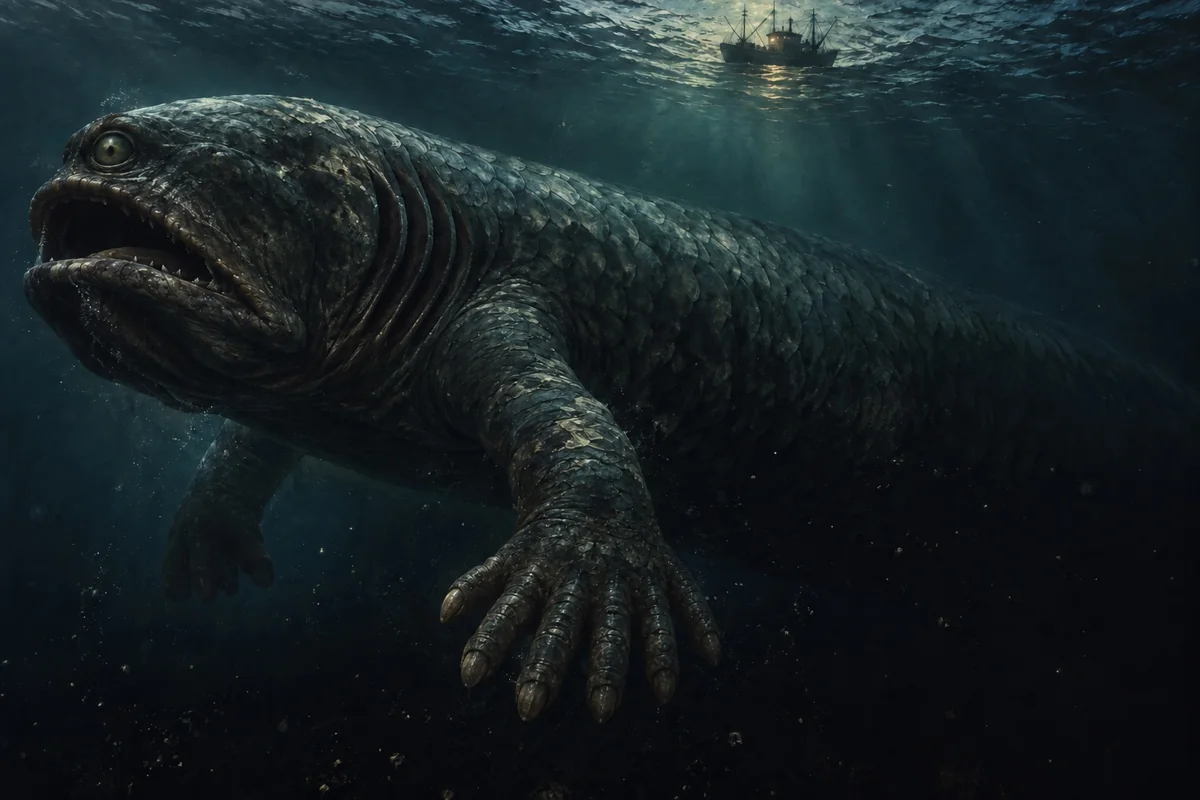
Orne and the crew of the Alma capture and kill the specimen on 17 May. It is roughly fifty feet long and ten feet thick, with a cylindrical body covered in heavy scales.
The anatomy combines gills and other aquatic features with forelimbs unlike ordinary pectoral fins. The feet have six toes. Its large mouth and single deeply recessed eye contribute to the impression of an organism that does not fit the categories used by the observers.
The investigators regard the creature as an infant only a few days old. That conclusion transforms its size from a limit into a clue: an adult may be far larger. The story does not give a measured adult length that can be calculated from the infant's dimensions.
The illustration imagines the specimen alive underwater to make the described features legible. The original narrator does not witness that underwater scene, and the painting should not be mistaken for an additional event in the story.
Anatomy, intelligence and uncertainty
Naturalists are interested in the brain and other internal features as well as the external appearance. Their observations suggest a level of development that makes the specimen more disturbing than a merely oversized fish.
The opening discussion of possible nonhuman hypnotic powers supplies a framework for interpreting the later disaster. It does not document an experiment demonstrating that the dead infant itself exercised those powers.
Neither the creature's evolutionary origin nor its relationship to familiar marine animals is settled. Its hybrid appearance is a feature of the fiction, not evidence for a real undiscovered taxonomic group.
The floating exhibition
The preserved body becomes an attraction aboard a vessel moored at the hotel wharf. Scientific interest and commercial display share the same object, making the captured creature publicly visible while leaving its wider environment unknown.
After a storm, the exhibition vessel disappears with the specimen and its sleeping guard. Searchers do not recover an explanation.
An adult retrieving the infant is one possible reading, especially in light of what follows. The disappearance itself is not witnessed, however, and the text does not show a parent taking the boat.
The force beyond the rescue rope
On 8 August, a cry from the water draws lifeguards into a rescue attempt. The line attached to a buoyant cushion becomes subject to an extraordinary pull. Men who join the effort find that they cannot let go.
Orne's involvement links the capture and exhibition with the later group of victims. The spectators also fail to intervene effectively, and the narrator connects their paralysis with the possibility of influence beyond ordinary physical force.
Rising water and a storm conceal the final stages. The rescuers vanish without a clear view of the thing holding them. The narrator's imagined eye beyond the line is not a direct anatomical observation of an adult.
Revenge as interpretation
The infant's killing, disappearance and the later destruction form a compelling pattern of retaliation. Nevertheless, the antagonist never states a motive, and the narrative provides no communication that confirms a parent-child relationship.
The entry therefore distinguishes a likely narrative implication from an established identification. It is possible to discuss the sea's response to exploitation without inventing a full species history or assigning a moral code to the creature.
The resemblance to other maritime horrors is likewise thematic. Neither Dagon, Cthulhu nor the Deep Ones are named as the specimen or the hidden attacker. Their separate entries offer comparisons, not alternative names for this being.
References
- The Horror at Martin’s Beach — original text
The fictional narrative is evidence for what the story says, not proof of events in the real world.
- The Horror at Martin’s Beach — publication data
- H. P. Lovecraft Archive — fiction in composition order
Composition dates; question marks and ranges retain the source uncertainty.
At a glance
1923, as The Invisible Monster
An infant, approximately fifty feet long
17 May 1922
Not supplied
Inferred; not directly established