

The Horror at Martin’s Beach
The Horror at Martin’s Beach follows a seaside resort’s encounter with an unknown marine life form and the disappearance of a group attempting a rescue. A captured creature becomes a profitable exhibition before an unseen force offshore turns the rescuers’ rope into a means of entrapment. The collaboration with Sonia H. Greene keeps its central danger partly outside the witnesses’ field of vision.
6 min read · 1,095 words
Authorship and publication
The Archive credits H. P. Lovecraft and Sonia H. Greene and dates composition to June 1922. The first publication was in the November 1923 Weird Tales, volume 2, number 4, on pages 75–76 and 83, under the title The Invisible Monster.
The story uses an unnamed eyewitness who attempts to reconcile contradictory accounts. The narrator says that a professor's discussion of possible nonhuman hypnotic abilities and the resort's attempts to limit publicity have shaped the public response.
This opening makes testimony part of the problem. Many people saw the event, yet the number of witnesses does not produce a single complete or reliable reconstruction.
Sources: The Horror at Martin’s Beach — original text, H. P. Lovecraft Archive — fiction in composition order, The Horror at Martin’s Beach — publication data
The capture on 17 May
Captain James P. Orne and the crew of the fishing vessel Alma, from Gloucester, capture and kill an immense sea creature after a prolonged struggle. Naturalists take steps to preserve the body.
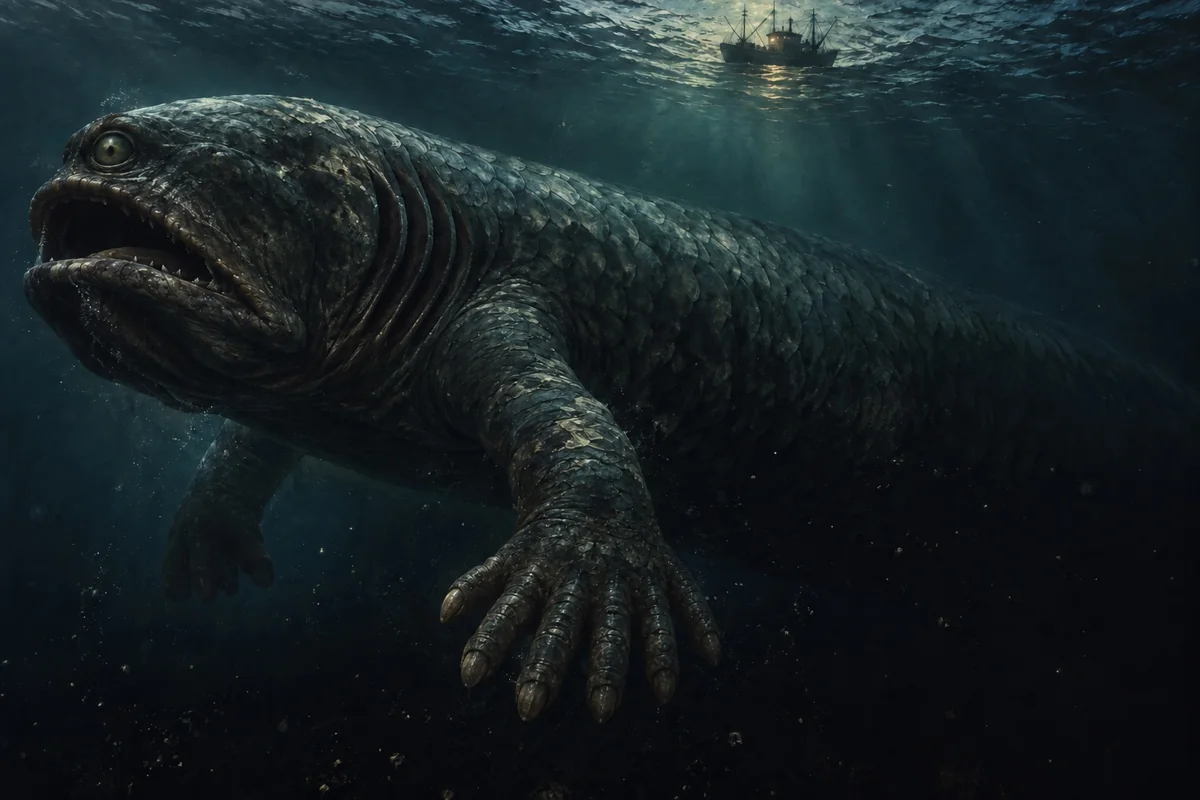
The animal is approximately fifty feet long and ten feet across, with a roughly cylindrical form. It has gills, heavy scales, an extraordinary mouth and a single recessed eye. Limblike structures with six-toed feet occupy the position where pectoral fins would normally be expected.
The specialists' most unsettling conclusion is that this enormous specimen is an infant only a few days old. Its brain and organs also suggest a development that challenges their expectations of fish.
The narrative supplies these observations as findings within its fictional world. It gives neither a formal species name nor a detailed account of an adult's anatomy.
The exhibition and its disappearance
Orne obtains a vessel large enough to hold the specimen and converts it into a floating attraction. Anchored at the hotel wharf at Martin's Beach, the display attracts paying visitors and scientific attention.
On the morning of 20 July, the vessel is discovered missing after a storm. The body and the guard who slept aboard have disappeared with it. A substantial search produces no explanation.
By 7 August the search has been abandoned, and Orne returns to settle matters at the Wavecrest Inn. The fatal event takes place the following evening.
The sequence invites the reader to connect the missing exhibit with what follows. The story does not show who or what removed the vessel, however, so deliberate retrieval by a parent creature remains an inference.
The cry from offshore
On 8 August 1922, people occupy the beach and the inn's veranda as moonlight begins to cross the sea. An unusual ripple approaches along the illuminated water and seems to subside near offshore rocks.
A cry then sounds from the water. Although the lifeguards find it unlike the distress calls they know, they act on their duty to attempt a rescue. One throws a buoyant cushion attached to a rope toward the sound.
The line becomes impossible to retrieve. The force at its far end pulls the guards toward the water, and spectators join them. Orne takes a leading role among the men trying to draw the unknown object ashore.
The motive for continuing shifts from rescue to investigation. As a drowning person becomes an implausible explanation, curiosity and determination keep the men at the rope.
The inability to release the line
Orne proposes obtaining a boat to approach the hidden source of resistance. When he tries to leave the rope, he discovers that he cannot release it. The other men are held in the same way.
The narrative does not describe knots binding their wrists or a visible organism wrapping itself around them. Their attachment is an unexplained compulsion or restraint, connected by the opening frame with the possibility of hypnosis.
The spectators also become incapable of useful action. The eyewitness includes himself among those who watch without assisting and acknowledges the shame attached to that behavior.
The scene thus involves more than superior physical strength beneath the water. Both the men on the rope and the people who might help them lose ordinary freedom of response.
The rising water and storm
The trapped group continues pulling as the tide rises around them. Their shared motion creates the appearance of one long, struggling body. The spectators retreat before the water and eventually climb toward the hotel as the storm intensifies.
Lightning intermittently reveals the diminishing line of heads. The narrator's language expands from individual fear to an overwhelming impression of suffering, but no new anatomical view of the hidden antagonist appears.
He imagines a single eye beyond the victims. That moment is explicitly presented as a vision shaped by his disturbed mind, not a clear observation of an adult matching the captured specimen.
After a final violent burst of weather, the sea becomes strangely quiet. The men have vanished, and a fading disturbance remains offshore. The narrator thinks he hears distant laughter from below.
What can and cannot be identified
The killed specimen and the later unseen force are related by the structure of the narrative and by Orne's speculation about an adult of the same kind. The text never supplies a direct recognition that conclusively establishes the relationship.
Likewise, revenge for the infant is a persuasive reading of the sequence, but the antagonist never states that motive. The cry might have functioned as a lure; the story does not show a human drowning victim whose distress can be independently confirmed.
No named Mythos deity appears. The creature should not be relabeled as Dagon, Cthulhu or a Deep One merely because the events take place at sea.
The uncertainty is not an accidental absence of explanation. It allows a familiar rescue procedure to become catastrophic without giving the witnesses enough understanding to resist or even describe the force completely.
Spectacle, responsibility and the sea
The first half turns an unfamiliar life form into an object of display, scientific argument and commercial opportunity. The second half reverses the relation of observer and observed: people gathered to investigate something in the water become the ones held within another power's reach.
Orne links the two phases. His enterprise brings the dead specimen to the resort, and his practical authority makes him a leader at the rope. The story does not reduce him to a passive bystander or a sole cause of everything that follows.
The eyewitness's enduring fear comes partly from the loss of the rescuers and partly from the collective failure to help. The inn can resume business and the beach can recover its popularity, while the narrator can no longer regard the ocean as an ordinary setting for recreation.
References
- The Horror at Martin’s Beach — original text
The fictional narrative is evidence for what the story says, not proof of events in the real world.
- H. P. Lovecraft Archive — fiction in composition order
Composition dates; question marks and ranges retain the source uncertainty.
- The Horror at Martin’s Beach — publication data
At a glance
H. P. Lovecraft; Sonia H. Greene
June 1922
1923, November
Weird Tales, 2, No. 4
Fiction