

Sarnath
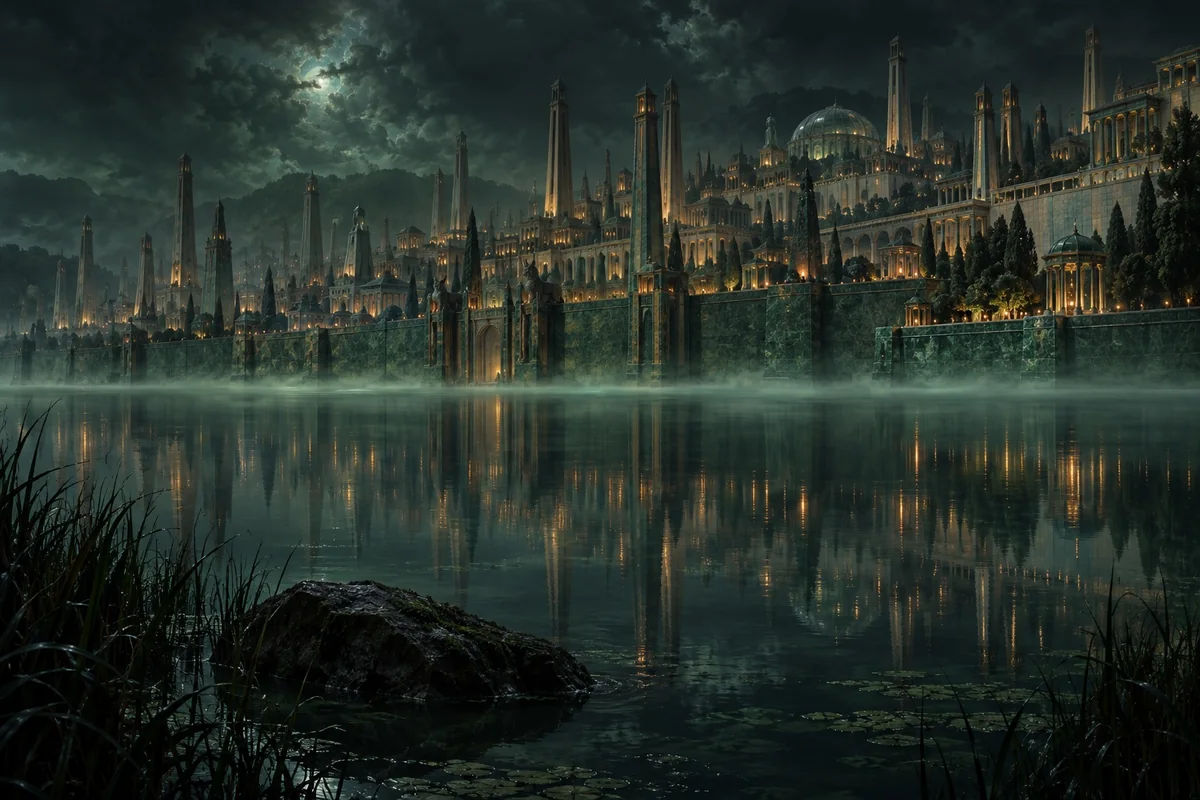
Sarnath is the wealthy human city beside the still lake of Mnar whose inhabitants destroy Ib and celebrate the massacre for a millennium. The Doom That Came to Sarnath describes its trade, architecture, religion and imperial power before showing the terror that precedes its disappearance. Its splendor and its violence are inseparable parts of the same history.
4 min read · 815 words
Settlement and the lake
The city begins when human pastoral peoples move beyond the settlements along the River Ai and discover precious metals near a remote lake. Other groups establish Thraa, Ilarnek and Kadatheron along the river; Sarnath develops at the mineral deposits.
Sources: [1]
The lake has no stream flowing into or out of it. Ib, an immensely older nonhuman city, already stands nearby. The human settlers’ reaction to their neighbors becomes the first decisive event in Sarnath’s history.
The story places these events in Mnar’s legendary antiquity. Its introductory ten-thousand-year distance should not be converted into a precise date in a real archaeological chronology.
A founding act of extermination
The settlers resent Ib’s inhabitants because of their appearance and the disturbing antiquity of their monuments. They discover that the beings are soft-bodied and easily injured, then send warriors to kill them all.
The victors push the bodies and sculptured stones into the lake. They retain Bokrug’s image as a trophy demonstrating their power over the older inhabitants and their god. The narrative records no earlier attack by Ib that would make this a defensive war.
Sarnath later turns the massacre into an annual festival. That repeated celebration matters as much as the original event: the city actively teaches its descendants to honor the destruction and mock its victims.
Sources: [1]
Trade and imperial expansion
A caravan route to Ilarnek exchanges the mined metals for books, tools, textiles, gems and luxury goods. Prosperity supports craft, learning and increasingly ambitious buildings. The city also sends armies against its neighbors.
Its kings eventually rule Mnar and adjacent territories. The later royal feast displays goods from distant islands, hills, groves and deserts, suggesting the reach of its commercial and political networks.
This growth explains why the first supernatural warning loses force. Many generations see wealth and conquest continue without an obvious catastrophe and begin to regard inherited fear as obsolete.
Sources: [1]
Walls, streets and royal buildings
The tale gives the walls a height of three hundred cubits and a breadth of seventy-five, with enough room for passing chariots. They enclose the city on the landward side, while a green stone seawall protects the lakefront.
Two intersecting groups of fifty streets organize the interior. Onyx paves the main routes, with granite used where heavy animals travel. Bronze gates are flanked by carved lions and elephants, and houses combine glazed brick, chalcedony, enclosed gardens and small pools.
The palaces contain elaborate columns, jeweled mosaics and scented fountains. The royal throne is described as a single enormous piece of ivory resting on golden lions. These exaggerated materials and measurements belong to the story’s legendary presentation; they should be preserved as textual details rather than treated as excavated architectural data.
Sources: [1]
Gardens and controlled nature
King Zokkar’s gardens occupy a large enclosed area beneath a glass dome. Fans cool them in summer and hidden fires warm them in winter, producing a permanent spring. Artificial celestial images supply light and ornament when the real sky is obscured.
Streams, waterfalls, bridges, flowers and terraced banks create an ordered landscape for leisure and worship. The engineering offers a striking contrast with the lake outside, whose strange annual behavior the city cannot control.
Royal amphitheaters can also be flooded through aqueducts for staged sea battles and dangerous contests. Water is both a managed spectacle within Sarnath and the surrounding medium through which its suppressed past returns.
Sources: [1]
Temples and the suppressed warning
Seventeen tall temples dominate the skyline. The greatest contains the principal shrines of Zo-Kalar, Tamash and Lobon, as well as the high-priests’ tower chamber.
There the clergy preserve the chrysolite altar marked by Taran-Ish before his unexplained death. They also perform a rite against Bokrug. Early unease about the vanished idol and lights beneath the lake gradually gives way to participation in the victory festival.
Religious authority is therefore divided between preserving evidence of danger and joining the civic confidence that dismisses it. The warning is not lost because nobody ever recorded it; it becomes ineffective despite surviving in a central sacred place.
Sources: [1]
The thousandth feast and the vanished site
At the millennium festival, Nargis-Hei and his court feast while Gnai-Kah sees shadows descend toward the lake. Green mist gathers and the rock Akurion begins to sink beneath rising water. Some visitors depart before the panic becomes general.
Fleeing townspeople later describe beings resembling the people of Ib in the royal hall, holding the feast’s jeweled platters with flames upon them. The text leaves the exact relation between the guests and these figures unstated.
Later travelers find marsh where Sarnath stood. Even the mines have vanished, while Bokrug’s image survives among the reeds. The Quest of Iranon subsequently has its singer recall seeing the marsh where the city once stood, extending its afterlife as a remembered absence.
References
- The Doom That Came to Sarnath — original text
The fictional narrative is evidence for what the story says, not proof of events in the real world.
- The Quest of Iranon — Unspeakable Tales ebook
The fictional narrative is evidence for what the story says, not proof of events in the real world.
At a glance
Mnar
Shore of a still lake without inflowing or outflowing streams
Precious metals and caravan trade
Zo-Kalar, Tamash and Lobon
Nargis-Hei
Thousandth anniversary of the destruction of Ib
Marsh; the city and mines are gone