

The Quest of Iranon
The Quest of Iranon follows a seemingly ageless singer searching for the beautiful city where he believes he was born a prince. Practical townspeople reject his calling, pleasure-seekers briefly reward it, and a childhood companion ages and dies beside him. The final encounter makes the existence of the remembered city inseparable from the belief that has sustained his identity.
5 min read · 1,037 words
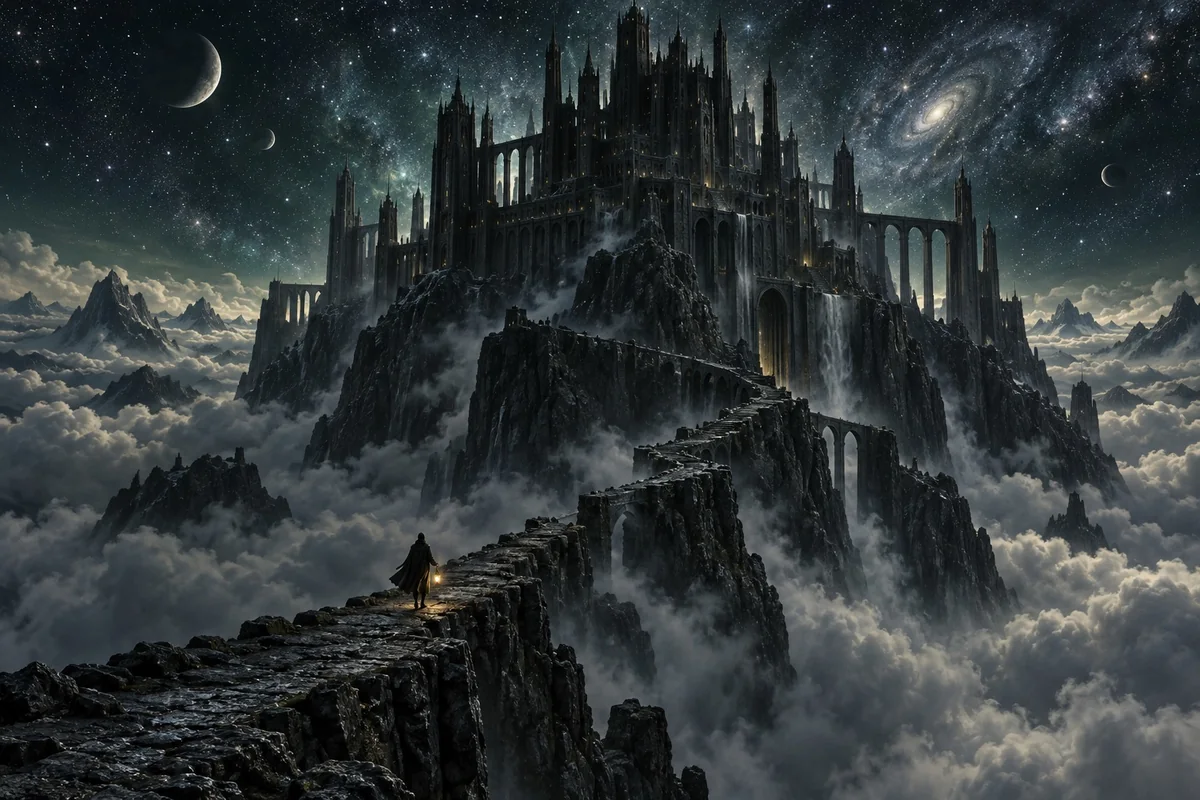
Composition and delayed publication
Lovecraft wrote the story on 28 February 1921. It first appeared in The Galleon’s July–August 1935 issue. Like several of his early imaginative tales, its composition substantially precedes its first publication.
The narrative is in the third person but gives considerable space to Iranon’s speeches and songs. His descriptions of Aira are the emotional center of the story, while his travels gradually test the relation between those memories and the world around him.
Sources: H. P. Lovecraft Archive — fiction in composition order, H. P. Lovecraft Archive — fiction in publication order, The Quest of Iranon — Unspeakable Tales ebook
Arrival in Teloth
Iranon enters the stern granite city of Teloth wearing a torn purple robe and a wreath in his golden hair. He explains that he is a singer whose wealth consists of memories, hopes and dreams of Aira, the distant city he seeks.
The townspeople allow him to sing, but most find nothing useful in the performance. A few respond with wonder or devotion, preventing the city from being reduced to complete unanimity. The dominant reaction is boredom or ridicule.
After lodging him in a stable, an official orders him to become a cobbler’s apprentice. Iranon argues that labor should make a life possible in which beauty and song have a place. The official regards the argument as irreligious and gives him until sunset to work or leave.
The remembered Aira
In Iranon’s songs, Aira is a city of marble and beryl beside the clear Nithra, with the smaller Kra flowing through a green valley. Gardens, colored palaces and the light from a childhood window form its remembered atmosphere.
He says his father was its king and that exile separated him from the city. He expects both a recovered royal position and an audience who will understand his art. The destination therefore unites home, social identity and artistic recognition.
At this stage these are Iranon’s claims. The narrator’s sympathetic presentation does not yet supply an independent witness to the city or confirm a royal genealogy.
Romnod and the departure
Beside Teloth’s river, Iranon meets Romnod, a lonely boy looking for green branches carried down from the hills. Romnod longs to escape the city’s severity and proposes traveling to Oonai, reputedly a place of music and dancing.
He suggests that Oonai might be Aira under a different name. Iranon doubts it, recalling earlier disappointments in cities where he hoped to find sympathetic listeners. Nevertheless he agrees to take the boy with him rather than leave him without an outlet for his longing.
Their journey lasts years. Romnod listens to the evening songs and grows into a man, while Iranon remains apparently young. The contrast establishes the unusual relation between the singer’s identity and the passage of time before the ending makes it explicit.
Welcome in Oonai
When they finally see Oonai, Iranon knows its harsh lights are not those of Aira. Its revelers nevertheless welcome his songs and shower him with flowers, giving him a temporary sense of recognition.
Daylight reveals a less attractive city and exhausted drinkers. Iranon stays because of the applause, while Romnod embraces the revelry more fully. The king clothes the singer richly and gives him a luxurious room.
His performances can momentarily make listeners imagine something beyond their banquet. Yet the city’s interest depends on entertainment and novelty rather than a lasting commitment to the kind of beauty he seeks.
Replacement, aging and bereavement
New dancers and musicians capture the court’s attention. Iranon continues singing, but fewer flowers are thrown to him. Romnod drinks heavily, grows coarser and gradually ceases to share the dreams that originally drew him away from Teloth.
One night Romnod dies while Iranon sings alone elsewhere in the room. The story does not provide a clinical diagnosis. It contrasts the companion’s bodily decline with the singer’s preserved youth and unaltered devotion.
Iranon mourns him and places budding branches on his grave, recalling the boy who watched for them beside the river. He abandons the court’s rich clothing, puts on his old purple robe and resumes the search.
The shepherd’s recollection
After more wandering, Iranon asks an aged shepherd about Aira and its rivers. The man recognizes the names from a boy he knew long ago: a beggar’s son who invented beautiful stories and believed himself a prince.
The shepherd says that the boy’s neighbors knew him from birth and laughed at his claims. He identifies that childhood companion as Iranon and says that Aira existed only in his dreams.
This testimony attacks the singer’s defining memory at its origin. It is more devastating than another indifferent audience because it purports to know who he was before the quest began. The story supplies no later expedition that could settle the city’s existence through ordinary geography.
The final change
The narration next shows an extremely old man in a tattered purple robe, with withered leaves on his head, walking into the deadly marsh. His gaze remains fixed as if on the city he has sought.
The abrupt aging links the collapse of belief with the end of the youth that had seemed immune to passing years. The final sentence mourns the loss of youth and beauty from the world, keeping the ending elegiac rather than treating the exposure as a straightforward victory for factual correction.
A synopsis should distinguish that literary effect from a diagnostic claim. The story does not name a medical condition, and the apparently supernatural preservation and collapse of youth are part of its imaginative form.
Art, work and imperfect audiences
Teloth refuses the value of song unless it can be made to fit compulsory labor. Oonai rewards song but treats it as replaceable amusement. Romnod initially offers genuine companionship, then loses the shared longing that made it meaningful.
Iranon’s difficulty is consequently more specific than simple hostility from everyone he meets. He encounters attention, patronage and friendship, but none becomes the durable understanding he locates in Aira.
His travel recollections connect the tale with Sarnath, the River Ai and Lomar. These names place his journey within a wider imaginative geography, while the plot remains a tragedy of identity and artistic belonging rather than an encounter with a named cosmic monster.
References
- H. P. Lovecraft Archive — fiction in composition order
Composition dates; question marks and ranges retain the source uncertainty.
- H. P. Lovecraft Archive — fiction in publication order
First publication dates and venues; issue dates can differ from actual release dates.
- The Quest of Iranon — Unspeakable Tales ebook
The fictional narrative is evidence for what the story says, not proof of events in the real world.
At a glance
H. P. Lovecraft
28 February 1921
1935, July–August
The Galleon, 1, No. 5
Fiction