

Star-borne Feeder
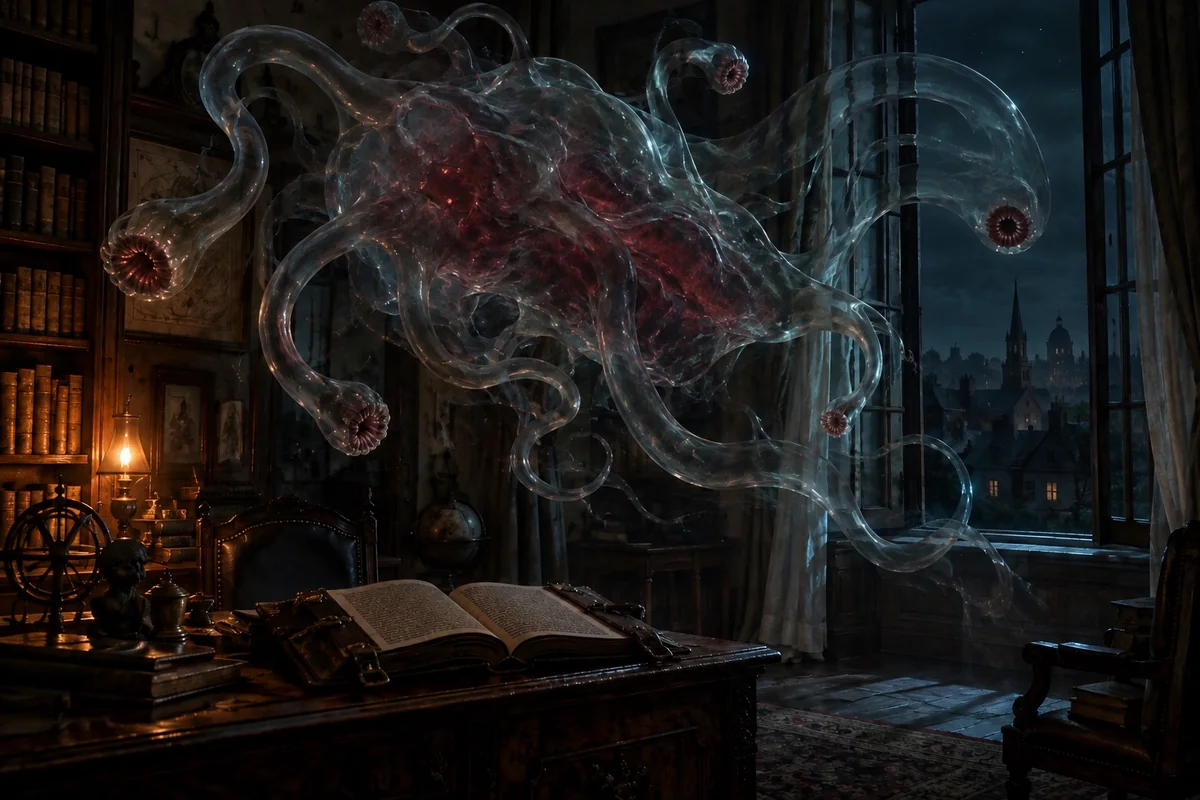
The star-borne feeder is the initially invisible entity summoned in Robert Bloch’s The Shambler from the Stars. It kills the reader of an invocation in De Vermis Mysteriis, and the blood it consumes reveals a fluid, many-appendaged body without a head, face or eyes. This descriptive entry concerns Bloch’s witnessed creature, without imposing a complete later species taxonomy.
4 min read · 831 words
Source and descriptive name
The creature appears in Bloch's 1935 story, dedicated to H. P. Lovecraft. The surviving narrator calls it a shambler from the stars and describes its feeding as vampiric. It is not given an individual personal name.
Star-borne feeder is used here as a descriptive heading. It identifies the being's role and stated association with the stars without claiming that Bloch supplied a formal scientific name, a lineage of rulers or a systematic classification.
The dedication connects the story with Lovecraft's literary circle, but the creature's particular appearance and attack belong to Bloch's narrative. They should not all be attributed to Lovecraft because the victim evokes his public image.
Prinn’s servants and the forbidden book
The narrative's account of Ludvig Prinn describes unseen attendants and beings commanded from beyond the stars. Those reports establish a precedent for what the book's readers later attempt.
The summoning passage occurs in a chapter concerning familiars. The Providence reader recognizes a possible connection with Prinn's reputed servants and recites it aloud. The arrival follows that act of invocation.
The story does not demonstrate that any page of the volume would produce the same result. Possessing the book, being able to translate Latin and speaking the particular passage are different steps in the sequence. The narrator's inability to read the text unaided is what brings another person into the immediate danger.
Arrival before visibility
The room becomes cold and a sudden wind enters through the open window. Sound, including disturbing laughter, accompanies physical effects on the window area before the narrator can see a body.
The victim is lifted and violently contorted by an apparently empty space. These effects establish that invisibility does not make the entity incapable of contact with ordinary matter. The observer's limited perception is part of the danger.
The story provides no instrument that detects the creature reliably in advance and no complete explanation of how it passes between the stars and the room. The invocation and the threshold are narratively connected without becoming a technical account of travel.
The revealed body
Feeding makes the body's outlines perceptible. The narrator sees an immense, pulsing, jellylike mass with numerous trunklike appendages. Suckers at their ends open and close, while the description also attributes a ravenous mouth and great talons to the being.
It lacks a recognizable head, face and eyes. Those negative details are explicit and distinguish the description from a conventional humanoid vampire or a miniature version of Cthulhu.
The visible red coloration is connected to consumed human blood. It should not be treated without qualification as the creature's permanent natural pigmentation. Nor does the story establish a stable number of limbs, a measured body size, a sex or a reproductive cycle.
Departure and the uncertain second visit
The entity leaves through the window after feeding. The narrator hears its laughter recede and remains with the body and the aftermath of the attack.
He later fears it will return for him without a renewed summons. That expectation is psychologically central to the ending, but a second attack does not occur within the narrated action. The survivor's prediction cannot be promoted into an observed rule that every witness is automatically pursued.
The volume is missing after the encounter. The story does not separately show the feeder taking it, so its disappearance should not be used as firm evidence that the creature collects books or deliberately erases every summoning text.
Knowledge lost in the fire
The narrator burns the room and escapes. The public account of his friend's death consequently rests on the fire rather than on the supernatural cause the reader has been told about.
This destruction prevents ordinary examination of the scene. The creature's anatomy survives in a terrified observer's written account, not in a preserved specimen or a collection of independent laboratory observations.
Its literary function follows from that asymmetry. A writer sought direct knowledge to improve his horror fiction, but the encounter supplies knowledge at another person's expense and leaves him unable to make his own life secure. Authentic experience proves destructive rather than simply useful material.
Distinctions from adjacent beings
The Haunter of the Dark belongs to another story and has another relationship to an artifact, darkness and a threatened writer. Similar positions within a literary exchange do not make the two beings identical.
Likewise, the word shambler is descriptive language rather than sufficient evidence of a shared species with every entity bearing that term in later fiction or games. An encyclopedia should connect those usages only where a source actually establishes the relationship.
The accompanying illustration interprets the fleeting revelation of a fluid, headless body. It omits the victim and treats transparency and limb arrangement as visual choices. The picture is not an additional witness, a literal film frame or a source for anatomy absent from Bloch's prose.
Sources: Robert Bloch — The Shambler from the Stars, The Haunter of the Dark — Unspeakable Tales ebook
References
- Robert Bloch — The Shambler from the Stars
- The Haunter of the Dark — Unspeakable Tales ebook
The fictional narrative is evidence for what the story says, not proof of events in the real world.
At a glance
Robert Bloch
The Shambler from the Stars (1935)
Invisible; feeding reveals the outlines
Headless, faceless, eyeless, jellylike; numerous appendages
De Vermis Mysteriis
Descriptive heading; the witnessed entity has no personal name