

The Shambler from the Stars
The Shambler from the Stars is Robert Bloch’s account of a struggling writer whose desire for unprecedented horror fiction leads him to a dangerous book and a fatal act of reading. The summoned creature is initially invisible; its feeding makes its outline perceptible. The survivor destroys physical evidence but cannot restore the distance between literary ambition and lived terror.
5 min read · 933 words
Publication, dedication and viewpoint
The story appeared in Weird Tales in September 1935 and carries a dedication to H. P. Lovecraft. Its narrator is a writer of weird fiction, describing his own ambition and failure after the event that has transformed them.
The Providence writer who helps him is unnamed in the narrative. The dedication and the surrounding literary relationship invite a connection with Lovecraft, but the character's occult history and death remain fictional. They are not claims about Lovecraft's actual activities.
From economic necessity to artistic ambition
The narrator first turns to writing because he needs a livelihood. Early stories fail, and he improves through work on language and structure until he begins making sales. The account recognizes craft before introducing the later obsession.
Success proves insufficient. He wants to write a lasting work and decides that familiar monsters and conventional perspectives cannot provide it. The pursuit of new material becomes a search for direct access to what horror literature ordinarily invents.
This motivation differentiates him from a collector interested only in a rare object's monetary value. He wants knowledge because he expects to transform it into art. The eventual encounter destroys the comfortable assumption that the artist can remain outside the suffering he seeks to describe.
Correspondents, refusals and the bookshop
He contacts scattered students of unusual subjects. A New England correspondent mentions dangerous books and reluctantly supplies possible contacts. Requests to institutions and private possessors meet evasion, hostility and warnings.
The eventual discovery occurs in a secondhand shop on South Dearborn Street. A black, metal-bound volume of De Vermis Mysteriis has been shelved among ordinary books, and the dealer sells it cheaply without understanding its supposed significance.
The contrast between the guarded network and the accidental retail discovery gives access an element of chance. Warnings do not create an effective barrier when a surviving copy can pass through an unknowing owner's hands.
Prinn’s reputation and the language barrier
The narrator recounts Ludvig Prinn's alleged history as a long-lived sorcerer, traveler and prisoner. His supernatural companions, obscure studies and fatal prosecution form the volume's fictional provenance.
The book is said to have been written during imprisonment and printed after Prinn's death. Suppression and altered later editions help explain its rarity and the special value attached to the Latin text. These dates and events belong to Bloch's invented bibliography, not an actual early printed occult work.
Obtaining the copy does not make the narrator able to read it. His limited Latin requires another person's assistance, and he travels to Providence to consult his correspondent. The language barrier transfers the immediate act of invocation to someone else.
Reading becomes invocation
The host initially hesitates, recognizing the possibility of danger. The narrator urges him onward. The ordinary appearance of the printed pages helps the men move from caution toward fascination, and the reader begins translating and reciting passages.
The text refers to Yig, Han and Byatis before reaching a passage concerning invisible familiars. Those names are references within the book. Their mention does not mean that each deity physically appears in the room.
The host recognizes a possible means of calling the star-borne servants associated with Prinn and reads it aloud. The story connects the arrival to that spoken summons rather than to mere ownership of the volume or the narrator's private imagination.
The creature becomes visible
Cold, wind, sound and distortion of the window announce a presence before any body can be seen. The host is lifted and killed by an apparently empty region of the room while the narrator remains a terrified witness.
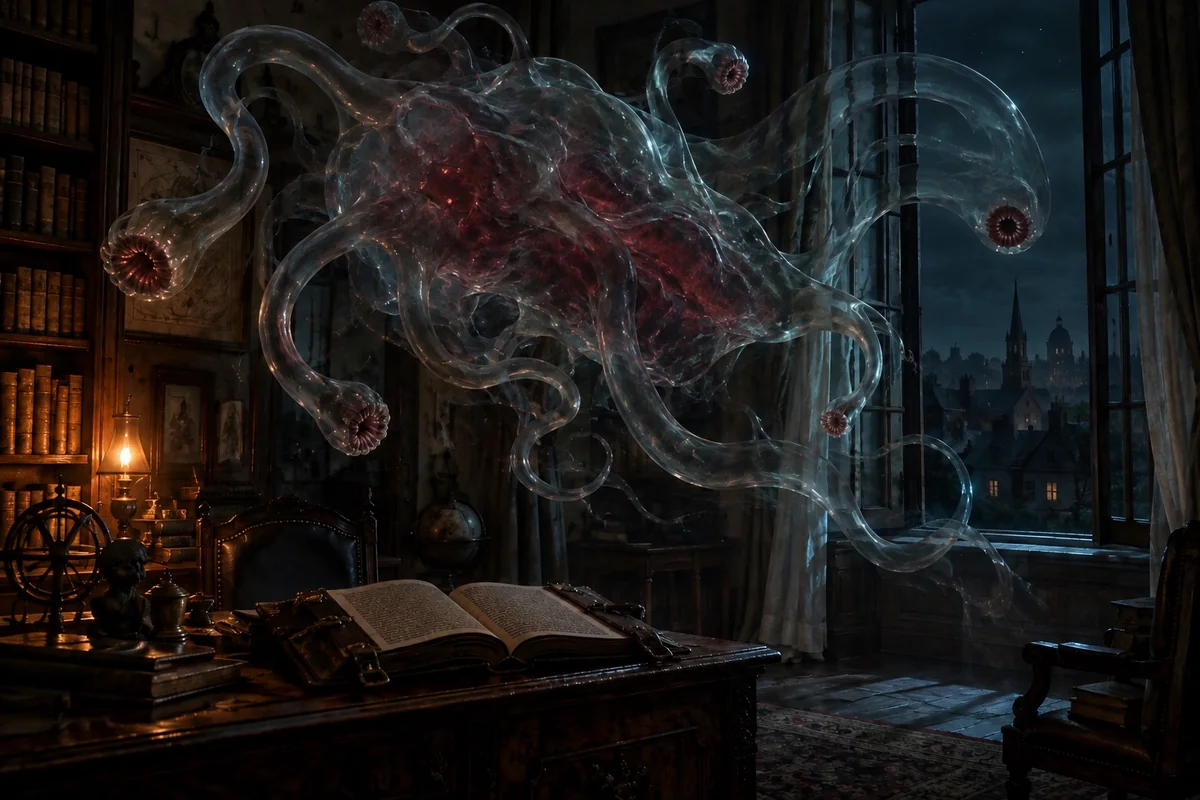
Feeding changes what the observer can perceive. Blood reveals the outline of a large, fluid, many-appendaged entity. Its initial invisibility is therefore a condition altered by what it consumes, not proof that it was wholly immaterial.
The creature is described without an ordinary face or eyes. The story gives no reliable origin map, population count or complete account of its life cycle. Later classifications should remain distinguishable from what this single encounter actually establishes.
Fire and the surviving account
The entity departs, leaving the dead host and traces of the attack. The book is no longer present, although the narrator does not give a separately witnessed account of where it has gone.
He sets fire to the room and escapes before the blaze is detected. A later report treats his friend's death as an accident. The apparent public explanation therefore depends on evidence that the survivor has deliberately destroyed.
His written account preserves what the fire conceals, while recurring dreams and fear undermine the composure he claims. He expects the creature may return for him without another summons, but the story ends with that expectation rather than a second witnessed attack.
The literary exchange and the story’s own ending
The dedication provides an explicit link to Lovecraft. Read beside The Haunter of the Dark, with its writer Robert Blake and dangerous act of looking, the tale also offers a comparison between artistic curiosity, scholarly mediation and fatal contact.
The two narratives should retain separate protagonists and mechanisms. Bloch's invisible feeder is called by a spoken passage; the Haunter's relation to its artifact and darkness follows another story's conditions. Shared literary play is not sufficient to identify the creatures.
Bloch's ending returns to the original desire for authentic knowledge. The narrator still imagines learning the ultimate secret even as he anticipates his own death. Ambition is neither simply fulfilled nor extinguished; it persists after the loss that has made its cost unmistakable.
Sources: Robert Bloch — The Shambler from the Stars, The Haunter of the Dark — Unspeakable Tales ebook
References
- Robert Bloch — The Shambler from the Stars
- The Haunter of the Dark — Unspeakable Tales ebook
The fictional narrative is evidence for what the story says, not proof of events in the real world.
At a glance
Robert Bloch
September 1935
Short story
Weird Tales