

Cool Air
Cool Air concerns a New York lodger whose physician neighbor can survive only under increasingly strict refrigeration. Written in March 1926 and first published in March 1928, the story connects medical gratitude, material dependence and a failed repair with a final revelation about how long the doctor has been dead.
6 min read · 1,180 words
Publication and the framing aversion
Lovecraft wrote Cool Air in March 1926. It first appeared in the March 1928 Tales of Magic and Mystery. The main events are set in New York in 1923, a separate date from either composition or publication.
The unnamed narrator begins by explaining his intense aversion to cold air. He insists that the experience responsible did not occur in a remote dark ruin, but in a busy city boarding house during an ordinary bright afternoon.
The account below includes the final revelation. The story’s structure depends on learning why the cold that initially seems merely unpleasant has acquired a lasting association with horror.
The West Fourteenth Street house
The narrator moves among cheap lodgings while earning little from magazine work. He settles in a former brownstone mansion on West Fourteenth Street, where traces of old decorative splendor survive amid shabby furnishings and ordinary domestic smells.
His third-floor front room lies beneath a small laboratory occupied by Dr. Muñoz. The doctor also rents an adjoining larger room as his main living space. Mrs. Herrero, the landlady, explains that he once had a substantial medical reputation but now lives in seclusion and requires unusual chemical baths and refrigeration.
An ammonia leak through the ceiling first draws the narrator’s attention to the arrangement. The machinery is initially a practical nuisance rather than a recognized threat.
Sources: [3]
A medical emergency establishes the friendship
A sudden heart attack drives the narrator upstairs to seek help. Muñoz admits him into a cold but richly furnished apartment and treats him with remarkable skill.
The doctor’s dress, books, furniture and manner impress the visitor. His cold touch, pallor and unusual voice also create a repugnance the narrator cannot adequately explain. Gratitude quickly outweighs that discomfort.
Muñoz describes a lifetime devoted to resisting death. The narrator becomes a frequent visitor, wearing an overcoat in the refrigerated room and eventually crediting the physician with a substantial improvement in his own condition.
Sources: [3]
Will, consciousness and preservation
Muñoz argues that will and consciousness may be stronger than the ordinary operation of the body’s organs. A suitably preserved frame, he suggests, could sustain a form of animation despite severe organic failure.
His approach combines unusual scientific experiments with an interest in old incantations, which he interprets as possible psychological stimuli. The story presents this as the doctor’s speculative theory rather than as a demonstrated general law of medicine.
He also recalls Dr. Torres of Valencia, who helped him through a severe illness eighteen years earlier and died after the ordeal. At this point the narrator understands the incident as an extraordinary cure with lasting complications.
Sources: [3]
The need for greater cold
The apartment is initially maintained near 55–56 degrees Fahrenheit by an ammonia absorption system driven by gasoline-powered pumps. As Muñoz declines, the narrator helps modify the equipment and piping to achieve lower temperatures.
The main room eventually reaches below freezing, while the bathroom and laboratory remain warmer so that water and chemical work remain usable. Heavy hangings reduce the cold leaking toward a neighboring tenant.
The increasingly elaborate arrangement shows that the doctor’s condition is not stable. What once preserved him adequately no longer does so, and maintaining the same conscious life requires more extreme material support.
Sources: [3]
Decline, secrecy and obligation
Muñoz’s appearance, movements and voice deteriorate. He uses stronger scents and incense, takes frequent chemical baths and increasingly abandons the pretense of ordinary eating.
Other residents withdraw from him. Mrs. Herrero stops sending her son on errands, while the narrator continues helping out of gratitude and concern. Suggestions that another physician should be consulted provoke anger.
The doctor prepares sealed documents for named recipients, but the narrator later burns them unopened. The story therefore denies the reader a complete surviving archive of the experiments, even apart from the immediate final disaster.
Sources: [3]
The pump fails
In mid-October, the refrigeration pump breaks around eleven at night. Within a few hours the system can no longer maintain the necessary cooling. The narrator attempts a repair, then brings a mechanic from an all-night garage.
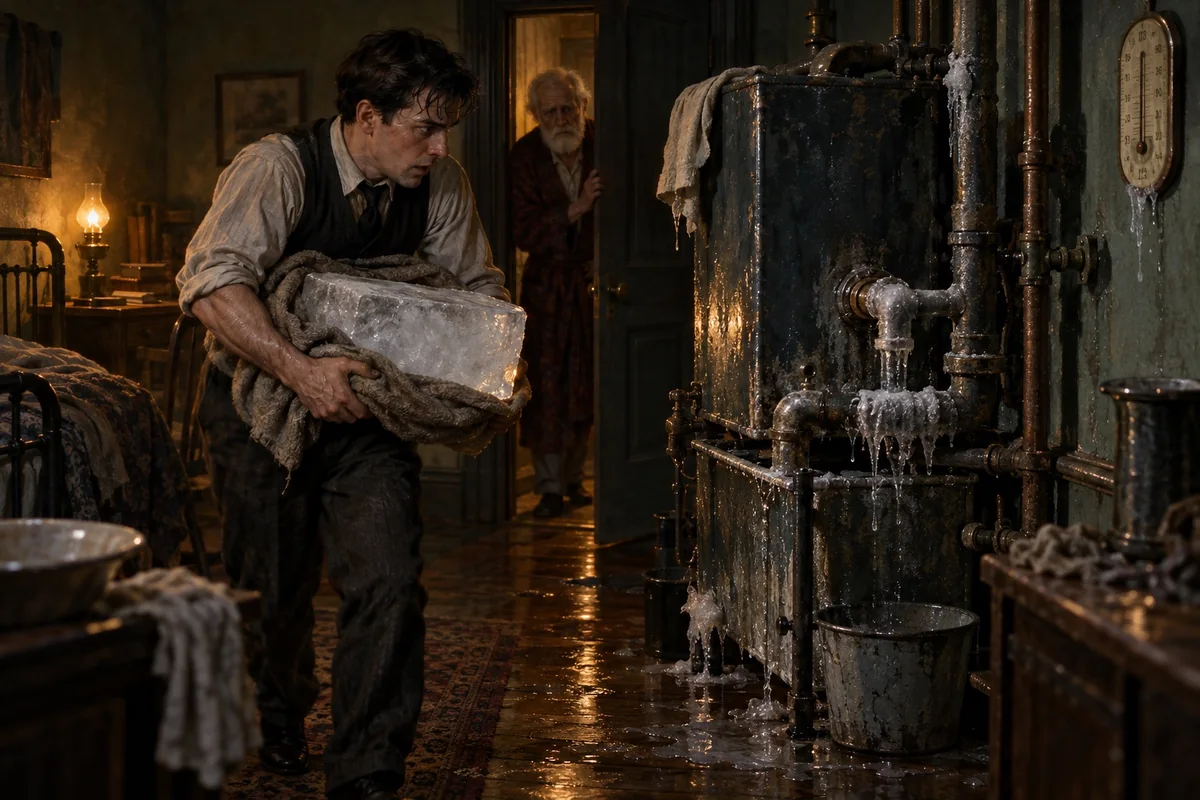
A replacement piston cannot be obtained until businesses open. Muñoz becomes frantic, bandages his face and retreats to the bathroom. The narrator begins collecting ice from establishments still open overnight.
The crisis depends on ordinary logistics: a machine part, store hours, transport and the availability of someone willing to carry supplies. Extraordinary survival has become vulnerable to a commonplace equipment failure.
Sources: [3]
The search through the city
By morning, the narrator needs both continued ice deliveries and a proper repair. Esteban refuses to help under his mother’s instructions. The narrator hires a man from the street to keep bringing ice and goes in search of the piston and workmen.
The errand takes hours. Around midday he finds a suitable supplier and returns at about half past one with the necessary part and two mechanics.
He has done what he can, but the delay has already become decisive. The hired helper has fled after looking into the bathroom, leaving the doctor without further ice.
Sources: [3]
The room in daylight
The house is in turmoil when the narrator returns. An overwhelming odor comes from behind the doctor’s locked door. Mrs. Herrero opens it from outside while the narrator and mechanics prepare to enter.
Inside, a dark trail leads from the bathroom to the hall door, then to the desk and finally the couch. What remains on the couch is left largely undescribed. A hastily written note on the desk explains the sequence.
The bright afternoon and street traffic continue outside. The setting refuses to isolate horror from everyday urban life: the catastrophe has occurred in a room above an ordinary crowded street.
Sources: [3]
The final explanation
Muñoz’s note says the tissues can no longer survive the rising temperature. His theory had sustained consciousness in a preserved body, but he had not anticipated the continuing deterioration.
The illness eighteen years earlier had actually ended in death. Torres had recovered and treated him under extraordinary circumstances, but his organs never resumed ordinary function. Artificial preservation had maintained the subsequent existence.
The narrator burns the note after reading it. He remains uncertain how to regard the experience afterward, but ammonia and cold air retain their terrible association. The ending retrospectively explains the physician’s condition without revealing a complete reproducible method.
Sources: [3]
Interpretation: care under material limits
In this encyclopedia’s reading, the relationship gives the final crisis emotional force beyond the revelation of an animated corpse. Muñoz is a skilled physician who helps the narrator, and the narrator’s loyalty is grounded in a real debt of care within the story.
The experiment’s failure comes through infrastructure as much as through forbidden knowledge. The doctor’s will remains intense, but it cannot replace a working pump, sufficient ice or another person willing to help.
The final note also changes the meaning of earlier observations. Coldness, unusual breathing, formal eating and chemical routines cease to be separate eccentricities and become parts of an effort to maintain a body after death. The horror lies in the collapse of that arrangement and the belated recognition of what the friendship has involved.
Sources: [3]
References
- H. P. Lovecraft Archive — fiction in composition order
Composition dates; question marks and ranges retain the source uncertainty.
- H. P. Lovecraft Archive — fiction in publication order
First publication dates and venues; issue dates can differ from actual release dates.
- Cool Air — Unspeakable Tales ebook
The fictional narrative is evidence for what the story says, not proof of events in the real world.
At a glance
H. P. Lovecraft
March 1926
1928, March
Tales of Magic and Mystery, 1, No. 4
Fiction