

New York
New York provides several distinct settings in Lovecraft’s fiction: the hidden Greenwich courtyards of He, the Brooklyn investigation of The Horror at Red Hook, and the boarding house of Cool Air. These stories use the city’s density, anonymity and layers of occupation in different ways, while often filtering its people through the narrators’ prejudices.
5 min read · 880 words
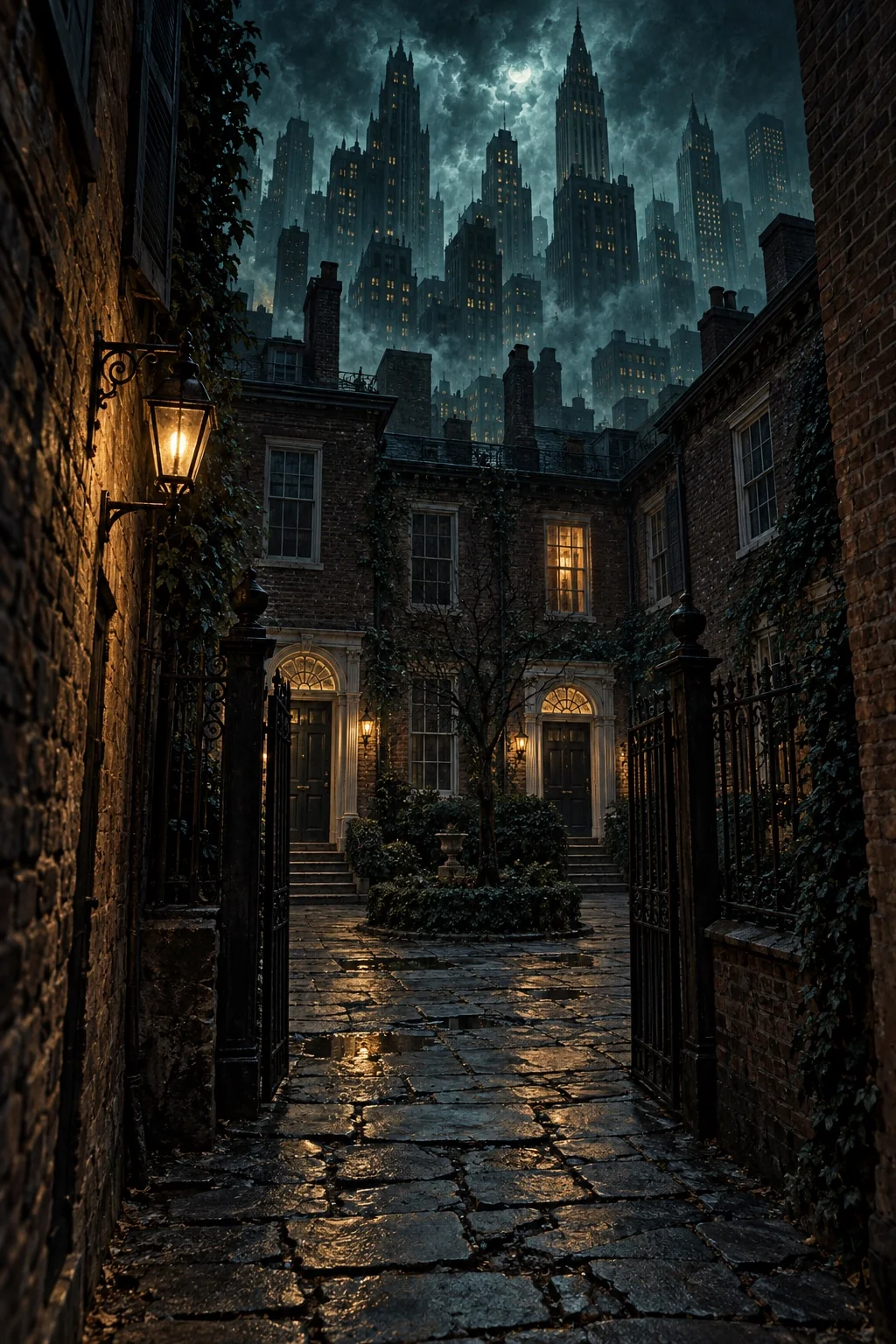
The city desired and rejected in He
The narrator of He arrives expecting the city to nourish his poetry. Seen at a distance and in favorable light, its towers suggest an almost fabulous landscape. Old lanes and Georgian buildings seem to promise an encounter with the past.
His disappointment is intensely subjective. He reacts to the city by withdrawing into night walking and by treating its inhabitants with racial contempt. The attractive architecture and his hostility toward the people around it become entangled in the same account.
This conflict prepares him to accept a stranger's offer of privileged access to older places. The search for a personally satisfying version of New York makes him susceptible to guidance whose danger he initially discounts.
Sources: He — Unspeakable Tales ebook
Greenwich and the disappearing route
The stranger meets him in the Greenwich district and leads him through courts, corridors and narrow passages. The route progressively defeats the visitor's geographical understanding. Lighting and architectural details seem to move backward through successive periods.
They reach a walled estate, presented as an old rural property engulfed by the expanding city. Inside, a library and family portraits appear to preserve an aristocratic past. The visitor believes he has reached what his wandering sought, but the residence also hides the violence by which its owner acquired knowledge.
The city contains the estate without making it readily accessible. The story's maze transforms historical survival into a secret held behind ordinary urban boundaries.
Sources: He — Unspeakable Tales ebook
Looking across time
At a window, the host reveals changing views: an earlier wooded and marshy landscape, an older Greenwich with distant steeples, and a terrifying city of monumental terraces and aerial movement. The narrator's longing to recover the past opens toward a much less welcome range of possibilities.
The final vision is described through the same racialized disgust that colors his account of contemporary New York. Its horror cannot be presented as a neutral prediction of urban history. It expresses what the narrator fears and what the magician forces him to see.
After the host's destruction and the building's collapse, the injured visitor is found near a court off Perry Street. The accessible city returns, but the route to the ordeal is lost.
Sources: He — Unspeakable Tales ebook
Red Hook and the police investigation
The Horror at Red Hook centers on detective Thomas F. Malone's investigation of Robert Suydam and a network of occult activity in Brooklyn. The story joins urban buildings to hidden passages, waterfront movement, disappearances and a ceremony beneath the visible district.
Its frame begins elsewhere: Malone is recovering in rural Rhode Island, where the sight of brick buildings triggers a severe reaction. That response ties his continuing trauma to a particular built environment rather than to a freely wandering apparition.
The official account of collapsing buildings does not encompass what Malone remembers below them. Investigation and public explanation diverge, leaving the reader with both the visible disaster and a much more disturbing private narrative.
The problem of the narrated neighborhood
Red Hook's description repeatedly associates immigrant communities with corruption and threat. Those sweeping judgments are part of the story's racist construction of urban fear, not reliable social evidence about the district or its residents.
The invented cult has particular actions within the plot. An account of those actions should not reproduce the narration's wider implication that foreign languages, poverty or ethnic difference are themselves evidence of supernatural danger.
The distinction is central to reading the setting: a real neighborhood is being transformed by a hostile literary gaze. Naming that transformation allows the work's mechanisms to be discussed accurately.
Cool Air’s boarding-house world
Cool Air reduces the scale to adjoining rooms in a West Fourteenth Street boarding house. The narrator first becomes aware of Dr. Muñoz through leaking chemicals from above. An urgent medical episode then leads him upstairs, where the apparently reclusive tenant saves him.
The doctor's dependence on refrigeration makes building services, machinery and deliveries essential. The relationship develops through assistance and gratitude, even though the narrator remains disturbed by his neighbor's physical condition.
New York's density makes this intimacy possible: a hidden experiment and an ordinary lodger occupy nearby rooms, with a landlady and her son supplying practical links between them.
Sources: Cool Air — Unspeakable Tales ebook
The city as a system of support
When the cooling apparatus fails, the narrator must seek help and obtain ice. The crisis depends on time, repair and access to supplies. Its final explanation gives the doctor's dependence a meaning far beyond an unusual sensitivity to heat.
This is a different city from the apparently limitless conspiracy of Red Hook or the temporal labyrinth of He. In Cool Air, the immediate urban world can offer useful assistance, but cannot indefinitely maintain the conditions of Muñoz's impossible survival.
Sources: Cool Air — Unspeakable Tales ebook
Three scales of urban horror
The three stories move from a private room to a neighborhood network to a vision spanning the city's past and possible future. Their common resource is layered occupation: people live close to histories, practices and experiences they do not fully perceive.
Their differences are equally important. Muñoz initially helps the narrator; the guide in He exploits his visitor's desires; Malone pursues a criminal and supernatural investigation. New York is a flexible narrative setting, not a single Mythos location governed by one entity or one kind of encounter.
Sources: Cool Air — Unspeakable Tales ebook, He — Unspeakable Tales ebook, The Horror at Red Hook — Unspeakable Tales ebook
References
- He — Unspeakable Tales ebook
The fictional narrative is evidence for what the story says, not proof of events in the real world.
- The Horror at Red Hook — Unspeakable Tales ebook
The fictional narrative is evidence for what the story says, not proof of events in the real world.
- Cool Air — Unspeakable Tales ebook
The fictional narrative is evidence for what the story says, not proof of events in the real world.
At a glance
New York City
Greenwich; Red Hook, Brooklyn; West Fourteenth Street
He; The Horror at Red Hook; Cool Air
Literary representations, with narrator prejudice attributed