

Herbert West—Reanimator
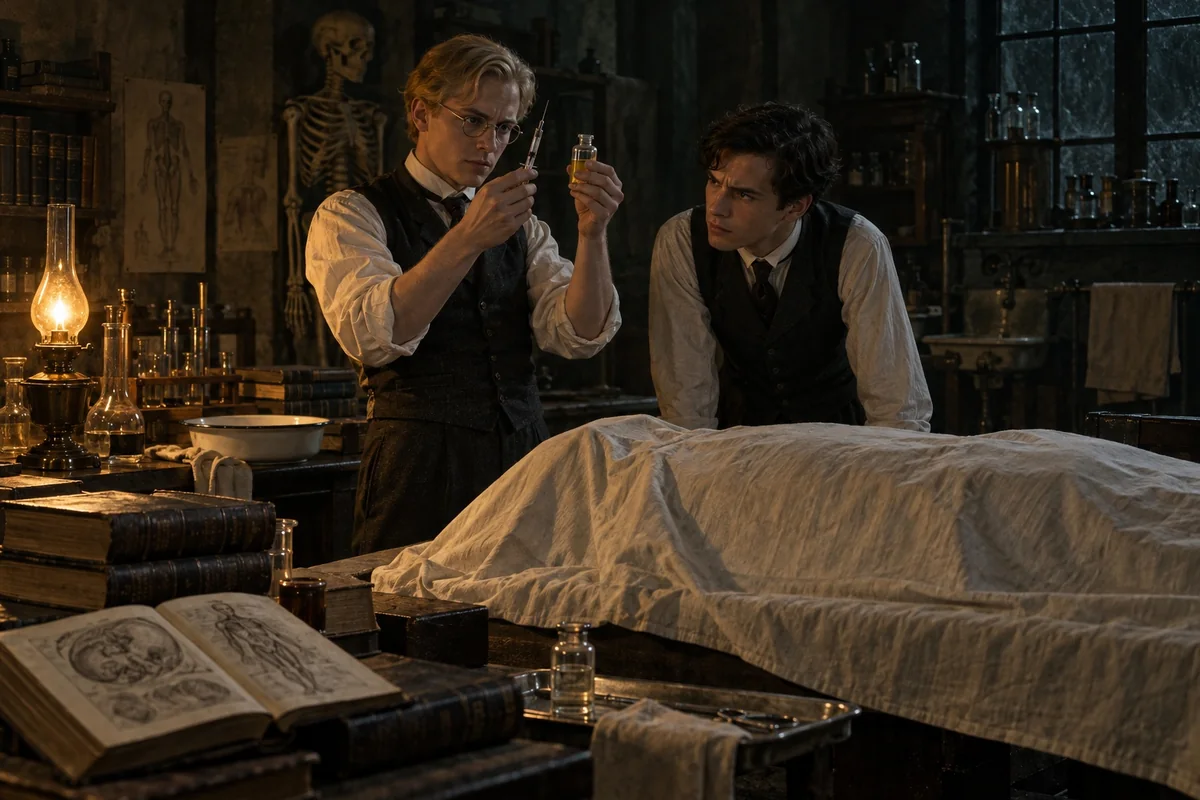
Herbert West—Reanimator is a six-part sequence tracing a physician’s attempts to restore movement and consciousness after death. First serialized in Home Brew from February to July 1922, it follows West and his unnamed assistant from medical school through a factory-town practice, wartime surgery and a final confrontation with the surviving products of their work.
8 min read · 1,659 words
Serialization and the shape of the narrative
Lovecraft composed the sequence from September 1921 into the middle of 1922. Home Brew published its six installments between February and July 1922.
Each section returns to the premise of reanimation and to the assistant’s fear of what has survived. The repetition belongs partly to the serial form: a new installment reorients the reader before introducing another experiment and a culminating shock.
The complete sequence also has a cumulative direction. An initial concern with whether the dead can move becomes a pursuit of rational speech, then of conscious activity in separated parts, and finally a fear that the experiments can organize their own response.
Sources: H. P. Lovecraft Archive — fiction in composition order, H. P. Lovecraft Archive — fiction in publication order, Herbert West—Reanimator — original text
The narrator and West’s theory
The unnamed narrator meets West at Miskatonic University Medical School and becomes his closest assistant. He shares much of West’s materialism while retaining some curiosity about whether a revived person might remember an existence beyond death.
West regards life as a physical and chemical process that can be restarted in sufficiently preserved tissue. Different organisms require different preparations, and damage to the brain becomes his main explanation for violent or unreasoning results.
The need for specimens creates the narrative’s escalating ethical problem. Restrictions first lead to clandestine work and grave robbery; later, the demand for absolute freshness leads to killing. The theory is fictional and does not provide a valid medical method.
I. From the Dark — the first human experiment
The medical school’s dean, Dr. Allan Halsey, forbids West’s work after numerous animal experiments. West and the narrator establish a concealed laboratory in the abandoned Chapman farmhouse beyond Meadow Hill.
They obtain the recently buried body of a drowned young laborer from the potter’s field. The first injection appears unsuccessful. While they prepare a modification in the adjoining room, a terrible cry erupts from the darkness where the body lies.
Both flee, overturning the lamp and setting the house on fire. Later newspaper reports describe the burned building and an attempt to claw into the newly disturbed grave. The experiment’s subject is not recovered, leaving West with a lasting fear of pursuit.
II. The Plague-Daemon — Halsey’s return
A typhoid epidemic overwhelms Arkham while West and the narrator undertake postgraduate work. Newly graduated, they help treat the population. Halsey becomes a public hero through exhausting service and dies in August.
West’s admiration does not stop him from obtaining the dean’s body. The experiment ends with the two assistants injured and the revived figure escaping through a window. They conceal the circumstances by claiming that an unknown drinking companion attacked them.
A series of killings follows. Searchers eventually capture the assailant, whose cleaned face resembles Halsey. The figure is confined at Sefton Asylum for sixteen years. West’s response is to blame insufficient freshness, treating the catastrophe as a technical failure rather than a reason to stop.
III. Six Shots by Midnight — the Bolton practice
The pair establish a practice among mill workers in Bolton and choose a house near the potter’s field. The professional work provides income and access, while their real interest remains the cellar laboratory.
After an illegal boxing match, they obtain the body of Buck Robinson. The experiment appears to fail, and they bury him in nearby woods. A child subsequently disappears, while the child’s mother dies in distress and the father threatens West.
When something rattles the back door at night, West expects a hostile relative or another ordinary visitor. Instead he sees the reanimated boxer with evidence of the missing child’s fate and fires every round in his revolver.
The episode’s treatment of Robinson is overtly racist, including dehumanizing description and unsupported assumptions about racial differences in the preparation. Those elements belong to the narrator’s and story’s prejudice, not to a biological explanation this encyclopedia adopts.
IV. The Scream of the Dead — freshness at any cost
In July 1910 the narrator returns from visiting his parents to find West excited about a new preservation compound. A man identified as Robert Leavitt of St. Louis lies in the laboratory, supposedly having died suddenly after asking directions to the mills.
West claims the new treatment kept the body fresh while awaiting the assistant’s return. During the preparation he briefly covers the subject’s face with a pillow-like object. The subsequent reanimation produces the rational speech he has long sought.
The revived man’s final terrified words identify West and his needle as the threat from which he was trying to escape. The narrator realizes the subject was alive when obtained and that the experiment’s freshness was secured through murder. The horror shifts decisively from the imperfectly revived body to the researcher’s deliberate conduct.
V. The Horror from the Shadows — experiments in Flanders
In 1915 West serves as a Canadian army medical officer in Flanders, taking the narrator with him. The assistant attributes his enthusiasm chiefly to the supply of recently killed and mutilated bodies.
West now studies activity in separated parts and the possibility of a continuing relationship between them. Reptilian embryonic tissue provides another experimental material. His public surgical work coexists with a concealed program that treats the battlefield’s dead as opportunities.
Major Sir Eric Moreland Clapham-Lee, a surgeon familiar with West’s ideas, dies in an aircraft crash. West separates the badly damaged head, preserves it apart and reanimates the body. The headless body moves as though repeating the struggle to escape the falling aircraft, while a warning to the pilot comes from the detached head’s location.
Shellfire destroys the building at that moment. West and the narrator survive, but the destruction prevents them from establishing what became of the experiment. The possibility of a revived colleague who understands the method becomes a new source of fear.
VI. The Tomb-Legions — the Boston laboratory
West’s later home overlooks an old Boston burying ground. A concealed sub-cellar contains an incinerator intended to destroy experimental remains. During construction, workers uncover old masonry apparently connected with the Averill tomb; West has it left intact and plastered over.
A newspaper report describes a group entering Sefton Asylum and demanding the long-confined figure from Arkham. Their leader wears a military uniform and an artificial face, with a voice apparently connected to a case he carries. Violence follows, and the captive is released.
The report terrifies West. A box then arrives addressed from Clapham-Lee at St. Eloi. West and the narrator burn it unopened. The story never discloses its contents, and the assistant later rejects the suspicion that he incinerated West’s body.
The final breach
Plaster falls from the wall covering the older masonry. A group of humanlike and partly human forms opens a passage stone by stone and enters the laboratory, led by a figure in Canadian uniform with a wax head.
The group seizes West, dismembers him and carries the remains into the opening. The leader takes his head. West, usually outwardly controlled, shows unmistakable terror at the end.
The narrator is found unconscious the next morning. Police discover only unidentifiable ashes in the incinerator and an apparently intact wall where he describes the breach. West is missing, while the surviving witness faces suspicion of madness or murder.
A progression of experiments
The six installments distinguish several kinds of result. Movement alone appears early; coherent consciousness is harder to recover; separated parts later exhibit activity suggesting retained memory or coordination.
West repeatedly explains earlier failures through deterioration of tissue. Once he obtains a rational response, however, his work does not settle into a humane program of recovery. The narrator describes an increasing appetite for grotesque experimentation and a calculating interest in healthy living people, including himself.
The development therefore undermines the researcher’s claim that a clear scientific goal justifies each successive violation. Achieving one goal becomes permission to seek another.
The returning subjects
The sequence’s final threat depends on what earlier experiments left unresolved. The first body was never recovered, Halsey remained confined rather than dead, and shellfire left Clapham-Lee’s fate uncertain.
The returning group is heterogeneous. The text does not identify every member individually or establish a complete roster. The military leader and the Sefton prisoner provide the strongest links to earlier installments.
Their coordinated behavior reverses West’s treatment of bodies as separate materials under his control. The objects of experiment appear capable of acting together, while the scientist can no longer dictate either the conditions or the outcome.
The assistant’s responsibility
The narrator increasingly fears West and eventually suspects he could become a specimen. Yet he has also helped choose sites, obtain bodies, conduct experiments and conceal consequences.
His retrospective horror does not erase that participation. The story makes him both the surviving source of information and a person with reasons to distance himself from the worst acts.
The final police suspicion intensifies that problem. His account may describe an extraordinary revenge, but the physical evidence available to the authorities does not neatly confirm it. The narration ends with fear rather than a publicly accepted explanation.
Relationship to the films
The 1985 Re-Animator and its sequels develop their own plots, characters and visual conventions from the reanimation premise. The original sequence unfolds across years and several locations rather than within one continuous modern medical-school crisis.
Lovecraft does not specify the familiar glowing-green screen serum as a defining property of every preparation. West’s formulas change, and the experiments’ narrative importance lies in the varying results and escalating acquisition of bodies.
The article’s links separate the literary sequence, West as a character and individual film continuities so that a memorable adaptation detail does not become an unqualified statement about the 1922 text.
Interpretation: success without a stopping point
In this encyclopedia’s reading, the sequence is not simply about a scientist whose formula never works. It repeatedly works in limited and increasingly consequential ways.
The central failure is the absence of a meaningful stopping point or responsibility toward the people transformed. West’s explanations become more precise while his ethical restraint diminishes. The assistant recognizes that change but remains involved.
The final return makes the consequences cumulative. A discarded or hidden experiment does not necessarily cease to exist when the scientist turns to the next problem, and the last installment gathers that unresolved past around him.
References
- H. P. Lovecraft Archive — fiction in composition order
Composition dates; question marks and ranges retain the source uncertainty.
- H. P. Lovecraft Archive — fiction in publication order
First publication dates and venues; issue dates can differ from actual release dates.
- Herbert West—Reanimator — original text
The fictional narrative is evidence for what the story says, not proof of events in the real world.
At a glance
H. P. Lovecraft
September 1921–mid 1922
1922, February–July
Home Brew, 1, No. 1–6
Fiction