
The Book
The Book is an unfinished account of a reader whose discovery of an anonymous manuscript opens successive passages beyond familiar space and time. Its narrator has gained extraordinary perception at the cost of a stable identity and an ordinary relation to the world. The surviving text leaves both the book’s title and the final outcome unknown.
3 min read · 491 words
Composition and publication
The composition date is uncertain: the Archive's chronology gives late 1933 with a question mark. The fragment first appeared in Leaves, number 2, in 1938, on pages 110–112.
It begins with a voice uncertain about memory, identity and even the means by which the message is being communicated. That disturbed present frames a recollection of the discovery that started the narrator's experiences.
The anonymous manuscript
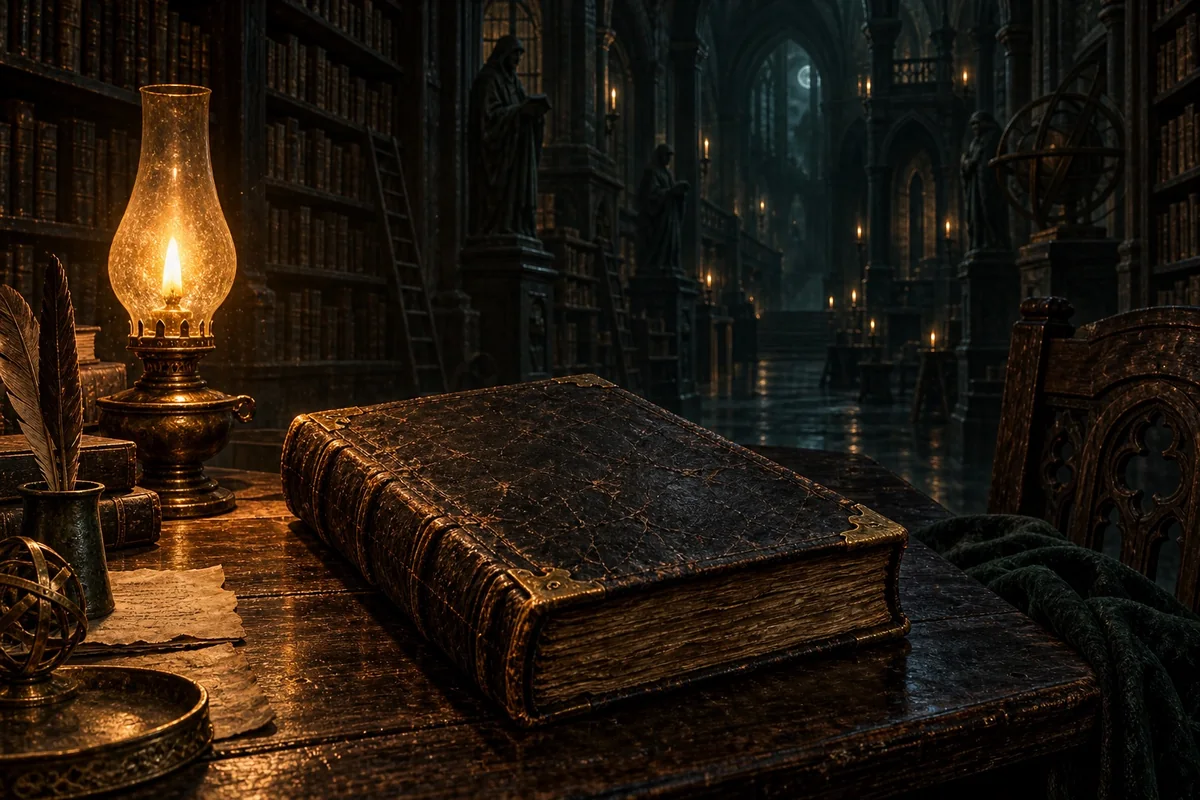
The narrator finds the volume among decaying books in an old shop near a dark river. Its first pages are missing, so he never learns its title. The text is handwritten in Latin rather than printed.
Recognizing a formula connected with forbidden transitions, he carries it away. The shopkeeper refuses payment and responds with unsettling amusement and a gesture whose significance becomes apparent only later.
The book is not explicitly called the Necronomicon. Its language, age and effects do not justify supplying that title where the narrator says the identifying pages are absent.
Sources: [3]
The first threshold
Back in an attic used for private study, the narrator reads by candlelight. The household and the date are already difficult for his later self to remember.
The recitation is accompanied by sounds at a high window. He understands that crossing a threshold brings an accompanying shadow and ends the possibility of being wholly alone.
The next morning the room remains recognizable in outline, but perception has changed. Past and future intrude into present objects. Other people do not share what he sees, while dogs react to the presence that accompanies him.
Sources: [3]
Knowledge that dissolves familiarity
The narrator continues reading and crossing further boundaries. Expanded sight leads him to additional hidden texts, so the change feeds the desire for more change rather than ending in immediate withdrawal.
One journey carries him above unfamiliar mountains and into a region of strange stars. He approaches a city on a green-lit plain and becomes terrified by a large square building.
After struggling against the approach, he returns to the attic. The episode makes him more cautious because he fears becoming permanently separated from his body and Earth. It does not identify the city or explain the precise danger associated with the building.
Sources: [3]
The unfinished frame
The fragment ends with that increased caution. It does not show the later event that apparently produced the confused opening voice, nor does it establish whether the narrator has become a ghost, an alien or a disembodied consciousness.
Its sustained subject is the changing cost of access. Each new perspective makes ordinary reality less available as a stable home, while the book remains a route toward further experience. Related stories about forbidden texts and dimensional travel illuminate that pattern without supplying the missing conclusion.
Sources: [3]
References
- H. P. Lovecraft Archive — fiction in composition order
Composition dates; question marks and ranges retain the source uncertainty.
- The Book — publication data
- The Book — original text
The fictional narrative is evidence for what the story says, not proof of events in the real world.
At a glance
H. P. Lovecraft
late 1933?
1938
Leaves, 2
Fragment / unfinished fiction