

The Colour out of Space
A meteorite falls beside a New England farmhouse, and the land begins producing abundant but poisonous growth. As the Gardner family and its surroundings deteriorate, the neighboring farmer Ammi Pierce witnesses a form of life that can be recognized through its effects but never comfortably described in human terms.
12 min read · 2,372 words
Composition, publication and the surveyor’s frame
Lovecraft wrote The Colour out of Space in March 1927. Amazing Stories published it in September of that year. The tale combines a rural history of suffering with a science-fictional arrival from outside Earth, while withholding the familiar bodily outline that would make its intruder easy to picture.
An unnamed surveyor narrates the frame. He has entered the country west of Arkham in connection with a proposed reservoir and encounters a desolate patch known as the blasted heath. Local reluctance to discuss the place directs him toward the elderly Ammi Pierce.
Most of the story is Ammi’s account of events beginning with the meteorite’s fall in June 1882. The surveyor did not witness those events. He can compare the account with the surviving landscape and his own impressions, but the principal history reaches the reader through a neighbor remembering a disaster many years afterward.
The reservoir gives that remembered disaster a future consequence. Flooding the valley may conceal the visible scar, yet the narrator is unwilling to drink the water. The frame converts an apparently local and completed event into a question about what may still remain beneath the ground.
Sources: H. P. Lovecraft Archive — fiction in composition order, H. P. Lovecraft Archive — fiction in publication order, The Colour Out of Space — Unspeakable Tales ebook
The meteorite at the Gardner farm
The object falls near Nahum Gardner’s well, attracting investigators from Miskatonic. Its appearance and behavior immediately resist ordinary explanation. It remains hot, changes in size and reacts unpredictably when samples are examined. The scientists can perform tests, but the results do not fit their established categories.
Within the material they find a globular inclusion associated with an unfamiliar color. The story describes the color by stressing the inadequacy of known hues rather than by giving it an ordinary place in the spectrum. When the inclusion is opened, the material does not behave like a stable mineral specimen that can simply be cataloged and stored.
The meteorite continues to diminish. A storm and repeated lightning strikes remove what remains at the site, leaving the investigators without the original object for further study. The absence of a durable specimen becomes crucial: the later effects persist after the most obvious candidate for scientific examination has vanished.
The arrival is therefore both physical and elusive. The ground is struck, people handle samples and instruments produce observations, yet the object refuses to remain a stable body of evidence. The story establishes the limits of the investigation through events rather than merely declaring the phenomenon indescribable.
Unnatural abundance
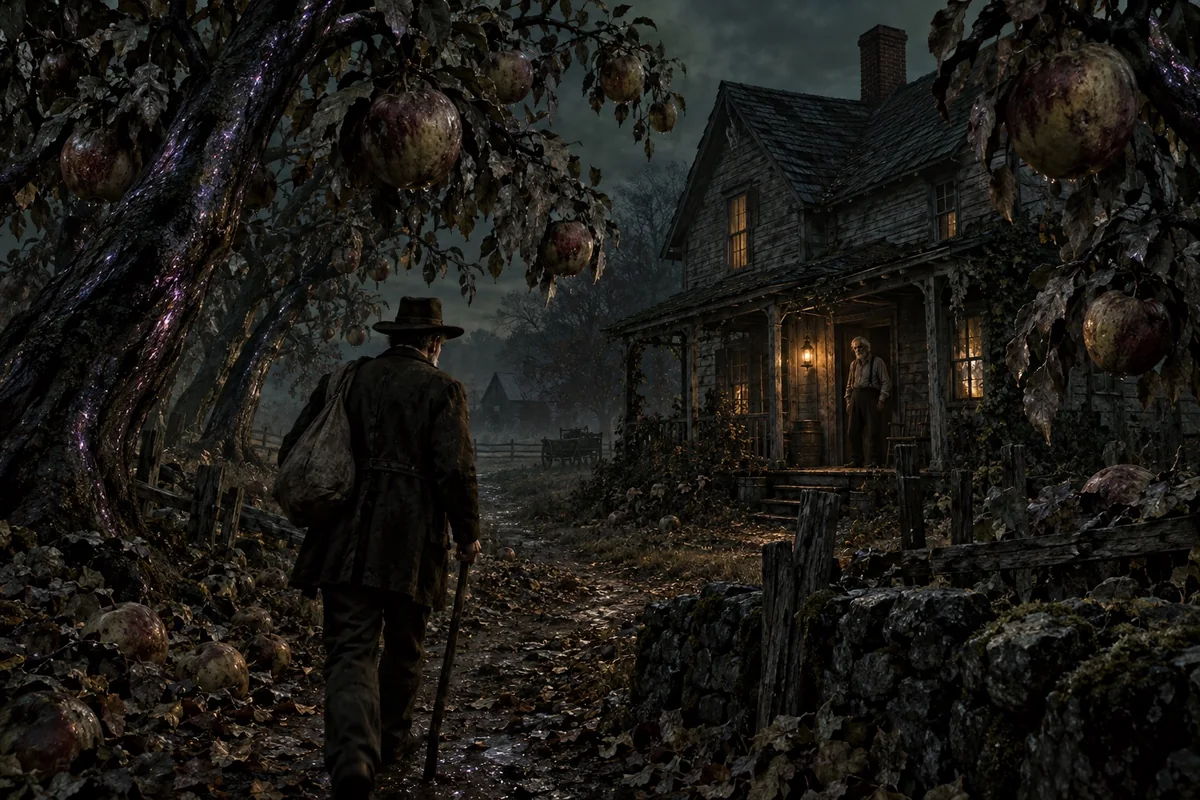
At first the farm seems unusually productive. Crops and fruit become large and visually impressive. This apparent benefit is overturned by their taste and quality: the growth cannot be used as ordinary food. Abundance has become a misleading sign of health.
Changes spread beyond cultivated plants. Wild animals look or behave strangely, and the local environment develops patterns that disturb observers familiar with it. The effect is gradual enough that individual incidents can initially be treated as curiosities or exaggerations.
The seasonal progression matters. The farm does not transform all at once into a visibly alien landscape. It passes through growth, winter changes, a disturbed spring and accelerating decline. That duration lets the family continue living within the danger while hoping that each stage may be temporary.
The color seen in the meteorite returns as a point of comparison for altered vegetation and later luminosity. It is not a decorative tint added to unrelated events. It acts as a recurring sign that connects the apparently separate changes in plants, animals, people and the well.
The household becomes isolated
Nahum and his family remain at the farm while neighbors increasingly avoid it. The land is their home and livelihood, and the changes develop through circumstances that are difficult to explain or reverse. Isolation grows as both the environment and the inhabitants become more disturbing to outsiders.
Ammi continues visiting longer than others. He performs errands and maintains a personal connection even when the farm’s condition frightens him. That loyalty gives him access to the family’s deterioration and makes him the witness through whom its history survives.
The household’s capacity to respond weakens. Nahum becomes less able to reason effectively about the danger or act on advice. The story suggests that whatever affects the farm also interferes with the will to leave it. The family’s continued residence should not be reduced to a simple decision made by people who remain otherwise unaffected.
This is one of the tale’s sources of pathos. The victims are not ambitious sorcerers attempting a forbidden experiment. They are a farming family whose ordinary life is overtaken by a process they did not invite and cannot understand.
Nabby and the sons
Nahum’s wife Nabby deteriorates mentally and physically. Her behavior frightens the children, and she is eventually confined in the attic. The response reflects the household’s inability to obtain a useful explanation or adequate help; confinement does not stop what is happening to her.
Thaddeus, the middle son, is especially sensitive to the changes around the farm. He insists that the trees move when there is no wind. After an encounter associated with the well, he too becomes disturbed and is confined upstairs. His later death leaves remains whose condition resembles the destructive changes already seen in animals.
Merwin, the youngest, disappears after going out at night. Zenas, the eldest, becomes increasingly vacant and then also vanishes. Nahum continues speaking as if Zenas can respond to his orders, showing how far his own understanding has broken down.
The sons’ fates are not interchangeable. The narrative gives each a different place in the family’s progression from fear through incapacity to disappearance. The later search of the well recovers evidence of what happened to the missing boys, connecting the household’s losses with the site beside which the meteorite first fell.
The well and the pattern of deterioration
Ammi notices that the well water has acquired an unpleasant and unfamiliar taste. He advises Nahum to establish another source on higher ground. Nahum does not effectively follow the suggestion, and the existing well remains central to the household’s daily life.
The well is more than a possible delivery route for ordinary contamination. It becomes associated with light, sounds, disappearances and the apparent retreat of the phenomenon after feeding. The story joins a practical necessity of farm life to a hidden place that the family cannot inspect safely.
Vegetation eventually crumbles into gray material. Animals become brittle and disintegrate, and similar destruction overtakes people. The process seems to draw something out of living matter rather than merely wound bodies from outside. Nahum’s final attempts to describe it emphasize burning, taking and an inability to get away.
The text invites comparisons with poisoning and disease, but the officials’ later deliberations cannot produce an adequate ordinary explanation. A metaphor of contamination can help interpret the tale without turning the fictional process into a diagnosed real illness.
Ammi’s last visit to Nahum
After a period without contact, Ammi returns to the farm and finds Nahum in a cold house, unable to give a coherent account of the remaining family. Nahum speaks of people as though their presence and absence no longer have stable meanings. Ammi must search rather than rely on his answers.
In the attic he encounters what remains of Nabby. The narration withholds the fullest physical description, emphasizing Ammi’s refusal to recount everything. His actions are likewise conveyed indirectly, allowing the reader to understand the extremity of the situation without a detailed procedural account.
When Ammi comes downstairs, Nahum himself is undergoing the destructive change. His broken speech connects the well, the meteorite and the family’s deaths. The final account is not a calm scientific explanation; it is the dying witness’s effort to name a process that has already damaged his ability to speak and think.
Nahum collapses into brittle remains. Ammi covers what is left and escapes by a route that avoids the well. His horse has already fled. The visit ends the household’s personal story while leaving the force responsible still active at the property.
The authorities examine the farm
Ammi reports the deaths and disappearances, bringing officers and other officials to the site. Their presence broadens the final event beyond his solitary testimony. They inspect the bodies and the well, finding remains associated with Merwin and Zenas.
The men consider possible causes but cannot make the evidence fit an ordinary explanation. Spoiled crops alone cannot account for all the affected life, and the condition of the bodies presents further problems. The investigation is not portrayed as complete indifference: the available categories fail while the men are still trying to use them.
As darkness falls, luminosity increases around the well and spreads through the property. The altered color connects the scene with the earlier meteorite inclusion. What had been inferred from aftermath and decay becomes an active display in front of several witnesses.
The men remain in the house longer than is safe, partly because they do not understand what they are seeing and partly because the phenomenon seems to exert a disturbing influence. Their own indecision begins to resemble the inability to leave that marked the Gardner family’s decline.
The departure into the sky
The light intensifies across the buildings and vegetation. Trees move in ways the witnesses cannot attribute to the wind. The surrounding world seems to be concentrating around the well and the force within it. The scene culminates in an upward movement that tears away from the farm toward the sky.
The witnesses flee. The event destroys much of the property and leaves the desolate ground later seen by the surveyor. Its direction suggests departure from Earth, but the story does not supply a spacecraft, an identifiable pilot or a spoken statement of purpose.
Ammi looks back and sees a smaller remnant fail to complete the ascent and fall again toward the well. This detail prevents the apparent departure from becoming a secure resolution. The destructive process may have left something behind that continues to affect the land.
The surviving scar and its reported gradual enlargement support that final uncertainty. A single cosmic visitation has become a persistent local condition, and the passage of decades has not restored the place to ordinary fertility.
What the colour is and what remains unknown
The narrator concludes that the phenomenon comes from outside the familiar order of terrestrial matter and life. It behaves as something capable of occupying an environment, drawing upon living things and eventually departing. Calling it merely a color is explicitly inadequate, yet color is the nearest perceptual category the witnesses can supply.
The story does not give it a human-like motive, a cult, a genealogy or a conversation with its victims. There is no demonstrated desire to punish the Gardners for wrongdoing. Its effects can be read as the activity of an organism whose needs are catastrophically incompatible with the surrounding ecology.
That relative absence of malice is part of the horror. The family’s suffering does not depend on its importance to an intelligent enemy. A process arriving from elsewhere can destroy a household as an incidental consequence of its presence.
Descriptions in later games and adaptations may give the phenomenon a more defined appearance or set of abilities. Those versions can be useful in their own contexts, but the original tale’s central achievement is a being represented through changes it causes rather than through a stable anatomy.
Ammi, memory and the reservoir
Ammi survives but refuses to return to the farm. Other witnesses disappear from the available record through death or unwillingness to speak. The surveyor receives the history when its surviving human source is already old and vulnerable.
The frame therefore makes preservation of memory part of the problem. The land visibly records damage, but without Ammi the sequence linking that damage to the meteorite and family could be lost. The surveyor’s narrative preserves an explanation that the surrounding community has not integrated into ordinary public knowledge.
The reservoir promises physical concealment. It will cover the heath and remove the most conspicuous reminder of the event. Yet water is precisely what the narrator distrusts, because the well remained associated with the surviving remnant. The planned improvement of the landscape may distribute unease rather than extinguish it.
The ending leaves Ammi as a person to be watched with care, not merely a source whose testimony has been extracted. His age, isolation and fixation on the continuing growth of the blighted area keep the human cost present after the cosmic event has passed.
Ecological horror and the story’s structure
The tale’s progression begins with abundance and ends in sterility. Enlarged fruit, abnormal growth and unusual luminosity appear as positive intensifications before revealing destructive consequences. The familiar signs of a productive farm become unreliable indicators.
The household and landscape deteriorate together. There is no clean boundary between a monster’s lair and the victims’ home because the process occupies soil, water, vegetation, livestock and bodies. The farm itself becomes the medium through which the encounter unfolds.
The frame’s distance deepens rather than weakens the effect. The reader knows from the start that the household is gone and the land remains damaged. Suspense concerns how those conditions came about and whether the apparent past is actually over.
A close reading can therefore treat the story as ecological and cosmic horror at once. The threat comes from beyond Earth, but its force is experienced through the ordinary systems that sustain a small place: food, water, work, family care and neighborly contact.
Adaptations and connected entries
Several films reshape the premise in different settings. Die, Monster, Die! (1965), The Curse (1987), Die Farbe (2010) and Color Out of Space (2019) have separate entries with their production information and source relationships. Their visual strategies necessarily choose ways of showing a phenomenon the prose defines partly through the inadequacy of ordinary sight.
The 2019 film, directed by Richard Stanley, develops its own Gardner family and contemporary setting. Huan Vu’s Die Farbe uses a different historical and geographical framing. These are adaptations of the central situation rather than interchangeable records of the same fictional events.
Within the literary wiki, the entity entry follows the phenomenon’s properties, the blasted heath entry focuses on the damaged site, and the pages on Nahum Gardner and Ammi Pierce distinguish victim and witness. The story article keeps the seasonal development and the sequence of losses together, because their accumulation is the principal form of the horror.
Sources: The Colour Out of Space — Unspeakable Tales ebook, Die, Monster, Die! (1965) — credits, synopsis and release history, The Curse (1987) — credits, synopsis and release history, Die Farbe (2010) — credits, synopsis and release history, Color Out of Space (2019) — credits, synopsis and release history
References
- H. P. Lovecraft Archive — fiction in composition order
Composition dates; question marks and ranges retain the source uncertainty.
- H. P. Lovecraft Archive — fiction in publication order
First publication dates and venues; issue dates can differ from actual release dates.
- The Colour Out of Space — Unspeakable Tales ebook
The fictional narrative is evidence for what the story says, not proof of events in the real world.
- Die, Monster, Die! (1965) — credits, synopsis and release history
- The Curse (1987) — credits, synopsis and release history
- Die Farbe (2010) — credits, synopsis and release history
- Color Out of Space (2019) — credits, synopsis and release history
At a glance
H. P. Lovecraft
March 1927
1927, September
Amazing Stories, Vol. 2, No. 6
Fiction