

Colour out of Space
The colour is the extraterrestrial or extra-cosmic presence associated with the meteorite that falls on Nahum Gardner’s farm in The Colour out of Space. Perceived through an indescribable hue, it alters the surrounding environment, consumes or drains living things and finally rises from the farm’s well, leaving evidence that some portion remains.
7 min read · 1,401 words
Why it is called a colour
The name reflects the limits of the observers’ vocabulary. The unusual bands seen in the meteorite’s spectrum and the later appearances in vegetation and vapor do not correspond to familiar terrestrial colors. Characters call the phenomenon a color by analogy, not because they have securely classified it as an ordinary optical effect.
The surveyor eventually suggests that, in terms of matter, something like a gas might be the closest description. He immediately qualifies that comparison by saying its behavior does not obey the expected laws. The story never supplies a stable humanoid body or a conventional animal anatomy.
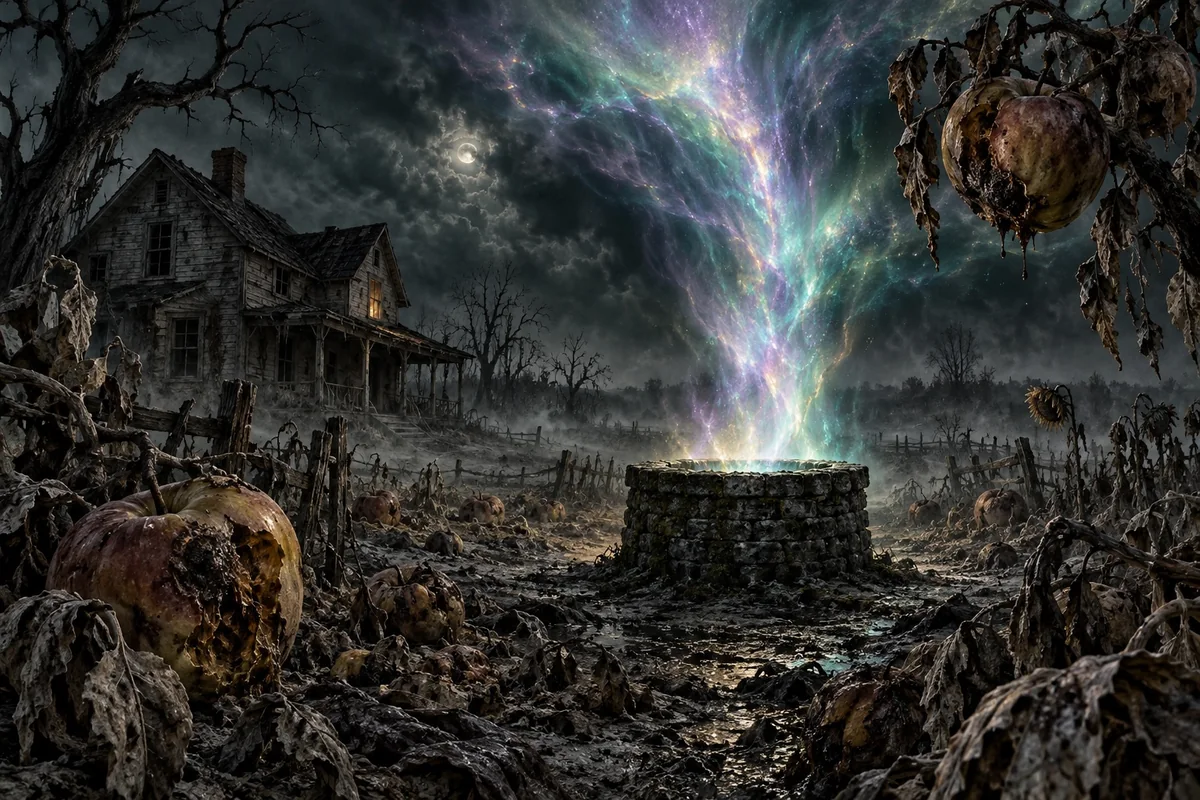
An illustration must therefore translate an impossible perception into visible colors. Violet, green or iridescent effects are artistic choices; none is a canonical wavelength specified by Lovecraft.
Arrival in June 1882
The immediate history begins with an aerial disturbance and a meteorite falling beside the Gardner well in June 1882. The mass remains hot, glows faintly and diminishes in size while the university investigators study it.
An embedded, glossy globule displays the same unplaceable hue later associated with the catastrophe. A hammer blow breaks it with a small pop, leaving a hollow space. No visible substance emerges at that moment.
The relationship between this globule and the later presence is reconstructed from repeated appearances of the color and the dying farmer’s testimony. The story strongly associates the arrival with the meteorite but does not show a labeled organism emerging in a form that the investigators recognize.
The meteorite under examination
The material is soft enough to be gouged, malleable, magnetic, persistently hot and resistant to the investigators’ reagents. Its spectrum includes unfamiliar bands. Specimens steadily diminish without leaving an ordinary residue.
One sample disappears together with the glass vessel containing it, leaving a charred mark. The scientists discuss an affinity with silicon compounds, while further testing fails to identify the substance. A later storm repeatedly strikes the remaining mass at the farm, after which it is gone.
These observations concern the carrier material and its samples. They should not all be converted without qualification into biological abilities of the developed presence. The story links them through origin and color while preserving uncertainty about exactly what arrived.
Growth that initially resembles abundance
The first major agricultural effect appears beneficial. Fruit grows unusually large, glossy and plentiful. At ripening, however, it proves bitter and repellent, making the harvest useless.
The next spring brings premature growth and increasingly unfamiliar hues. Flowers, orchard blossoms and other plants appear distorted or chromatically wrong. The family connects those colors with the globule exposed inside the meteorite.
The process moves from excessive apparent vitality toward exhaustion. Plants eventually turn gray and brittle and break into powder. The sequence suggests exploitation of living material rather than simple fertilization or an ordinary seasonal blight.
Animals and altered behavior
Wildlife around the farm begins behaving or appearing abnormally. Tracks seem wrong to Nahum, a rabbit’s leaps alarm Ammi and his horse, and a hunted woodchuck is described as altered in proportion and expression.
Domestic animals become frightened, ill or unmanageable. The horses stampede and later have to be killed; dogs and cats leave; livestock develop disturbing bodily changes. Swine and cattle eventually share the gray brittleness also affecting vegetation.
The cases do not fit a simple explanation through eating contaminated crops. Some animals have not consumed the altered plants, and the locked barn shows no ordinary route for a biting predator. The witnesses therefore struggle to connect the symptoms through familiar veterinary categories.
Attention, exhaustion and loss of initiative
The Gardner family becomes increasingly withdrawn and physically unwell. Members develop a habit of listening for something they cannot identify. Periods of diminished awareness increase, while the ability to respond decisively to danger weakens.
Nahum continues using the bad well water after Ammi advises another supply. He recognizes that the farm is changing but becomes resigned to conditions he would earlier have challenged. His final speech describes an influence that first overcomes the mind and then takes its victim.
The account supports a pattern of mental as well as bodily depletion. It does not supply a precise range, dosage or universal rule explaining which visitor must become affected after how many minutes.
The well as a focus
The meteorite falls beside the old well, and the later water becomes unpleasant. Thaddeus is terrified after looking down it. Merwin and Zenas disappear in connection with visits there, and their remains are eventually recovered from the bottom.
The investigators also find animal bones. The mud beneath the low water seems porous and bubbling, and a long pole fails to reach a firm bottom. During the final evening a column of the unknown luminosity rises from the shaft.
The well functions as both a household necessity and an apparent refuge or feeding center. Its danger is difficult for the family to avoid because water is part of daily survival, and their weakening initiative makes changing that routine harder.
A presence moving through the house
In the attic, Ammi experiences a clammy movement of vapor and a momentary appearance of the familiar color. Shortly afterward he hears sounds below and finds Nahum undergoing rapid collapse and disintegration.
The account does not present a clear outline crossing every intervening space. Ammi reconstructs the sequence from what brushes him, the sounds he hears, Nahum’s condition and a splash outside. His horse has fled, but no displaced stone explains the splash in the well.
The implied movement makes walls and locked rooms an inadequate protection. It also preserves a troubling difference between direct observation and inferred passage: Ammi encounters effects in sequence without obtaining a complete view of the agent.
Feeding as the witnesses’ explanation
Nahum describes something that consumes the life of the farm and grows stronger. Ammi adopts that explanation when the well begins shining before the officials. Both connect the process with the meteorite’s globule and the family’s decline.
Their language of feeding organizes the evidence, but it is not a laboratory account of metabolism. The suggestion that the globules were seeds and that more than one developed remains a hypothesis advanced within the narrative.
The presence also affects organic material after ordinary life has ended, including the house’s woodwork and furnishings. That wider spread complicates a simple model of an animal that merely eats living prey.
The departure
On the final night, treetops move despite the absence of wind and develop points of the same strange radiance. The well’s luminosity intensifies, while buildings and objects on the farm begin shining.
The witnesses escape by the rear path. From higher ground they watch the color rise abruptly into the sky, passing through a round opening in the clouds. Ammi looks toward Cygnus and Deneb as it vanishes into the Milky Way.
This direction is a sightline in the witness’s experience, not a confirmed home planet. The story does not establish that the being originated specifically on Deneb or in a named stellar civilization.
The remnant and continuing blight
After the main departure and the farm’s destruction, Ammi sees a weaker portion rise and sink back. No one else in the party reports that final observation. It becomes the basis of his belief that something remains in the well.
The site stays gray and barren. Later local reports describe subtle spread, abnormal plants, tracks and distressing dreams. The surveyor’s own discomfort and the unusual appearance of sunlight near the well make him reluctant to dismiss the story.
The future reservoir will cover the site, but neither witness demonstrates that water will destroy the remnant. The final fear concerns concealment and continued influence, including the possibility that the city’s new supply will connect the hidden place with its inhabitants.
A threat without a human motive
The narrative does not reveal a plan to conquer Arkham, a cult commanding the color or a moral judgment selecting the Gardners. Nahum wonders whether the disaster is punishment but cannot identify an offense that would explain it.
In this encyclopedia’s reading, the horror depends partly on that absence of a human-scale motive. Ordinary efforts to farm, investigate, help a neighbor or obtain water bring people into contact with a process that may not recognize them as persons.
The story’s language often attributes hostility to the landscape, yet the evidence supports destructive contact more clearly than deliberate humanlike malice. Its alien quality lies in the failure of familiar categories to explain what the witnesses survive.
References
- The Colour Out of Space — Unspeakable Tales ebook
The fictional narrative is evidence for what the story says, not proof of events in the real world.
At a glance
The Colour out of Space
Associated with a meteorite, June 1882
Nahum Gardner’s farm, west of Arkham
An unfamiliar color; luminous or vapor-like manifestations
Abnormal growth, altered behavior, gray brittleness and disintegration
The old farm well
A luminous ascent followed by destruction of the farm
Ammi reports a portion sinking back into the site