

Arkham
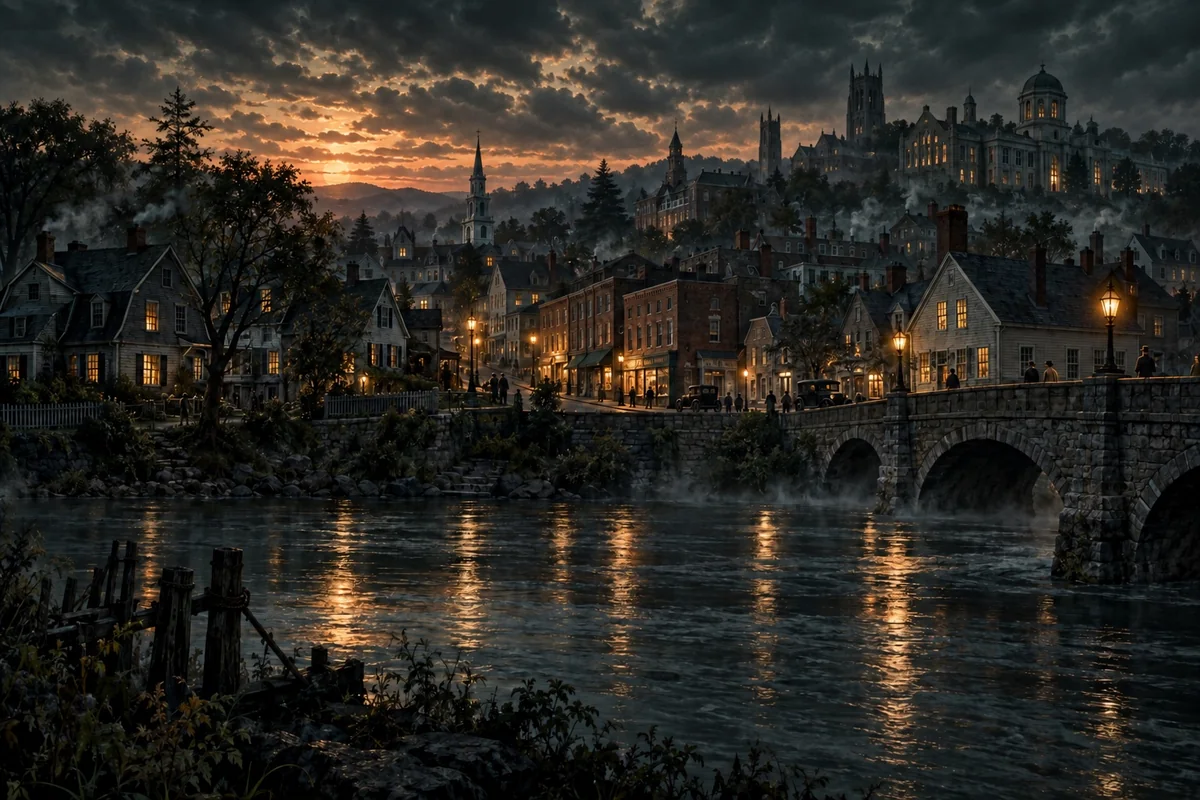
Arkham is Lovecraft’s fictional Massachusetts town on the Miskatonic River: an old New England community of decaying houses, family histories and modern scholarship. It contains Miskatonic University and serves as a recurring point of contact between ordinary civic life, dangerous local survivals and discoveries reaching far beyond Earth.
7 min read · 1,307 words
Creation and the real-world model
Arkham is first mentioned in The Picture in the House, written in December 1920 and published in an issue of The National Amateur bearing a July 1919 date but actually issued in 1921. The narrator is traveling toward Arkham when he takes shelter in a remote house. The town initially serves as an offstage destination within a newly developing regional geography.
Sources: [1], [2], [3], [4], [5], [6]
Lovecraft later described Arkham and Kingsport as adapted versions of Salem and Marblehead. The statement identifies real sources of atmosphere and architecture without making either fictional town a disguised street-by-street transcription. Arkham’s university, characters and supernatural incidents develop across separate stories. A fictional setting can inherit the visual impression of a place while acquiring an independent history.
The Miskatonic River helps connect the town with a larger invented region. Its upper reaches appear in the country around Dunwich, while Arkham’s bridges, banks and old houses repeatedly give the river a place within urban scenes. The original fiction supplies such relationships in pieces; it does not present one comprehensive municipal atlas.
Architecture, streets and the persistence of the past
Arkham’s characteristic scenery includes clustered gambrel roofs, old Georgian details, narrow or irregular streets and buildings whose deterioration leaves earlier forms visibly present. In The Thing on the Doorstep, Daniel Upton’s profession as an architect gives a human connection to that built environment. The town is inhabited, studied and altered, rather than merely observed as a picturesque ruin.
The Dreams in the Witch House makes a particular lodging house the center of its danger. Walter Gilman chooses a room associated with Keziah Mason because its strange angles seem relevant to his mathematical and folkloric inquiries. The same building houses people with different incomes, languages and explanations of what occurs there. Its supernatural history is embedded within the arrangements of an ordinary rented room.
Garrison Street and the bridge over the Miskatonic enter Gilman’s movements through the town. From the bridge he sees an island with standing stones and a figure he recognizes as the old woman of his dreams. Public space and private obsession become connected by a sightline. Arkham’s terror often depends on such relationships: a familiar route allows an apparently impossible event to intrude on daily life.
Miskatonic University and civic knowledge
Miskatonic University gives Arkham a continuing center of teaching, research and specialized collections. The medical school in Herbert West—Reanimator, the library in The Dunwich Horror, the folklore scholarship of The Whisperer in Darkness and the expeditions in At the Mountains of Madness and The Shadow out of Time are different uses of the same institution.
The university does not have a single consistent response to the unknown. Officials oppose West’s experiments; Henry Armitage studies dangerous material in order to prevent its use; scientific specialists initially fail to classify the meteorite in The Colour out of Space. Scholarship can expose a threat, contain part of it or discover the limits of its own assumptions. Arkham’s identity depends on that range more than on an idea that every faculty member is secretly an occultist.
The Arkham Advertiser supplies another form of civic knowledge. Reports from the Antarctic expedition pass through it and the Associated Press. The university town is therefore connected to modern communications and a wider public. The distance between what readers have been told and what Dyer later discloses is part of the structure of At the Mountains of Madness.
The Witch House and its material aftermath
Keziah Mason’s history connects Arkham with the Salem proceedings of 1692, but The Dreams in the Witch House develops the danger through Gilman’s later scientific work. His studies of non-Euclidean mathematics and physics converge with the angles of the room and stories of witchcraft. The town’s past supplies a pattern that contemporary language can begin to reinterpret.
Gilman’s death does not leave only an unverifiable dream account. Damage to the old house and subsequent work on its fabric uncover remains in concealed spaces. The discoveries retrospectively connect the building’s physical arrangement to the experiences of its occupants. Architecture has preserved evidence as well as concealed it.
This mechanism recurs in different forms across the fiction. An old house can function as a repository whose contents become legible only after demolition, excavation or a change in the observer’s knowledge. The surviving material does not make every witness equally reliable, but it prevents the town’s older legends from being dismissed merely because they began as oral reports.
Sources: [6]
Derby, the Crowninshield house and the sanitarium
The Thing on the Doorstep gives Arkham a social and domestic plot centered on Edward Pickman Derby, Asenath Waite and Daniel Upton. Asenath acquires the old Crowninshield property at the end of High Street and settles there with Derby after their marriage. Books, servants and possessions arrive from Innsmouth, creating a direct connection between the two fictional towns.
The university’s library and social circle help explain Asenath’s interest in Arkham. The story’s conflict then develops inside the marriage and the house, through changes in behavior, control and the apparent identity of the person occupying a body. Arkham’s institutions become involved when Derby is confined at the sanitarium and Upton acts on the conclusion he has reached.
The town is not collectively aware of everything Upton claims to understand. Police and medical explanations remain part of the frame, and the narrative is his attempt to justify an act that appears to be murder. Arkham thus supports competing interpretations of the same events. Its recurring horrors should not be mistaken for universal public knowledge shared by every resident.
Sources: [7]
The countryside west of town
The Colour out of Space locates its calamity in the hills and farms west of Arkham. A surveyor arrives for a proposed reservoir and encounters the blasted heath, the remnant of the Gardner family’s destruction. Townspeople direct him toward Ammi Pierce, whose recollections carry the main story.
The university’s scientists had examined the fallen meteorite, but the later damage unfolded through crops, animals, water and the family’s bodies. Arkham provides the nearby center of expertise and the place from which outsiders try to understand the country. Its institutions are close enough to investigate but unable to prevent the slow disaster.
The planned reservoir would place the old site beneath water. Modern development threatens to cover the visible record without necessarily eliminating the force that produced it. That prospect gives Arkham’s regional geography a historical dimension: roads, farms and engineering projects change the landscape, while knowledge of what happened there remains unevenly distributed.
Sources: [12]
Expeditions and connections beyond New England
Arkham’s importance is not confined to haunted houses near the Miskatonic. The university sends or supports investigations of Antarctica and the Australian desert. Dyer participates in both narratives, creating a specific personnel connection between them. Peaslee’s earlier collapse occurs while teaching economics, bringing the extraordinary temporal displacement into a recognizable academic career.
These stories reverse the expectation that an old New England town can be understood solely by examining its colonial past. Arkham becomes the starting point for discoveries that place all human history within far older biological and cosmic chronologies. It is at once local and outward-looking: the same institution that owns rare books also equips expeditions and receives scientific reports.
Later mapped and playable versions
Chaosium’s Call of Cthulhu: Arkham develops the setting for roleplaying with 290 locations across nine neighborhoods, more than eighty detailed nonplayer characters and separate maps for players and the Keeper. It adds the practical density needed for continuing investigations and campaigns. Those elaborations are valuable evidence for that game version of Arkham.
They should be credited as later setting design when used alongside the original fiction. A precise business directory, campus plan or neighborhood boundary may come from a game supplement rather than from Lovecraft’s text. This encyclopedia links the versions through their shared setting while identifying which source supplies a particular detail.
Sources: [13]
Related music
The Esoteric Order of Dagon is a dark metal descent into the world of Innsmouth, where ancient bloodlines, forgotten covenants and the call of the sea endure through countless generations.
References
- The Picture in the House — Unspeakable Tales ebook
The fictional narrative is evidence for what the story says, not proof of events in the real world.
- H. P. Lovecraft Archive — fiction in composition order
Composition dates; question marks and ranges retain the source uncertainty.
- H. P. Lovecraft Archive — fiction in publication order
First publication dates and venues; issue dates can differ from actual release dates.
- H. P. Lovecraft — Autobiography: Some Notes on a Nonentity
Written 23 November 1933. A retrospective self-portrait, not an independent biography; the original essay is public-domain text.
- The Dunwich Horror — Unspeakable Tales ebook
The fictional narrative is evidence for what the story says, not proof of events in the real world.
- The Dreams in the Witch House — original text
The fictional narrative is evidence for what the story says, not proof of events in the real world.
- The Thing on the Doorstep — Unspeakable Tales ebook
The fictional narrative is evidence for what the story says, not proof of events in the real world.
- Herbert West—Reanimator — original text
The fictional narrative is evidence for what the story says, not proof of events in the real world.
- The Whisperer in Darkness — original text
The fictional narrative is evidence for what the story says, not proof of events in the real world.
- At the Mountains of Madness — original text
The fictional narrative is evidence for what the story says, not proof of events in the real world.
- The Shadow out of Time — original text
The fictional narrative is evidence for what the story says, not proof of events in the real world.
- The Colour Out of Space — Unspeakable Tales ebook
The fictional narrative is evidence for what the story says, not proof of events in the real world.
- Chaosium — Call of Cthulhu: Arkham
A later roleplaying expansion of the city, with its own maps, inhabitants and campaign material.
At a glance
Fictional Massachusetts town
Miskatonic
Miskatonic University
The Picture in the House
Lovecraft identified an adapted relationship with Salem
Dunwich, Innsmouth and the countryside of the blasted heath