

The Ghost-Eater
The Ghost-Eater recounts a traveler’s night in a seemingly hospitable woodland house, where a werewolf attacks a man who is already a ghost. The visitor’s weapons cannot interrupt the scene. Only after escaping does he learn that both figures, and the house itself, belong to a violent episode sixty years earlier. The horror comes from a killing that appears able to continue beyond death.
5 min read · 904 words
Publication and the retrospective witness
The story appeared in Weird Tales, volume 3, number 4, April 1924, on pages 72–75. It is credited to C. M. Eddy, Jr., with Lovecraft, and the composition catalog places it in 1923.
An unnamed traveler recounts the event after surviving it. His opening and closing statements return to the same remembered sounds, showing that physical escape has not ended the experience's hold over him.
He allows illness or an altered state as possible explanations but says he cannot accept them with confidence. The narrative eventually supplies a local legend that corresponds to what he witnessed without having previously heard it.
The journey through the woods
The traveler needs to get from Mayfair to Glendale in Maine by the following noon. A longer route through Potowisset would take too much time. Local people refuse to guide him through the direct woodland path, giving excuses rather than a clear warning.
He begins alone, carrying money and a pistol. Heat, an overgrown trail and a long sleep after lunch destroy his plan to arrive before nightfall. A gathering storm makes shelter increasingly urgent.
The opening builds danger through ordinary misjudgment rather than an immediate supernatural attack. His confidence in his strength and his contempt for superstition make the locals' evasiveness easier to dismiss.
Sources: [3]
The house and its courteous host
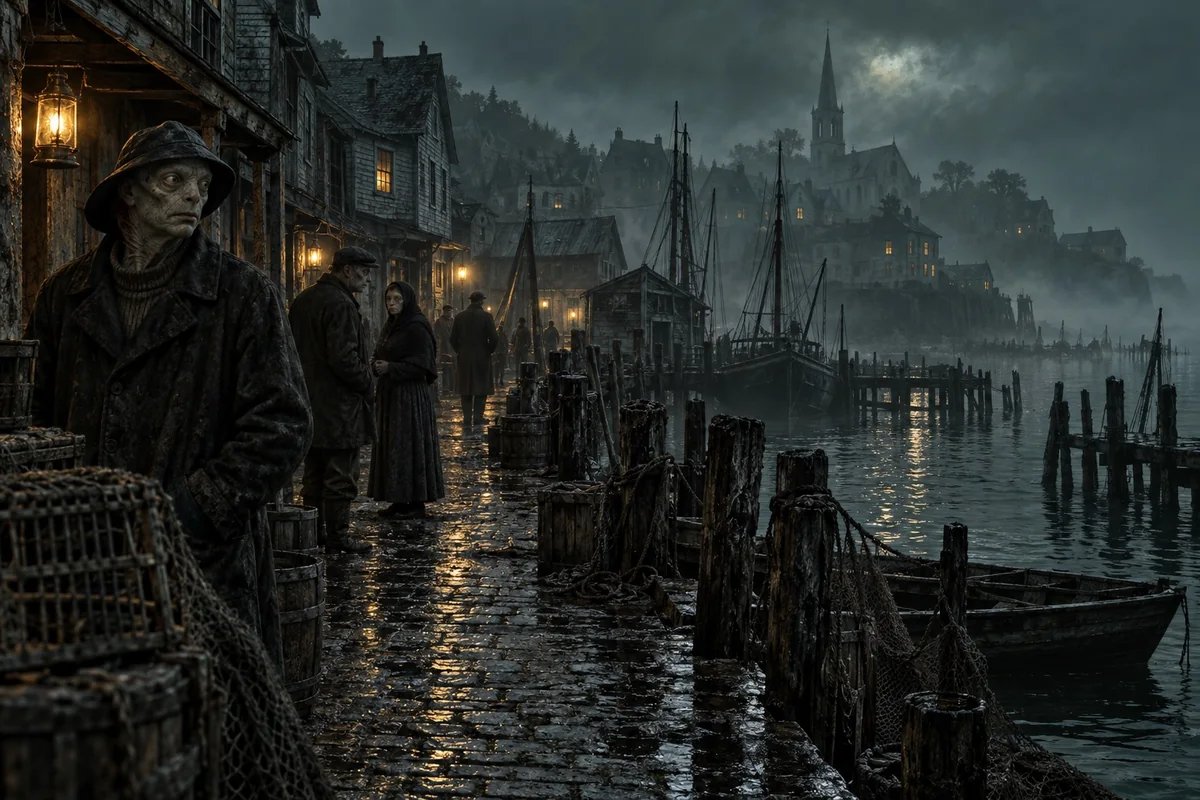
The building he finds is a well-kept two-story house, unexpectedly refined for its isolated setting. Its occupant is a handsome, pale-haired man with expressive gray eyes, fine hands, prominent teeth and a pronounced limp.
An animal-like odor and the host's ability to move in darkness disturb the visitor without yet proving anything supernatural. The host permits him to prepare food and offers a room for the night. His own lack of appetite and changing manner add ambiguity to the welcome.
The visitor's money eventually makes him cautious. Rather than immediately sleeping, he arranges the bed to suggest an occupant and sits in shadow with his pistol available. His precautions are designed for robbery or murder by an ordinary host, not for the phenomenon that follows.
Sources: [3]
The sleeping stranger
A second man enters the bedroom, apparently unaware of the traveler. His clothing is old-fashioned, and his appearance differs entirely from that of the host. He undresses and goes to sleep in the bed.
When the traveler tries to touch him, his hand passes through the figure and reaches the bedding. The sleeper remains visible and audible. The encounter therefore establishes intangibility before the werewolf appears.
That order is essential to the final shock. The traveler does not merely discover a wolf eating a person. He has already tested the victim's lack of ordinary physical substance.
Sources: [3]
The wolf and the impossible feeding
A large gray wolf enters, limping on a hind leg. Its luminous eyes resemble the host's, linking the two forms through both gaze and injury. It turns toward the sleeping apparition and attacks.
The traveler fires, but the bullets pass through the wolf and strike the wall beyond. The weapon provides an audible measure of the creature's intangibility rather than a means of rescue.
He flees as the wolf begins feeding. The remembered sound of breaking bones is particularly disturbing because the victim had offered no resistance to his own hand. The scene gives the apparition a form of suffering and vulnerability that does not depend on the material conditions familiar to the observer.
Sources: [3]
The names and the old murder
At Glendale, the proprietor of the Lafayette House identifies the woodland tradition. Vasili Oukranikov, a Russian recluse, had been suspected of becoming a wolf. A gunshot injury to the animal was followed by a corresponding limp in the man.
Oukranikov invited Count Feodor Tchernevsky to his house. The Count arranged for his men to follow if he failed to return. They eventually found his mutilated body and a wolf nearby.
The men killed the wolf, buried it in the house and burned the building. The proprietor dates the episode to sixty years before the traveler's visit. This makes the apparently intact house part of the haunting rather than simply a surviving crime scene.
The local account associates the repetition with the full moon. The traveler had observed both the moonlight and the repeated injury before hearing the names, providing the story's strongest internal corroboration.
Sources: [3]
What repeats, and what remains unexplained
Both predator and victim appear as manifestations of a past event. Calling Oukranikov simply a living werewolf who feeds on the dead misses the final revelation that he too was killed long before the encounter.
The story does not establish whether the Count's consciousness is newly tormented each month, whether the scene is a fixed reenactment or whether the traveler might have altered its outcome by some unknown means. His attempt with an ordinary weapon fails, and the narrative offers no successful exorcism.
Nor does it identify a god or curse-maker responsible for the repetition. The title describes the disturbing act at the center of the scene, not a fully explained supernatural species or a named member of the Cthulhu pantheon.
The traveler publicly denies seeing anything when questioned. His later narration preserves what his immediate social response concealed. The story closes with memory and isolation rather than the destruction of the haunted place.
Sources: [3]
References
- The Ghost-Eater — publication data
- H. P. Lovecraft Archive — fiction in composition order
Composition dates; question marks and ranges retain the source uncertainty.
- The Ghost-Eater — original text
The fictional narrative is evidence for what the story says, not proof of events in the real world.
At a glance
C. M. Eddy, Jr., with H. P. Lovecraft
1923
1924, April
Weird Tales, 3, No. 4
Fiction