

The Moon-Bog
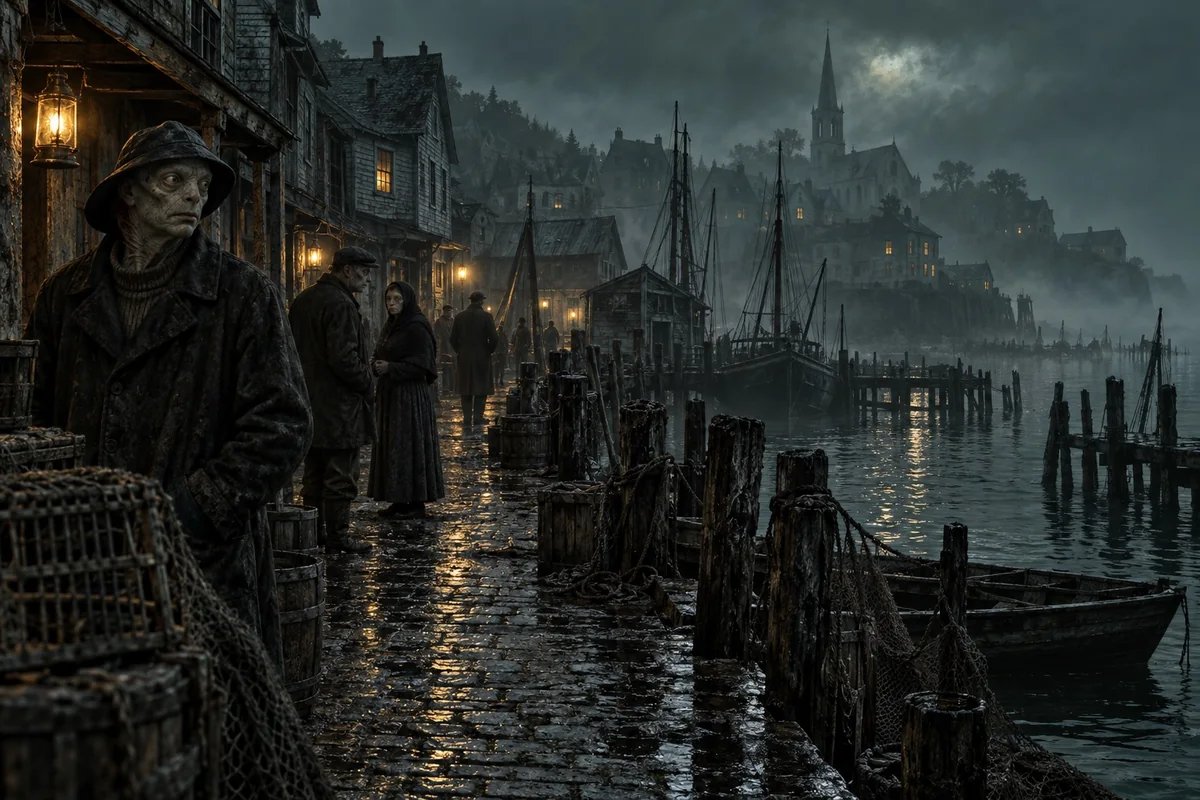
The Moon-Bog concerns Denys Barry’s plan to drain a marsh beside his restored ancestral castle at Kilderry, Ireland. Local people leave rather than assist, while replacement workers begin experiencing unexplained exhaustion and dreams. An American visitor witnesses nocturnal processions and an apparent revival of the bog’s older sacred history before Barry and his household disappear.
5 min read · 979 words
Return to an ancestral estate
The unnamed narrator knew Denys Barry in America, where Barry became wealthy. Barry uses that wealth to buy back the castle associated with his family at Kilderry in County Meath.
Restoration initially wins local approval. The castle returns to prominence, and Barry presents the project as a recovery of ancestral life. His plan to drain the adjacent bog changes that relationship decisively.
He sees the marsh as land and peat that should be put to use. The local inhabitants regard disturbance of it as dangerous. His enthusiasm for heritage therefore coexists with a refusal to accept the inherited limits attached to the landscape.
Departure and replacement
Residents refuse to help drain the bog and leave for Ballylough when Barry persists. He replaces servants and laborers with people brought from the north.
The change leaves him lonely, prompting an invitation to the narrator. The visitor arrives through Ballylough, where people warn him about Kilderry. He initially shares Barry's dismissal of their fears.
The narrator nevertheless responds strongly to the beauty of the setting: green hills, blue water, an island ruin and the castle in sunset light. His later hesitation is partly connected with the prospect of destroying a landscape he already values aesthetically.
The bog’s older story
Local accounts describe a guardian presence, unusual lights, cold winds and pale forms over the water. They also speak of a stone city concealed beneath the marsh.
The story combines Irish legendary names with a Greek-associated origin. The inhabitants connect the lost settlement with Partholan and a catastrophe followed by burial beneath the landscape. The island ruin is associated with a surviving sacred place.
This combination is the fiction's invented legendary history. It should not be presented as established Irish archaeology or as proof that a Greek city lies beneath an actual County Meath bog.
Dreams and exhausted workers
From his tower room, the narrator hears distant, partly musical sounds. His dreams develop a city of marble streets, statues, villas and temples, apparently shaped by the legends Barry has told him.
Meanwhile, the replacement workers repeatedly oversleep and wake without feeling rested. They vaguely remember strange sounds but cannot recover a clear account of the night.
The parallel experiences suggest a common influence before the narrator obtains any direct view of its effects. The dreams alone remain open to explanation through expectation; the workers' condition introduces an observable consequence outside his private sleep.
The first nocturnal dance
A later dream shows plague and an overwhelming movement of the surrounding slopes burying the city. Only the high temple of Artemis and the moon-priestess Cleis remain outside the general burial.
After waking, the narrator continues to hear piping. Looking from the tower, he sees a dance involving the workers and pale, partly indeterminate forms associated with the bog. Their movements have a mechanical quality inconsistent with ordinary celebration.
He loses consciousness and later questions the workers, who cannot remember taking part. Sunlight makes him doubt what he saw, and he fails to communicate a forceful warning to Barry.
The night before drainage
Barry announces that work will begin the following day. The narrator's growing fear remains too weak to overcome his host's laughter or make him leave in time.
That night, a red radiance enters the tower room from the bog. The island ruin seems to rise into a complete, columned temple. Piping and drums accompany a procession of pale figures drawing the workers toward the water.
The servants emerge from the castle and join them. The entire group enters the bog and disappears. The lights and music then cease, leaving the place in ordinary moonlight.
Barry’s disappearance and the frogs
The narrator hears terrible cries from Barry elsewhere in the castle, then escapes through the empty rooms and along the bog's edge. He does not witness the full event that produces those cries.
During flight, he notices enormous frogs in water previously described as lacking animal life. Their piping and their appearance immediately after the procession suggest a transformation of the vanished people, although the text does not show the change directly.
He also sees, or believes he sees, a figure resembling Barry drawn upward along a pale path from the island toward the moon. The account frames this through his overwhelmed perception. Searchers later fail to find Barry, the servants or the workers.
The threatened landscape
The story's conflict begins before any drainage actually occurs. Barry's announced intention and preparations are enough to call forth the bog's response. His technical ability to alter the site does not imply knowledge of what it contains.
The original inhabitants avoid the final catastrophe by leaving. Their refusal, initially mocked as superstition, proves more protective than the visitor's cultivated skepticism. Replacement labor allows the project to proceed while removing the people who knew why they would not take part.
An ecological reading can see the bog resisting conversion into a resource, while a mythic reading emphasizes disturbance of an older sacred place. Both are interpretations of the narrative, whose actual events remain filtered through one surviving witness.
Classical references and source limits
Artemis, Demeter and other classical powers appear through dream imagery, comparisons and the narrator's frightened prayers. Those references should be distinguished from a scene explicitly identifying each named deity as an actor in the disappearance.
The pale figures are described through the language of naiads and wraiths, but no complete species history or independent pantheon is supplied. The tale has its own compact supernatural setting rather than an explicit appearance by Cthulhu or a named Great Old One.
The ending leaves the narrator with lasting fear of moonlight, marshes and frogs. The disappearances are publicly known within the story, while his account of their mechanism remains something he cannot prove to others.
References
- The Moon-Bog — Unspeakable Tales ebook
The fictional narrative is evidence for what the story says, not proof of events in the real world.
At a glance
H. P. Lovecraft
March 1921
1926, June
Weird Tales, 7, No. 6
Fiction