

The Street
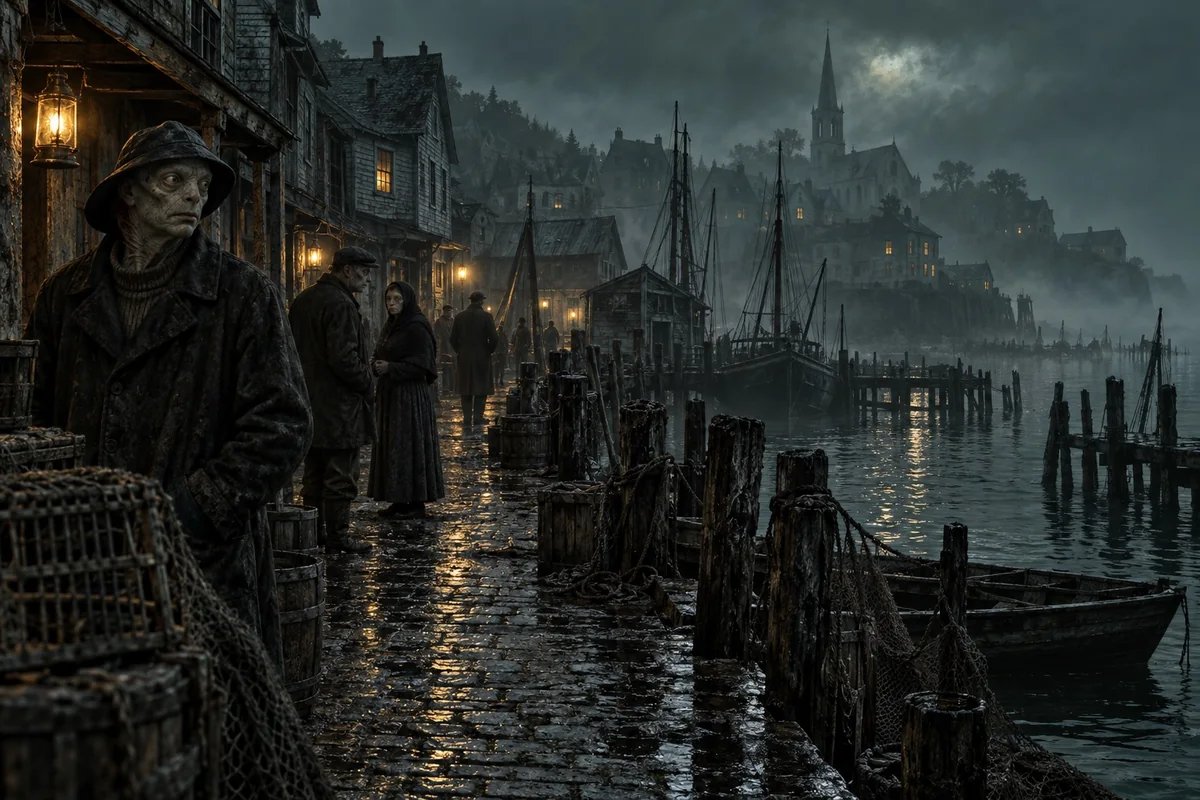
The Street personifies an old American street as the bearer of an inherited community’s values. Its account of changing inhabitants culminates in a collapse that destroys an alleged revolutionary conspiracy. The supernatural suggestion is inseparable from the narrative’s racist and nativist distinction between an idealized Anglo-Saxon past and immigrants represented as a threat.
4 min read · 805 words
Publication and narrative method
The Archive's composition chronology gives 1920 with a question mark. The first publication was in The Wolverine, number 8, in December 1920, on pages 2–12.
An unnamed narrator opens and closes by asking whether places can have souls while declining to make an explicit declaration. Between those statements, the street repeatedly seems to absorb, remember and react to the lives of its inhabitants.
The narrative names neither the street nor its city. Its American historical sequence and New England atmosphere do not establish a verified address.
Sources: H. P. Lovecraft Archive — fiction in composition order, The Street — publication data, The Street — original text
The idealized colonial beginning
The street begins as a path between a water source and a small settlement. Houses, families and institutions gradually accumulate around it, and the narrator celebrates the settlers' strength, religion, learning and English inheritance.
The account treats Indigenous inhabitants primarily as a hostile presence to be overcome. Their disappearance from the narrative is folded into the settlers' prosperity. This perspective is part of the work's colonial ideology, not a neutral description of all the people whose land and lives the settlement affects.
As cabins become more elaborate houses, the street gains gardens, trees, books, music and university-educated residents. Architectural and cultural refinement become mutually reinforcing signs of the favored community.
Sources: The Street — original text
Change that the street accepts
The American Revolution alters flags and political allegiance without, in the narrator's view, breaking the street's underlying continuity. Later changes in clothing, transport and infrastructure likewise leave its supposed spirit intact.
This distinction matters because the story does not simply reject every kind of modernization. It accepts substantial technological and political change when it regards the population as continuous with the founders.
The criterion of belonging is therefore tied to ancestry, language and inherited culture. The street's apparent memory becomes a way of authorizing that selective definition of continuity.
Sources: The Street — original text
New inhabitants and manufactured menace
The narrator represents later arrivals through disparaging descriptions of their accents, bodies, languages and neighborhoods. Physical decay, unfamiliar signs and commercial activity are grouped with an alleged decline in moral and political character.
These descriptions do not merely accompany an otherwise neutral supernatural plot. They prepare the reader to treat immigrant presence itself as evidence of danger, before any particular conspiracy has been established.
The text briefly distinguishes returning soldiers and acknowledges some conspirators whose appearance resembles the earlier inhabitants. Nevertheless, its dominant opposition remains between a praised ancestral community and a racialized body of newcomers.
Sources: The Street — original text
War, revolution and the alleged plot
The later sequence evokes a world war, a revolution overseas and fears of revolutionary violence in America. Within the story, investigators watch meeting places including a bakery, an economics school, a social club and a café.
Rumors predict coordinated destruction around the Fourth of July. Police searches fail to produce evidence sufficient to identify who should be arrested, and soldiers eventually take over the public-security role.
The narrator later treats the threat as real and the outcome as the country's rescue. A critical summary must retain the difference between the story's assertions and verified history: the fictional plot is not evidence that real immigrant neighborhoods collectively organized such a conspiracy.
The lack of a successful ordinary investigation also serves the narrative's design. Human authorities cannot resolve the threat that the personified place will apparently answer.
Sources: The Street — original text
The collapse and the remembered gardens
During the climactic night, the old buildings collapse together. The account emphasizes the strange uniformity of the event while retaining age and structural deterioration as its immediate physical vocabulary.
The occupants do not survive. Only limited fragments of masonry remain. The story presents this mass death as the defeat of the conspiracy, connecting the preservation of an imagined national inheritance with the destruction of the current community.
A poet later reports a vision of the former houses and trees above the ruins. A traveler notices the fragrance of roses. These impressions recall the gardens associated with the street's favored past.
The closing rhetorical uncertainty does not erase the pattern: the narrative has arranged the collapse and sensory afterimages so that the street's remembered identity appears to have acted.
Sources: The Street — original text
Place-memory and the politics of belonging
The Street offers a supernatural model in which a built environment can preserve and defend a collective identity. That model is inseparable from the question of whose lives the place is allowed to value.
The story's hostility to immigrants and racialized outsiders should be analyzed directly rather than diluted into a generic fear of change. At the same time, recognizing that ideology does not require inventing a named deity or occult organization behind the collapse.
For the wider encyclopedia, the useful connections are living places, inherited identity and the political uses of horror. The street is neither explicitly Arkham nor a documented site in another Mythos narrative.
Sources: The Street — original text
References
- H. P. Lovecraft Archive — fiction in composition order
Composition dates; question marks and ranges retain the source uncertainty.
- The Street — publication data
- The Street — original text
The fictional narrative is evidence for what the story says, not proof of events in the real world.
At a glance
H. P. Lovecraft
1920?
1920, December
The Wolverine, No. 8
Fiction