

New England
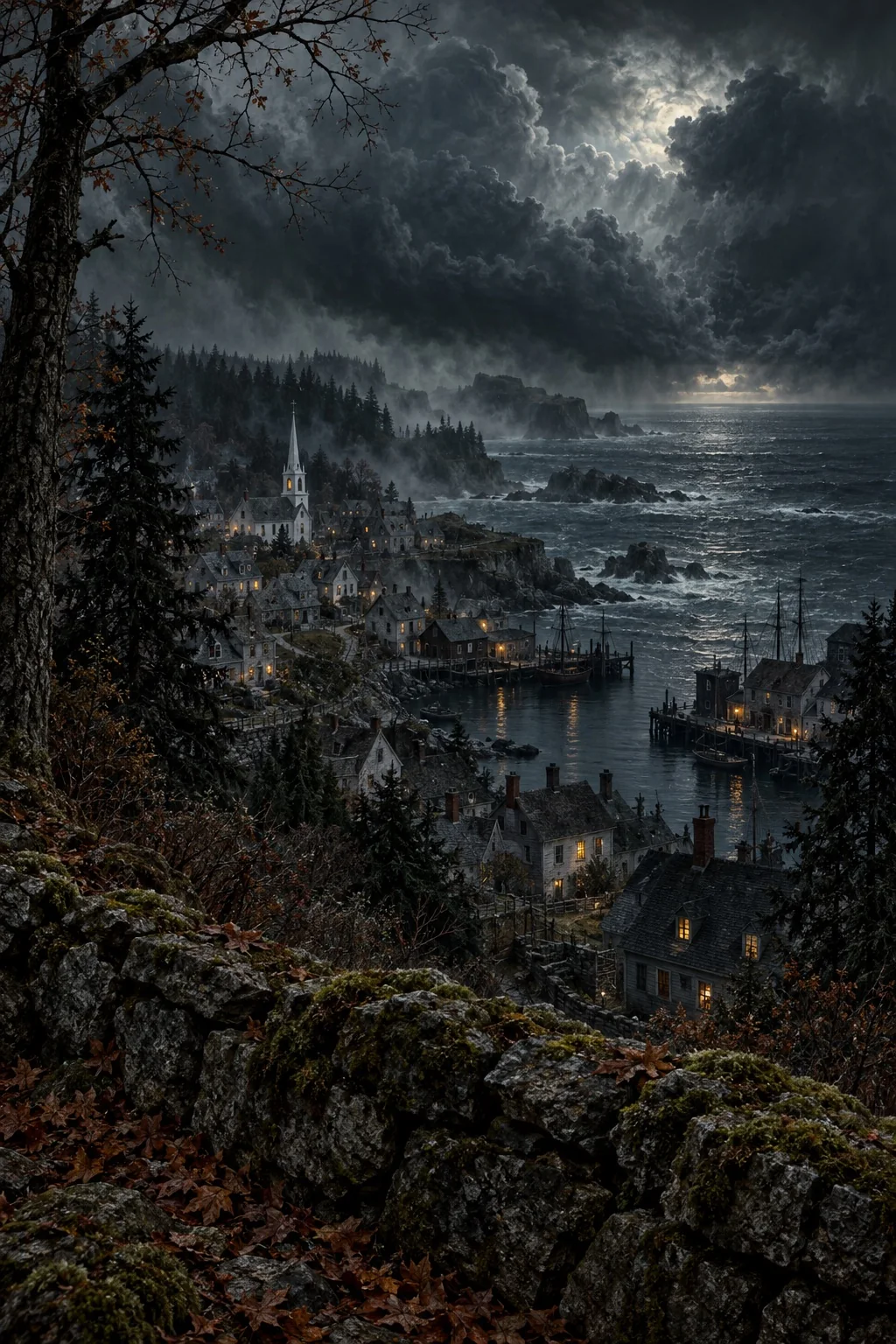
New England is the principal regional framework of Lovecraft’s fiction: a landscape of old towns, seaports, farms, woods, libraries and remembered homes. Real places such as Providence and Boston coexist with Arkham, Dunwich, Innsmouth and Kingsport. The region can offer belonging and beauty, while its buildings and local records open onto histories that overwhelm their human scale.
5 min read · 925 words
A network rather than one haunted town
Lovecraft's fictional New England works through connections between places. Investigators travel by train, bus, road and foot; scholars consult collections outside their own towns; relatives and correspondents transmit news across the region. An encounter acquires credibility because it can be placed among ordinary journeys and institutions.
Arkham's university connects the rural crisis of The Dunwich Horror with a specialist library and three scholars capable of interpreting evidence. The Shadow over Innsmouth begins within a young traveler's economical tour of old towns, making the decision to take a particular bus the entrance to the story's danger.
These routes matter to the action. A place is not simply a background illustration: access, expense, distance and available transport can determine why a character arrives and whether departure remains possible.
Sources: The Dunwich Horror — Unspeakable Tales ebook, The Shadow over Innsmouth — Unspeakable Tales ebook
Old buildings and the persistence of the past
The Case of Charles Dexter Ward makes Providence's surviving streets and houses the objects of a young man's absorbing historical curiosity. A portrait, documents and an ancestral connection turn local antiquarian interest into an increasingly dangerous project.
The Shunned House concentrates the same relation between architecture and memory within one building. Repeated illness and death become legible only when the narrator and his uncle assemble the history of earlier residents. The house has continued to function in ordinary urban life while carrying a cause that its occupants cannot identify.
In these stories, age provides evidence as well as atmosphere. Alterations, ownership, family succession and buried structures allow the investigators to reconstruct a sequence instead of confronting an entirely contextless apparition.
Sources: The Case of Charles Dexter Ward — original text, The Shunned House — Unspeakable Tales ebook
The countryside beneath cultivation
The Colour out of Space locates catastrophe on a farm whose dependence on soil, water, crops and animals makes environmental change intimate. The strange arrival does not remain at a single impact point. It enters the conditions of daily subsistence, damaging the distinction between a family's property and the larger forces acting through it.
The Dunwich Horror presents a different rural disturbance. Wilbur Whateley's development is observed through neighbors' recollections, cattle purchases, changes to the farmhouse and activity on nearby hills. The local account gradually acquires a scale far beyond gossip about an unusual household.
The woods and hills are therefore not uniformly empty wilderness. They surround worked land, inhabited houses and social networks whose partial observations become essential evidence.
Sources: The Colour Out of Space — Unspeakable Tales ebook, The Dunwich Horror — Unspeakable Tales ebook
Ports, reefs and the sea
Innsmouth's maritime setting joins a town's economic history to an agreement with nonhuman beings. Shipping routes and the experiences attributed to Obed Marsh connect a declining local port with distant waters. Devil Reef and the submerged Y'ha-nthlei bring that connection close enough to affect the town's families.
Kingsport offers another relation to the coast. In The Strange High House in the Mist, the cliff above the harbor becomes a threshold between everyday settlement and an older, more expansive world. In The Festival, the narrator's ancestral return leads below the town toward a river connected with the sea.
These coastal works range from wonder to organized predation. A seaport's openness to elsewhere can be desirable, terrifying or both.
Sources: The Shadow over Innsmouth — Unspeakable Tales ebook, The Strange High House in the Mist — original text, The Festival — Unspeakable Tales ebook
Vermont and correspondence
The Whisperer in Darkness begins with reports arising from Vermont floods and develops through correspondence between Albert Wilmarth and Henry Akeley. The rural property becomes increasingly hard to interpret from afar: photographs, recordings and letters promise access, but also create opportunities for deception.
Wilmarth's eventual visit tests the picture he has assembled through those media. The transition from a distant account to a night inside Akeley's house changes the nature of the evidence and the narrator's freedom to withdraw.
This use of New England is neither purely urban nor purely antiquarian. Roads, communications and modern recording technology connect an isolated landscape with a much wider cosmic explanation.
Home as a source of dream architecture
The Dream-Quest of Unknown Kadath gives the region a positive imaginative role. Carter pursues a magnificent sunset city without recognizing how deeply its beauty draws upon remembered places of his waking life. Near the end, familiar New England scenes become the key to understanding what he sought.
The revelation joins dream travel to attachment rather than simply opposing fantasy and reality. An apparently inaccessible marvel has been made from things Carter already loved. Boston and other remembered places acquire a significance that no list of hostile beings could capture.
This is one reason a Lovecraftian geography should include homes, streets and beautiful prospects alongside ruins and forbidden sites.
Whose version of the region?
The affection for an imagined old New England can coexist with exclusionary judgments about class, ancestry and newcomers. In He, the narrator contrasts the home he longs for with a New York population he describes through racial hostility. In The Shadow over Innsmouth, the traveler's changing account of his own family destabilizes the separation he initially assumes between himself and the town.
Those attitudes belong to the texts and their narrating voices. Describing them accurately helps explain how belonging and estrangement generate horror, without turning the stories' prejudices into neutral descriptions of real communities.
Sources: He — Unspeakable Tales ebook, The Shadow over Innsmouth — Unspeakable Tales ebook
A regional reading route
For the urban archive, begin with Providence and Charles Dexter Ward. For a modern scholarly response to a rural event, follow Arkham toward Dunwich. For a coastline bound to secret ancestry, take the Innsmouth route. For the emotional transformation of remembered streets into fantasy, return through Carter's dream quest.
These are complementary paths through a shared regional imagination. They do not require every town, family or supernatural event to be part of a single coordinated conspiracy.
Sources: The Case of Charles Dexter Ward — original text, The Dunwich Horror — Unspeakable Tales ebook, The Shadow over Innsmouth — Unspeakable Tales ebook, The Dream-Quest of Unknown Kadath — original text
Related music

The Esoteric Order of Dagon is a dark metal descent into the world of Innsmouth, where ancient bloodlines, forgotten covenants and the call of the sea endure through countless generations.
References
- The Dunwich Horror — Unspeakable Tales ebook
The fictional narrative is evidence for what the story says, not proof of events in the real world.
- The Shadow over Innsmouth — Unspeakable Tales ebook
The fictional narrative is evidence for what the story says, not proof of events in the real world.
- The Case of Charles Dexter Ward — original text
The fictional narrative is evidence for what the story says, not proof of events in the real world.
- The Shunned House — Unspeakable Tales ebook
The fictional narrative is evidence for what the story says, not proof of events in the real world.
- The Colour Out of Space — Unspeakable Tales ebook
The fictional narrative is evidence for what the story says, not proof of events in the real world.
- The Strange High House in the Mist — original text
The fictional narrative is evidence for what the story says, not proof of events in the real world.
- The Festival — Unspeakable Tales ebook
The fictional narrative is evidence for what the story says, not proof of events in the real world.
- The Whisperer in Darkness — original text
The fictional narrative is evidence for what the story says, not proof of events in the real world.
- The Dream-Quest of Unknown Kadath — original text
The fictional narrative is evidence for what the story says, not proof of events in the real world.
- He — Unspeakable Tales ebook
The fictional narrative is evidence for what the story says, not proof of events in the real world.
At a glance
Real region used as a literary framework
Providence; Boston
Arkham; Dunwich; Innsmouth; Kingsport
Geography and its narrative functions in selected primary texts