

Dark Young
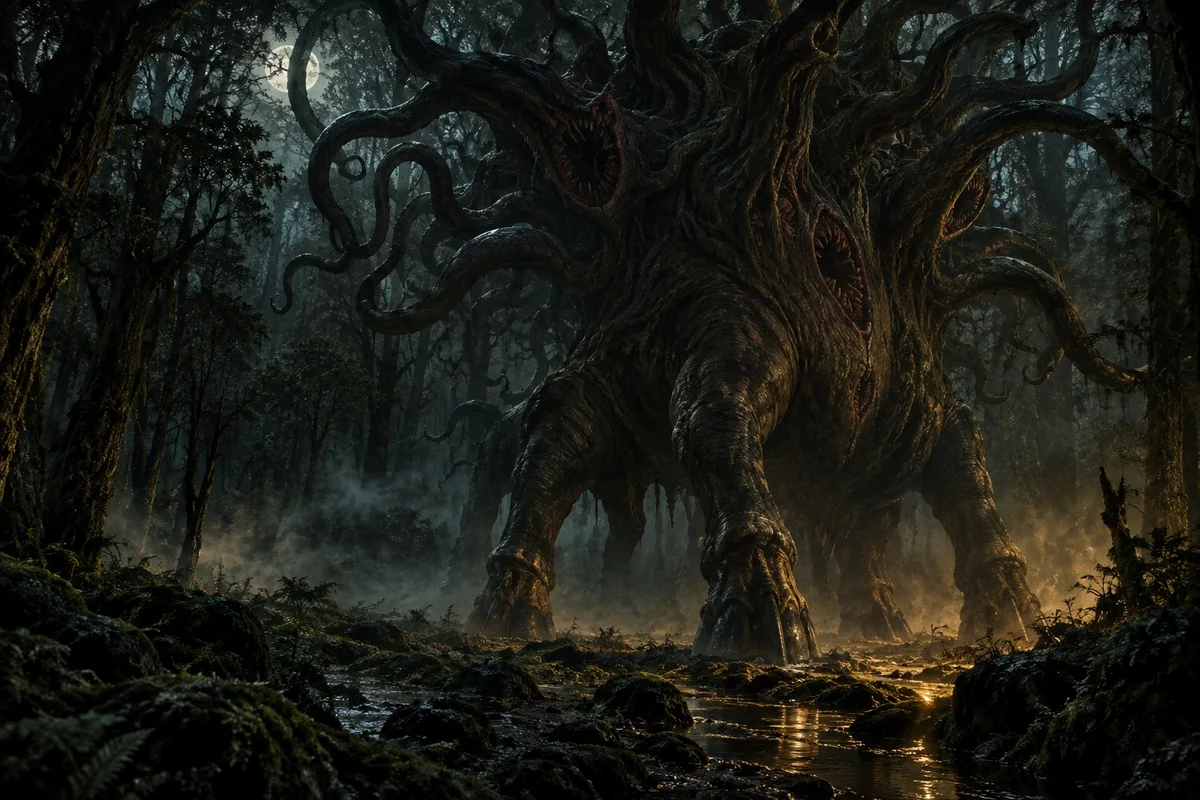
The dark young are the tree-like, tentacled servants of Shub-Niggurath described in Call of Cthulhu. They give a specific monstrous form to imagery that remains much less anatomically defined in Lovecraft’s invocations of the deity.
2 min read · 325 words
Form and function in the game
Chaosium presents dark young as large black tentacular masses with mouths and hoof-like supports. Their outline resembles a gnarled tree. They act for Shub-Niggurath, receive cult offerings and threaten outsiders. The bestiary explicitly associates them with the offspring invoked in her familiar epithet.
Sources: [1]
The invocation in The Whisperer in Darkness
Lovecraft's Vermont narrative brings Shub-Niggurath into a recorded ceremony. The invocation occurs among other names, strange voices and ritual responses. It expands the scale of the investigator's suspicions beyond an isolated local phenomenon.
The passage supplies a religious name and an image of abundant offspring. It does not pause to identify a separate species of mobile trees, enumerate their limbs or define their physical resistance to weapons. Those differences matter when tracing how a suggestive phrase becomes a developed bestiary entry.
Sources: [2]
A deity, an epithet and a species
A divine title can imply relationships without explaining them. In The Whisperer in Darkness, the ritual language reaches beyond the immediate action, suggesting a body of knowledge shared by participants and unavailable to the narrator.
An encyclopedia can record that suggestion without converting every noun in the invocation into a complete biological classification. Shub-Niggurath is the deity named; the dark young article concerns a later, more particular embodiment of part of that imagery.
Sources: [2]
Keeping literary occurrences legible
When the deity's name occurs in a story, the most useful occurrence record states what happens: an invocation, a quotation, a claim by a character or a direct encounter. Those forms of evidence should remain distinct. A reference to Shub-Niggurath in Lovecraft does not by itself mean that a dark young enters the scene.
This distinction also preserves the effect of the original narrative. In the Vermont investigation, fragments of language and sound allow the reader to infer an unfamiliar religious world. The scene does not require every invoked being to become visible.
Sources: [2]
Related music
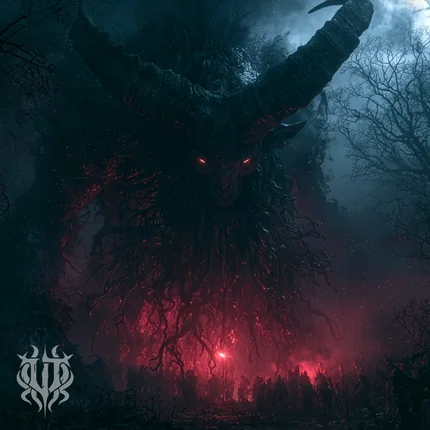
The Black Goat of The Woods is a dark metal tribute to Shub-Niggurath, the ancient woodland deity whose forgotten cults gather beneath twisted trees and indifferent stars.
References
- Chaosium — Mythos Monsters
Descriptions belong to the roleplaying game; they are not automatically facts in Lovecraft’s original stories.
- The Whisperer in Darkness — original text
The fictional narrative is evidence for what the story says, not proof of events in the real world.
At a glance
Chaosium’s Call of Cthulhu bestiary
Shub-Niggurath
Tree-like tentacular body with hoof-like supports
A Shub-Niggurath invocation is not necessarily a dark-young encounter