

Great Race of Yith
The Great Race of Yith is a civilization whose most capable minds investigate and survive across immense spans of time by exchanging bodies with other intelligent beings. The Shadow out of Time presents its libraries, institutions and migrations through Nathaniel Wingate Peaslee’s recovered experiences and the ruins he explores in Australia.
10 min read · 2,031 words
A civilization identified by its minds
The familiar cone-shaped body is one historical embodiment of the Great Race. Its continuing identity depends on transferable minds and accumulated knowledge, rather than on an unchanging biological form. The story distinguishes the population whose bodies originally developed on Earth from the incoming intelligences that appropriated them.
Yith appears as the name of a remote world in the uncertain testimony of the fictional Eltdown Shards. The migration from that world supplies a prehistory for the terrestrial civilization. The name does not make the ancient Australian city a place physically located on Yith, nor does it establish that the conical organisms evolved there.
Peaslee obtains this history through an uneven combination of dreams, research into related experiences and apparent memories. His narrative becomes increasingly persuasive to him, but it retains the form of a personal account undergoing verification. Its details are fictional evidence within that narrative, not an independent scientific reconstruction of Earth’s actual past.
The conical terrestrial body
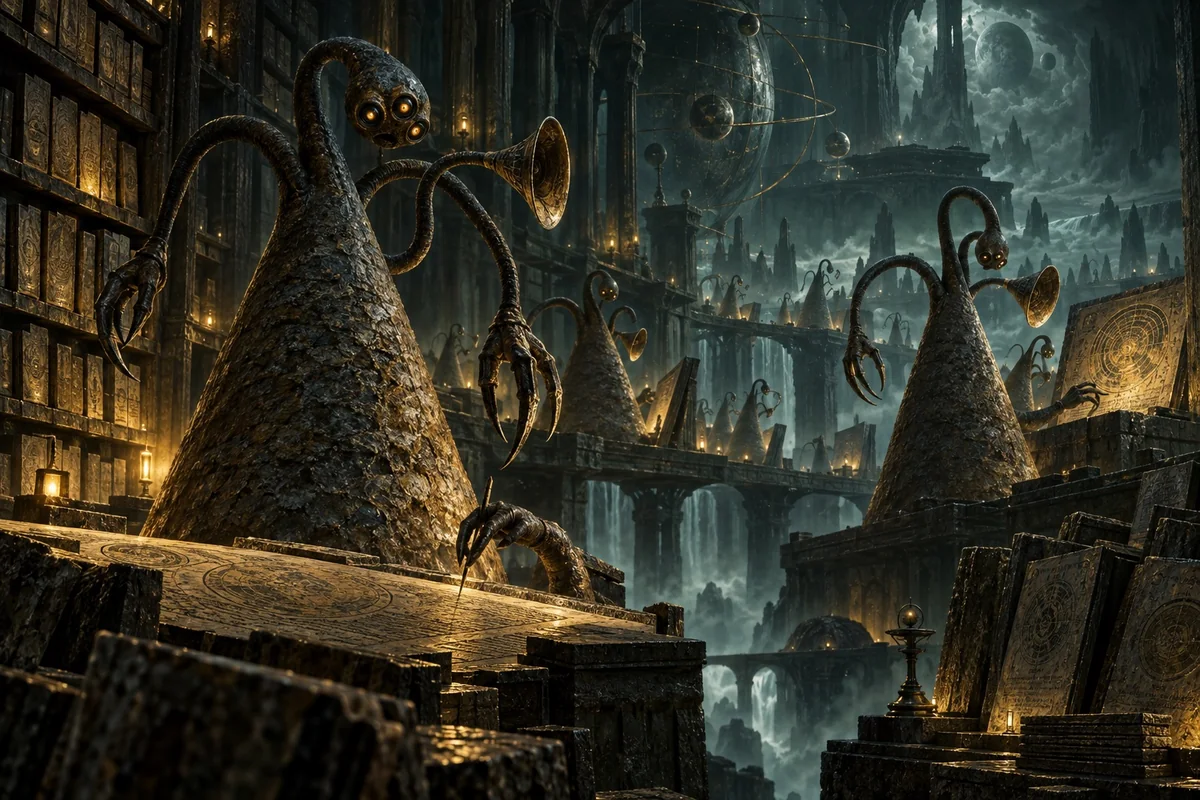
The bodies encountered in Peaslee’s visions are ridged, flexible cones approximately ten feet high and equally broad at the base. Four extensible limbs emerge from the top. Two terminate in large claws, one carries four red trumpet-shaped organs, and the fourth supports a roughly globular head.
Three dark eyes are spaced around the yellowish head. Above them stand four slender stalks with flower-like structures; below hang eight greenish appendages used for delicate manipulation, including writing. The flower-shaped organs perform a hearing function. Locomotion comes from a contracting and expanding material around the cone’s broad base, rather than from ordinary legs.
The beings use their claws both to handle objects and to communicate through clicks and scraping sounds. They carry bags rather than conventional clothing. Peaslee is particularly disturbed by seeing this unfamiliar anatomy perform familiar intellectual activities: reading, selecting books, writing and conversing. The horror comes partly from recognizable intelligence expressed through an utterly different arrangement of organs.
Senses, reproduction and lifespan
The conical organisms possess sight and hearing together with senses that Peaslee cannot adequately describe or use while occupying one of their bodies. Their three eyes provide a broad field of vision. The account also gives them thick greenish internal fluid and denies them ordinary human experiences of touch and physical pain.
They reproduce without sexes through seed-like or spore-like growths around the base, developed in shallow water tanks. Few offspring are raised because an individual commonly lives for four or five thousand years. These claims concern this bodily phase, not every later organism that the Great Race may occupy.
The social treatment of bodies is severe. The account describes the removal of individuals judged defective, recognition of illness through visible signs and ceremonial cremation of the dead. Extraordinary longevity does not produce a society free from death or coercion. It changes the scale on which those problems are managed.
How the exchange works
For an expedition into the future, a projecting mind uses mechanical assistance to find a suitable organism in the desired period. It enters that organism’s brain, while the displaced consciousness moves backward into the traveler’s former body. This reciprocal displacement explains why Peaslee’s body can continue acting in the twentieth century while his own mind experiences an ancient city.
The visitor studies its host era, learns its language and institutions, and gathers information. To reverse the exchange it constructs appropriate apparatus in that era. Restoration depends on the continued availability of both bodies; the death of either can leave one consciousness permanently stranded.
The text describes knowledge of the past as more difficult to obtain than knowledge of the future and does not present all time exploration as identical physical travel. The most explicit method is the exchange of minds across periods. It is therefore misleading to picture the Great Race’s entire program as conical passengers entering a conventional vehicle that transports their bodies through time.
Captivity, cooperation and memory removal
A displaced consciousness is initially guarded and prevented from harming its unfamiliar body. Questioners extract information about its home period. Where necessary, the hosts use mechanisms to reproduce speech their own organs cannot form. Communication is a technical problem they have learned to solve across different kinds of life.
As the captive adapts, restrictions may loosen. Access to libraries, travel and contact with other displaced minds can make the experience intellectually compelling. In exchange, captives write accounts of their own worlds. Peaslee participates in this system partly willingly and partly because the privileges encourage cooperation.
Before an ordinary return, mechanical hypnosis suppresses knowledge acquired in the ancient period. The Great Race considers unrestricted transfer of such knowledge dangerous. Residual dreams, strange writing and apparent memories can nevertheless remain. The same procedure that enables its research thus produces the human cases of missing time and disturbed identity that Peaslee later investigates.
Permanent displacement and survival
Some members facing death take future bodies permanently. The displaced occupants then live out their remaining time in the dying bodies left behind. They may receive unusually considerate treatment, but the fundamental transaction still sacrifices one person’s expected life to extend another’s.
The society regulates exchanges involving its own members and can punish attempts to escape death at the expense of a future Great Race mind. Because enforcement can reach forward through time, a changed body does not automatically shield the offender. Complicated overlapping displacements can also require correction.
This system makes the civilization morally more complicated than a benevolent collective of cosmic historians. Its capacity for careful administration coexists with the appropriation of bodies. From the captive’s perspective, opportunities to learn may coexist with the original loss of consent and the risk of never returning home.
Libraries and the collection of history
The central archive preserves accounts of many successive terrestrial cultures. Records are written or printed on durable sheets and bound in volumes that open from the top. Individual protective cases use a light, corrosion-resistant metal and carry identifying marks. Storage is organized into secure vaults within a massive underground structure.
Peaslee’s account of his own period belongs in the section concerning vertebrate civilizations, alongside material about humanity and other dominant forms. The organization extends beyond a single species’ rise and fall. Human history becomes one classified portion of a much larger collection.
The archive matters directly to the ending. Peaslee’s later discovery of material written in his own hand threatens to convert an apparently private disorder into evidence of literal captivity. A book is not simply decorative scenery in the city. It is the object through which the civilization’s vast historical program intersects with one individual’s need to explain what happened to him.
Government, labor and intellectual life
Peaslee describes a loosely unified civilization with shared institutions and four main divisions. Governing boards are selected through restricted voting that requires educational and psychological qualification. Resources are centrally organized, mechanization reduces the labor expected from each citizen, and much available time goes toward intellectual and artistic activity.
The narrator uses a historically charged political label for this arrangement. Its institutions are more informative than treating that label as a simple modern party identification. The society combines collective provision, selective participation, expert administration and harsh treatment of some individuals.
Its arts and sciences draw on information obtained from other periods. Peaslee considers science exceptionally developed while describing art as past its highest point during his visit. Technology also answers urgent environmental needs: maintaining large cities through geological upheaval requires continuing practical effort. Mastery of history has not removed the demands of living in a changing physical world.
Transport, food and the inhabited world
The civilization uses huge road vehicles, fast ocean-going vessels and enclosed aircraft. Its machinery enables captives with sufficient permission to travel widely and observe other cities. Peaslee’s memories remain fragmentary, so these journeys do not produce a complete, consistently scaled world map.
Food is vegetable or synthetic, and domestic animals have disappeared from this highly mechanized culture. The surrounding world remains full of wild life, including enormous reptiles and insects. The narrative’s geological ages and labels belong to its historical imaginative framework and should not be silently converted into a modern scientific chronology.
The distinction between a long-established technological civilization and its apparently primordial surroundings is central to the story. Earth’s antiquity does not mean a simple progression from lifeless rock to animals to human invention. In this fiction, sophisticated institutions and machines occupy stretches of time that modern humans generally imagine without them.
The feared beings below the cities
A rival alien population, conventionally called the flying polyps, built the dark, windowless basalt towers associated with the Great Race’s deepest fear. The incoming minds subdued these beings with weapons and confined them underground, then used many of their cities. Some older structures remained within or near the inhabited settlements.
The opponents’ minds resist the Great Race’s exchange technique. Their powers include unusual movement, intermittent invisibility and the military use of winds, while particular electrical effects can destroy them. The Great Race maintains armed precautions around the sealed routes into their underground domain.
Knowledge of the eventual breakout does not prevent it. The future disaster becomes the reason for another mass migration. Much of the subject is suppressed in ordinary conversation and accessible records, revealing a gap in a civilization otherwise devoted to gathering knowledge. Its archive is enormous, but its inhabitants still organize their lives around something they fear to discuss.
Later bodies and the fate of the conical civilization
When the underground threat finally overcomes the ancient world, the Great Race’s leading minds escape into the bodies of a future beetle civilization arising after humanity. The story does not say that every inhabitant is saved. Its language repeatedly emphasizes the minds capable of making the transfer.
A still later migration carries the surviving intelligences into vegetable-like organisms on Mercury as Earth’s available future diminishes. These are further refuges in a sequence of bodily appropriations. A civilization that can outlive one world is still dependent on finding another population with a viable span ahead of it.
The conical race’s physical destruction and the migrating minds’ continuation are therefore compatible claims. Survival operates at the level of selected consciousnesses and retained knowledge. It does not preserve every body, city or captive, and it does not turn the Great Race into beings outside all material limitation.
Peaslee and the limits of recovered evidence
Peaslee loses ordinary control of his body in May 1908 and regains it in September 1913. During the interval, the personality occupying him studies widely, travels and assembles unusual equipment. His own later experiences return as dreams whose detail increasingly resembles memory.
The Australian expedition gives those experiences a possible external setting. His solitary descent through the ruins produces recognition of spaces he should never have known and the apparent discovery of his own ancient manuscript. Yet his escape leaves him without the decisive object he would need to show others.
The result is an asymmetry between personal conviction and publicly available proof. The Great Race’s history can become terrifyingly real to Peaslee while remaining difficult for his contemporaries to establish. That unresolved relation between evidence and memory is part of the civilization’s presentation, rather than a defect to repair by inventing a later official confirmation.
The separate Yekubian threat
Lovecraft's contribution to The Challenge from Beyond describes cone-shaped terrestrial beings whose mental powers and flight into the future closely match the Great Race in The Shadow out of Time. This is a strong narrative connection, although the collaborative tale does not explicitly use the name Great Race. The Yekubians send crystal devices into space to seize suitable minds and gain access to inhabited worlds. The terrestrial defenders recognize the danger and act against it.
The two civilizations must remain distinct. The Yekubians are the many-legged beings encountered by George Campbell; the cone-shaped civilization associated here with the Great Race detects and frustrates their earlier terrestrial operation. Similar use of transferred consciousness does not make the Yekubians a previously unnamed Yithian body form.
The Eltdown Shards help connect the narratives at the level of fictional documentation. In The Shadow out of Time, the disputed fragments name Yith as the Great Race's earlier world. In The Challenge from Beyond, they carry a larger account of cosmic history. Neither occurrence makes the fragments an independently verified historical source outside these stories.
Sources: The Challenge from Beyond — original text, The Shadow out of Time — original text
References
- The Shadow out of Time — original text
The fictional narrative is evidence for what the story says, not proof of events in the real world.
- The Challenge from Beyond — original text
The fictional narrative is evidence for what the story says, not proof of events in the real world.
At a glance
The Shadow out of Time
A civilization of migrating minds
Conical organisms about ten feet high and ten feet across at the base
Mechanically assisted exchange of minds across time
Commonly four or five thousand years
Central historical archives
Flying polyps
Post-human beetle civilization; later vegetable-like beings on Mercury