

Miskatonic University
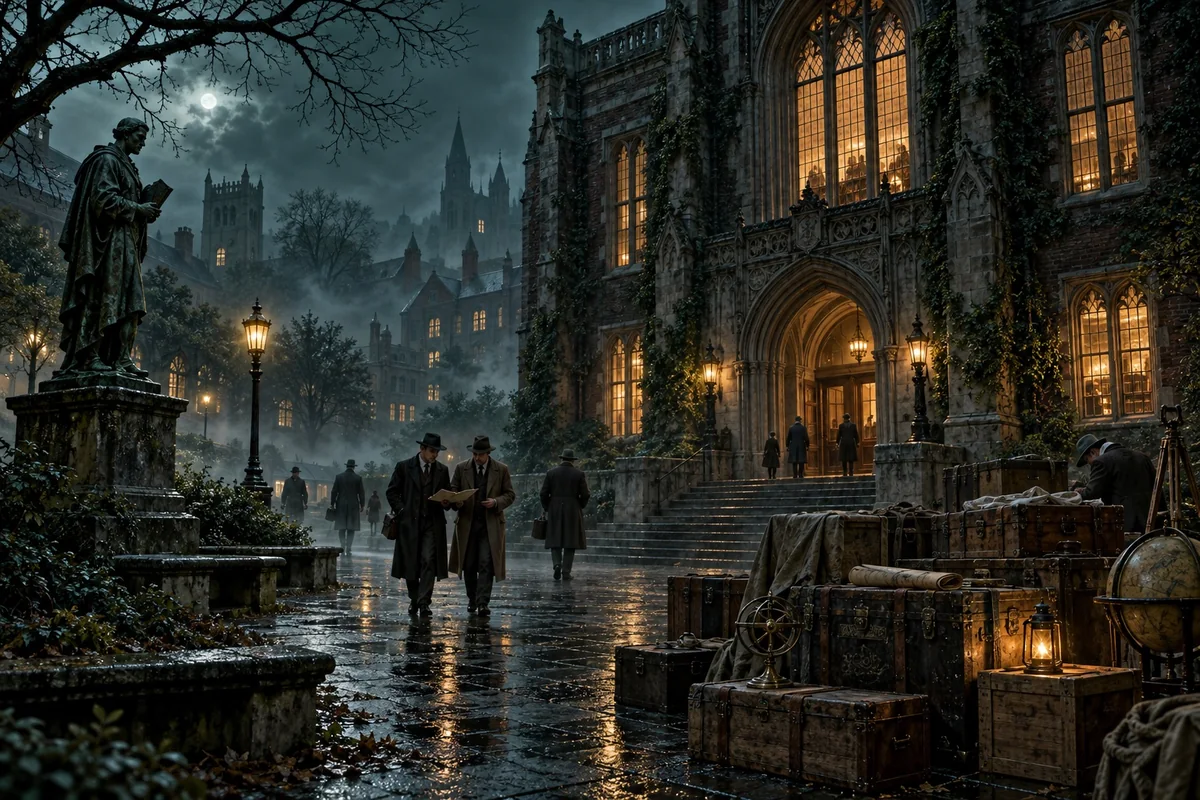
Miskatonic University is the fictional institution in Arkham whose medical school, library, scholars and expeditions recur across Lovecraft’s stories. It connects local New England settings with investigations of forbidden books, alien phenomena, Antarctica and the remote past.
7 min read · 1,285 words
Introduction and place in the fiction
Miskatonic University appears in Herbert West—Reanimator, written in 1921–1922 and first serialized in Home Brew in 1922. The narrator and Herbert West study at its medical school in Arkham. Subsequent stories broaden the institution into a research university with a rare-book library and faculty in several fields.
The name belongs to the same invented regional geography as the Miskatonic River. Lovecraft situates the university within Arkham while allowing its people to investigate events far beyond Massachusetts. The result is a recurring institutional connection among stories with different protagonists and very different kinds of horror.
The original narratives reveal the university through particular uses rather than a complete prospectus. They name scholars, degrees, courses, collections and expeditions as a story requires. A later campus guide may supply a founding date, building plan or full administrative history, but such details need their own attribution rather than automatic acceptance as statements made by Lovecraft.
Sources: Herbert West—Reanimator — original text, At the Mountains of Madness — original text, The Shadow out of Time — original text, H. P. Lovecraft Archive — fiction in composition order, H. P. Lovecraft Archive — fiction in publication order
The medical school and Herbert West
West’s student experiments meet resistance from the medical school’s authorities, especially its dean, Dr. Allan Halsey. West interprets life as a physical and chemical process and seeks a method of restoring activity to dead tissue. The narrator assists him in work that requires increasingly disturbing access to bodies.
Halsey’s opposition places an ethical and institutional boundary around the experiments. His later death during an epidemic allows West to cross that boundary in a particularly grotesque way by using the dean’s body. The scientific institution is both the source of West’s training and the community whose standards he evades.
After graduation, university influence helps West and the narrator secure a practice in Bolton. Their later experiments move through other locations, including wartime service and Boston. Miskatonic should therefore not be made the physical setting of every incident in the sequence. It provides the educational origin and one crucial early crisis; the full career extends beyond the campus.
The library, Henry Armitage and the Necronomicon
In The Dunwich Horror, Wilbur Whateley visits the library to compare his incomplete English Necronomicon with its Latin copy. Henry Armitage questions him and becomes alarmed by the purpose of the research. The difficulty is partly textual: translations differ, passages are missing and a dangerous formula cannot be treated as an ordinary academic curiosity.
Armitage refuses to let Wilbur borrow the volume and helps prevent him from obtaining equivalent access elsewhere. Wilbur later attempts to enter the library at night and is fatally attacked by its watchdog. Armitage, Warren Rice and Francis Morgan discover the body, which exposes the nonhuman component of Wilbur’s ancestry.
The library’s role continues after that encounter. Armitage interprets the diary recovered from the Whateley property and develops a response to the larger danger in Dunwich. Books are instruments of intervention as well as potential sources of catastrophe. The story gives the librarian the responsibility to judge use, restrict access and continue studying when refusal alone no longer suffices.
History of the Necronomicon independently lists Miskatonic among the holders of surviving copies. This is a fictional bibliography supporting a fictional institution. It should not be mistaken for the catalogue of a real university collection.
Sources: The Dunwich Horror — Unspeakable Tales ebook, History of the Necronomicon — original text
Restricted study and Walter Gilman
Walter Gilman’s studies in The Dreams in the Witch House combine advanced mathematics and physics with folklore. He consults the Necronomicon, the Book of Eibon and von Junzt’s Unaussprechlichen Kulten while trying to connect older accounts of witchcraft with the properties of space. His professors become worried, reduce his workload and stop his access to the dangerous volumes.
The university’s precautions arrive after he has already gathered material that feeds into his experiences in the Witch House. The institution is not simply offering an approved course in magic. Its staff respond to a student whose research and condition have become alarming, even though they cannot fully understand what is happening to him.
Gilman’s case also distinguishes knowledge in a book from knowledge embodied in a place. The angles of his room become as important as the texts he has read. Miskatonic supplies one part of the investigation; the rented house and the histories attached to it provide another.
Folklore and the limits of professional skepticism
Albert N. Wilmarth, the narrator of The Whisperer in Darkness, is associated with the university’s teaching of literature and folklore. Reports of strange bodies in Vermont initially seem to him like material that established scholarly methods can explain. His correspondence with Henry Akeley gradually presents photographs, recorded sound and other purported evidence that complicate that dismissal.
The resulting journey is a personal investigation rather than a university expedition on the Antarctic scale. Wilmarth’s professional identity nevertheless matters: the reader sees a trained interpreter of stories confronted by claims that the stories describe an active nonhuman presence. His movement from skeptical commentary to fear gives the university another role, as the home of expertise whose categories are placed under strain.
The Antarctic expedition
At the Mountains of Madness is framed by Professor William Dyer’s effort to prevent another Antarctic venture. His own Miskatonic expedition of 1930–1931 brought together scientific specialists, aircraft, ships, dogs and equipment designed for geological exploration. Professor Lake leads the group that discovers the unusual specimens; Frank H. Pabodie’s engineering work helps make deep investigation possible.
Public wireless reports initially tell a story of extraordinary scientific success. After disaster at Lake’s camp, Dyer and Danforth cross the mountains and find the immense abandoned city. Its carvings allow them to reconstruct the history of the Elder Things and to reconsider the specimens as intelligent beings rather than merely anomalous animals.
The university thus supplies the resources enabling a discovery it cannot safely publicize in full. Dyer’s later statement is motivated by the gap between public reports and what the survivors actually learned. The institutional expedition remains a scientific enterprise, even when its consequences reveal a history in which human science has only just begun to find its place.
The Peaslees and the Australian expedition
Nathaniel Wingate Peaslee describes an ordinary academic career before his collapse in The Shadow out of Time. He graduates from Miskatonic, studies economics at Harvard and returns as an instructor in political economy in 1895. His promotions lead to a full professorship in 1902. The extraordinary interruption occurs during a class in 1908, making the displacement of his mind an event within a documented professional life.
His son Wingate remains his ally after other family relationships break down. Later investigation of reported Australian ruins brings together the Peaslees, William Dyer of geology, Ferdinand C. Ashley of ancient history and Tyler M. Freeborn of anthropology, with assistance from Robert B. F. Mackenzie. These names and fields give the expedition a deliberately interdisciplinary basis.
Peaslee’s final discovery is not shared in the same way as the public results of an excavation. He writes the account for his son, who must decide how to use it. Miskatonic again connects the gathering of evidence with a question about disclosure: a fact can be important enough to record while remaining difficult or dangerous to announce.
Ordinary science confronting the colour
The Colour out of Space gives a smaller, local example of the university’s investigative role. Three professors examine the meteorite at the Gardner farm and carry a sample back for tests. Its changing size, unusual material properties and unfamiliar color resist their expectations.
Their work establishes that something is anomalous, but it does not produce an effective explanation or protection for the family. The later deterioration of crops, animals and people continues beyond the laboratory’s initial encounter. Scientific attention is present in the story without becoming omnipotent. The contrast with Armitage’s successful intervention is instructive: Miskatonic’s recurring name does not guarantee that its scholars will have the same degree of understanding or success in every tale.
Related music
The Key and the Gate is a dark metal retelling of The Dunwich Horror, following Wilbur Whateley’s doomed search for forbidden knowledge and the power of Yog-Sothoth.
References
- Herbert West—Reanimator — original text
The fictional narrative is evidence for what the story says, not proof of events in the real world.
- At the Mountains of Madness — original text
The fictional narrative is evidence for what the story says, not proof of events in the real world.
- The Shadow out of Time — original text
The fictional narrative is evidence for what the story says, not proof of events in the real world.
- H. P. Lovecraft Archive — fiction in composition order
Composition dates; question marks and ranges retain the source uncertainty.
- H. P. Lovecraft Archive — fiction in publication order
First publication dates and venues; issue dates can differ from actual release dates.
- The Dunwich Horror — Unspeakable Tales ebook
The fictional narrative is evidence for what the story says, not proof of events in the real world.
- History of the Necronomicon — original text
The fictional narrative is evidence for what the story says, not proof of events in the real world.
- The Dreams in the Witch House — original text
The fictional narrative is evidence for what the story says, not proof of events in the real world.
- The Whisperer in Darkness — original text
The fictional narrative is evidence for what the story says, not proof of events in the real world.
- The Colour Out of Space — Unspeakable Tales ebook
The fictional narrative is evidence for what the story says, not proof of events in the real world.
At a glance
Arkham, Massachusetts — fictional
Herbert West—Reanimator, serialized 1922
Henry Armitage
Medicine, geology, engineering, political economy, ancient history, anthropology, literature and folklore
Antarctica, 1930–1931; Australian desert, 1935
Necronomicon and other occult volumes