

Devil Reef
Devil Reef is the rocky formation off Innsmouth that links the town’s visible harbor with the deep-water world of the Deep Ones. It serves as a meeting place, a focus of remembered sacrifices and the landmark toward which the narrator plans to swim at the end of The Shadow over Innsmouth.
4 min read · 691 words
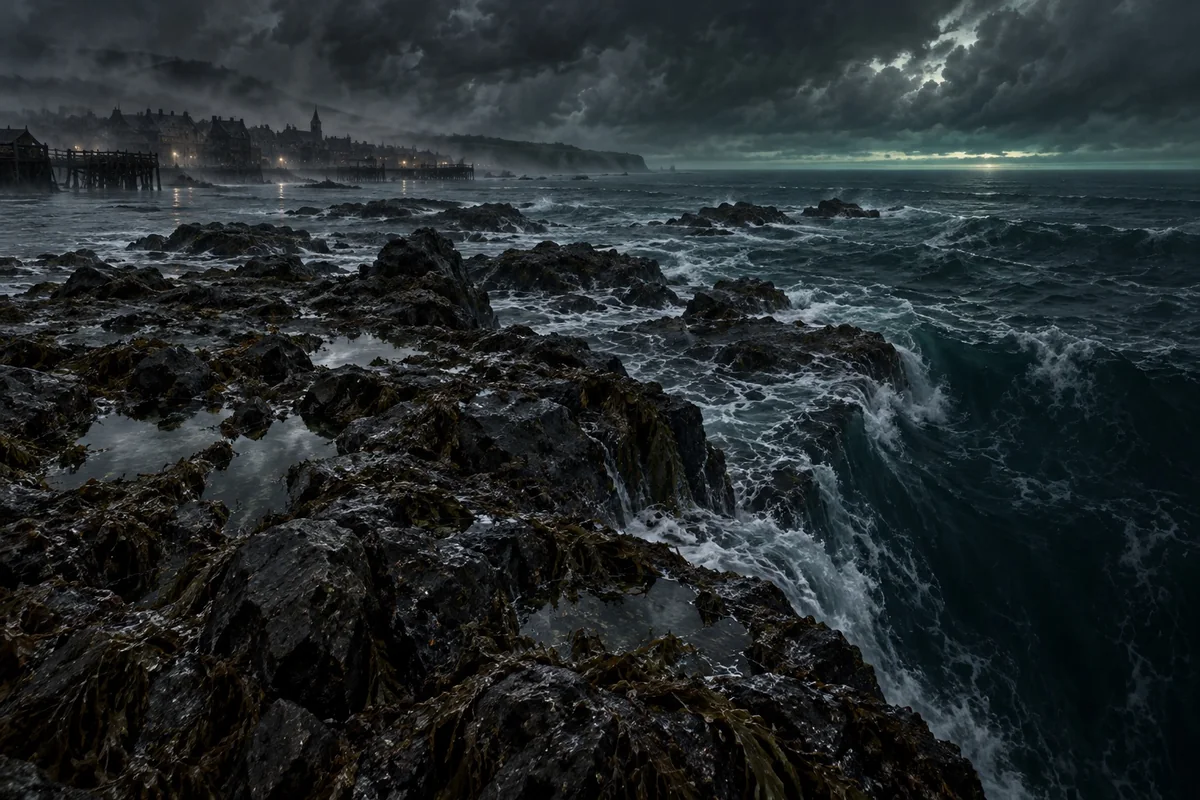
Appearance from the shore
The Newburyport ticket agent describes the reef as lying a little more than a mile offshore. Much of it is exposed at times, and even when submerged it is not usually far beneath the surface. It is too limited and irregular to function as an ordinary inhabited island.
Sources: [1]
Its uneven shape and apparent caves attract stories of figures lying on it or moving in and out. Sailors from outside Innsmouth reportedly make detours to avoid it.
Those early descriptions mix a visible maritime feature with rumor. The narrator has not yet seen the people or activities that will give the landmark a different significance.
The drop beyond the rocks
Zadok places the beginning of the dangerous deep water at the reef. Beyond it, the bottom falls sharply into a depth he describes as impossible to sound.
This makes the formation an interface rather than merely a remote rock. Boats can approach the exposed surface, while the deep side connects with the marine inhabitants’ environment.
The story does not give a bathymetric survey or establish that the same passage leads to every submarine city in the Mythos. The named local connection is with the world associated with Y’ha-nthlei.
Sources: [1]
Obed’s meetings
According to Zadok, Obed and groups of townsmen row out at night and chant loudly enough to be heard from shore when the wind permits. The captain drops heavy objects into the water beyond the reef.
Allen connects these actions with the summoning method acquired from Walakea and with disappearances in Innsmouth. He recalls watching from his childhood home’s cupola through a ship’s glass.
His observations supply more than a general claim of devil worship: boats, movements, sounds and the timing of missing persons form the specific pattern from which he draws his conclusion.
Sources: [1]
The events of 1846
Opponents follow Obed’s party to the reef, and shots are exchanged between boats. The captain and others are imprisoned afterward.
When the offerings remain interrupted, Zadok sees large numbers of beings on the reef and moving through the harbor toward the river. The subsequent violence changes control of the town and is later described to outsiders as an epidemic.
The reef therefore participates in both directions of the compact. Townsmen travel outward to make contact, and the beings move inward when the arrangement breaks down.
Sources: [1]
The waterfront conversation
During his interview with the narrator, Zadok repeatedly looks toward the reef. Its appearance triggers the history he has been reluctant to tell, and the rising tide contributes to his increasing anxiety.
At the end he sees something that convinces him they have been noticed. The narrator sees no definite creature, only water and a possible localized disturbance. Zadok runs away after urging immediate escape.
The difference between their perceptions preserves uncertainty at that moment. The story does not turn the scene into a clear daylight inspection of a named guardian standing on the rocks.
Sources: [1]
Military action and the final route
The opening’s account of the later federal operation includes naval activity near the reef. The narrator’s subsequent dreams insist that the underwater city survives, though damaged.
At the end, he plans to return with Lawrence, swim to the reef and descend toward Y’ha-nthlei. The same landmark that first concentrated local fear becomes a guide to the life he now desires.
No completed crossing follows within the original story. The reef’s final function is prospective: it marks the passage the narrator intends to take beyond the human community.
Sources: [1]
Relationship to other submerged sites
Devil Reef belongs to the coastal geography of Innsmouth. It is not identified as the risen Pacific ground in Dagon or as R’lyeh in The Call of Cthulhu.
Those locations share a concern with what the ocean conceals, making comparison useful. Their circumstances differ: a local reef used for repeated contact, a transient exposure of an uncertain seabed and an immense sunken city encountered elsewhere.
Keeping those differences visible allows the marine stories to enrich one another without collapsing every dark offshore place into a single setting.
Related music

The Esoteric Order of Dagon is a dark metal descent into the world of Innsmouth, where ancient bloodlines, forgotten covenants and the call of the sea endure through countless generations.
References
- The Shadow over Innsmouth — Unspeakable Tales ebook
The fictional narrative is evidence for what the story says, not proof of events in the real world.
- Dagon — Unspeakable Tales ebook
The fictional narrative is evidence for what the story says, not proof of events in the real world.
- The Call of Cthulhu — Unspeakable Tales ebook
The fictional narrative is evidence for what the story says, not proof of events in the real world.
At a glance
The Shadow over Innsmouth
A little more than a mile off Innsmouth, in the ticket agent’s description
Rugged reef, periodically exposed
Sharp descent described by Zadok
Obed Marsh’s nighttime meetings and offerings
Y’ha-nthlei
Waypoint in the narrator’s planned return beneath the sea