

Innsmouth
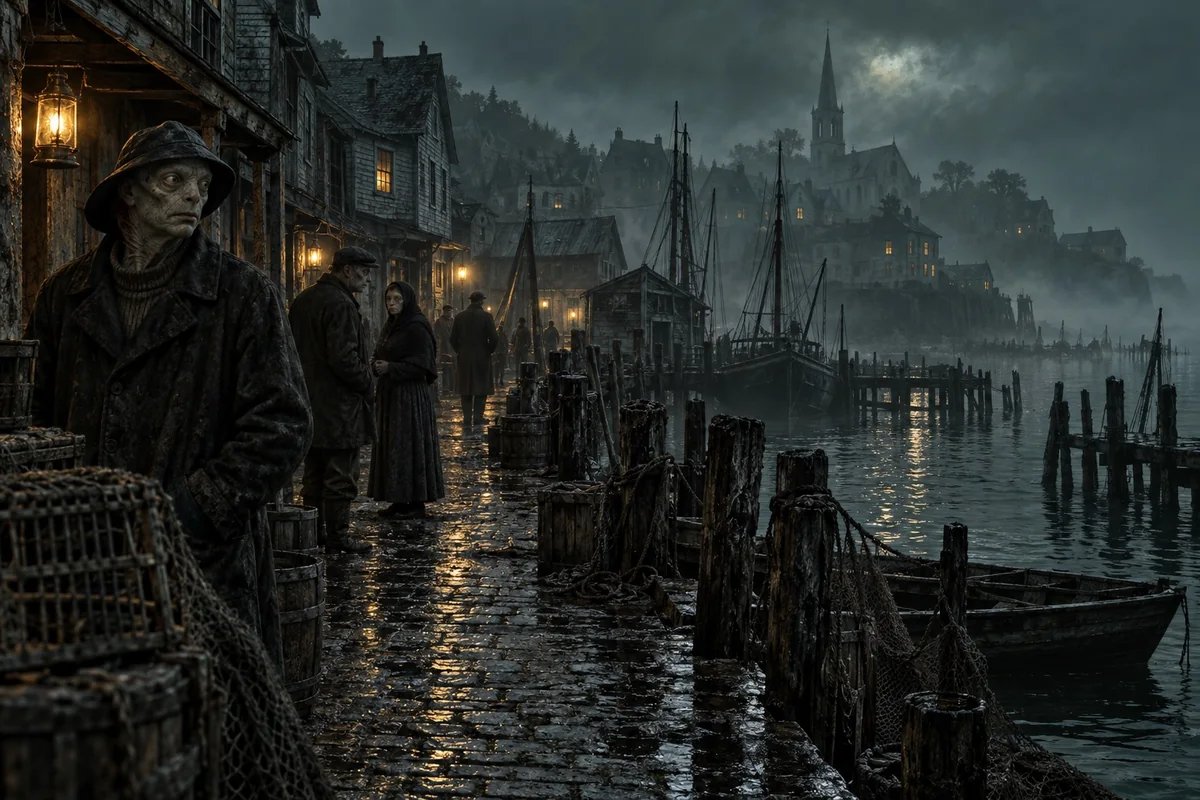
Innsmouth is the declining Massachusetts seaport at the center of The Shadow over Innsmouth. Its ruined maritime economy, powerful Marsh family, altered religious institutions and relationship with the Deep Ones gradually disclose a history that reaches from Pacific trade to the narrator’s own ancestry.
7 min read · 1,462 words
Location and the layered account
Innsmouth stands at the mouth of the fictional Manuxet River. Salt marshes and sparsely inhabited country separate it from nearby communities, while abandoned transport connections reinforce its isolation. Newburyport, Arkham, Ipswich and Rowley provide familiar regional points of reference around the invented town.
The Shadow over Innsmouth presents the place through several kinds of evidence. A ticket agent offers hostile local gossip; county histories provide a thin civic record; a museum object prompts further inquiry; a young grocery clerk explains the streets; Zadok Allen supplies a much darker historical narrative. The visiting narrator then witnesses enough during his escape to revise what he had considered implausible.
These accounts overlap without carrying equal authority. The town’s apparent population, the explanation of the 1846 deaths and the identity of the people who rarely appear outdoors change as the story progresses. A reliable description needs to preserve the source of a claim instead of flattening every rumor into an agreed municipal fact.
Sources: The Shadow over Innsmouth — Unspeakable Tales ebook
From shipbuilding to the Marsh refinery
The county histories consulted by the narrator give 1643 as the founding year. They describe shipbuilding before the American Revolution, considerable maritime prosperity in the early nineteenth century and later manufacturing powered by the Manuxet. By the time of the visit, most of those activities have disappeared. Fishing, lobstering and the Marsh gold refinery remain conspicuous exceptions to the broader decline.
The surviving architecture reflects that earlier wealth. Large residential streets, old churches, commercial buildings and extensive wharves remain after the trade that supported them has contracted. The result is not a village that has always been small and poor. It is the residue of a more substantial port whose buildings outlast its visible economic life.
The refinery is especially troubling because its continuing output does not fit the town’s apparent condition. Marsh wealth and the strange jewelry associated with Innsmouth eventually connect the gold to the offshore alliance. An industrial activity that first seems an ordinary exception to decline becomes evidence of another source of prosperity.
Sources: The Shadow over Innsmouth — Unspeakable Tales ebook
Obed Marsh and the agreement offshore
Zadok Allen attributes the decisive change to Captain Obed Marsh, whose Pacific voyages brought him into contact with an island community trading with undersea beings. According to Zadok, the arrangement offered fish and gold in exchange for sacrifices and, ultimately, relationships between the human and marine populations. Obed sought a comparable bargain when Innsmouth’s own economy faltered.
The account makes maritime commerce the route by which the supernatural enters local history. Obed does not find the Deep Ones by discovering an ancient New England manuscript in isolation. He brings knowledge home from a trading world that already connects distant shores. Devil Reef becomes the local focus of contact.
Zadok’s drunkenness and fear complicate his testimony, but the narrative does not leave it unsupported. The jewelry, the altered inhabitants, the night pursuit and the narrator’s later family discoveries supply additional evidence. His story remains a reported history whose broad implications receive corroboration; the visitor does not personally witness Obed’s earlier voyages.
Sources: The Shadow over Innsmouth — Unspeakable Tales ebook
The crisis of 1846
The ordinary county account treats 1846 as a year of epidemic and riots. Zadok gives a different explanation: opposition to the new practices brought a violent intervention from the sea, after which the surviving community was bound more tightly to the Deep Ones. The apparent public disaster and the concealed religious transformation occupy the same historical moment.
The aftermath helps explain the town’s increasingly unusual population and its reluctance to communicate with outsiders. Those born of mixed ancestry may appear comparatively human when young and change later. The older or more transformed inhabitants remain out of ordinary sight. A casual count made from the streets therefore cannot establish how many beings occupy the houses or the waters beyond them.
The text’s racial language and hereditary fears are part of its historical construction and need critical attention. Its fictional transformation should not be treated as evidence validating real-world prejudices against isolated communities or intermarriage. The story turns its narrator’s own family discovery into the final collapse of his assumed distance from the town.
Sources: The Shadow over Innsmouth — Unspeakable Tales ebook
Streets, neighborhoods and landmarks
The grocery clerk identifies Federal Street as the road by which the visitor has arrived. West of it lie former prosperous residential streets, including Broad, Washington, Lafayette and Adams; eastward lie the more neglected areas toward the shore. Old Georgian churches stand along Main Street, many abandoned. Conditions north of the river are particularly unwelcoming to a conspicuous stranger.
New Church Green contains the pillared hall of the Esoteric Order of Dagon, occupying the former Masonic building. The refinery, active churches and Order’s hall are places the clerk advises the visitor not to study too openly. They are centers of continuing activity within an otherwise largely decayed town.
The Gilman House offers lodging and becomes the setting for the attempted nighttime seizure. Its connected rooms, doors, bolts, windows and relation to neighboring buildings matter directly to the escape. Beyond the hotel, the narrator must move through back routes, crossings and an abandoned railway rather than trust the apparent safety of the main streets. The town’s physical layout gradually changes from an object of architectural curiosity into a problem of concealment and pursuit.
Sources: The Shadow over Innsmouth — Unspeakable Tales ebook
Transport and the outsider’s visit
The narrator chooses the Innsmouth bus as an inexpensive way of continuing his antiquarian trip toward Arkham. The vehicle and its driver, Joe Sargent, immediately disturb him, but curiosity and economy outweigh the warnings. The railway has ceased to provide ordinary passenger access, and the bus is a fragile connection to neighboring towns.
His visit begins on 15 July 1927. During the day he studies the architecture, questions the grocery clerk, examines the waterfront and hears Zadok’s story. A claimed mechanical failure prevents the expected onward departure, forcing him to remain overnight. The failure of an ordinary travel plan places him inside the town when its hidden population becomes active.
He escapes during the following night and morning, eventually reaching safety outside Innsmouth. The route makes transport infrastructure serve two contrary functions: the scheduled bus carries him into danger, while the disused railway helps him evade it. The abandoned landscape still contains lines that can guide someone who understands how to use them.
Sources: The Shadow over Innsmouth — Unspeakable Tales ebook
Devil Reef and Y’ha-nthlei
Devil Reef lies about a mile and a half from the harbor. Its low, dark surface provides a visible marker for a much less visible marine world. Zadok associates the reef with Obed Marsh’s practices and with movements between the sea and the town. Later reports of government action focus on the depths beyond it.
Y’ha-nthlei is the undersea city connected with the Deep Ones and the narrator’s final dreams. It is not simply another district reached by walking along Innsmouth’s waterfront. The two settlements occupy different environments but are joined by kinship, commerce, worship and bodily transformation.
The narrator’s eventual intention to release his cousin and descend to the city changes the meaning of the coast. What began as a boundary from which an outside threat emerged becomes an imagined route to another mode of existence. The story ends with that intention and anticipation, rather than a completed eyewitness tour of Y’ha-nthlei.
Sources: The Shadow over Innsmouth — Unspeakable Tales ebook
The federal operation of 1927–1928
The opening describes a secret federal investigation during the winter of 1927–1928. Public reports in February concern extensive raids, arrests and the destruction of buildings along the waterfront. No ordinary public trial explains the prisoners’ fate. A report of a submarine torpedoing the depths near Devil Reef appears in a discredited tabloid.
The narrator’s disclosure after escaping contributes to the operation, but he does not provide a complete firsthand military record. His account distinguishes what became public, what he was told and what he believes the intervention accomplished. The secrecy is part of the fiction’s frame: readers encounter an extraordinary event hidden beneath explanations associated with more familiar government activity.
The later dreams and transformation also prevent the destruction of waterfront buildings from functioning as a simple end to the story. Even a substantial intervention in the town cannot undo the narrator’s ancestry or close the imagined life waiting offshore.
Sources: The Shadow over Innsmouth — Unspeakable Tales ebook
Connections in other fiction and adaptation
The Thing on the Doorstep gives Innsmouth another role through Asenath Waite and her father Ephraim. Asenath’s move to Arkham brings servants, books and household goods from the town. This is a specific connection through characters and property, rather than proof that every event in the two stories belongs to one centrally directed conspiracy.
The 2001 film Dagon, directed by Stuart Gordon, draws strongly on The Shadow over Innsmouth while relocating its maritime setting. Its title should not obscure that relationship or make every element of its plot evidence about Lovecraft’s original town. Screen adaptations can preserve the pattern of an isolated coastal community while changing its geography, characters and events.
Sources: The Thing on the Doorstep — Unspeakable Tales ebook, Dagon (2001) — credits, synopsis and release history
Related music

The Esoteric Order of Dagon is a dark metal descent into the world of Innsmouth, where ancient bloodlines, forgotten covenants and the call of the sea endure through countless generations.
References
- The Shadow over Innsmouth — Unspeakable Tales ebook
The fictional narrative is evidence for what the story says, not proof of events in the real world.
- The Thing on the Doorstep — Unspeakable Tales ebook
The fictional narrative is evidence for what the story says, not proof of events in the real world.
- Dagon (2001) — credits, synopsis and release history
At a glance
Fictional Massachusetts seaport
Manuxet
1643
1846
15 July 1927
Winter 1927–1928; public reports in February
Devil Reef; Y’ha-nthlei
Marsh Refining Company