

Deep Ones
The Deep Ones are the sea-dwelling people whose bargains, descendants and underwater civilization lie behind the history of Innsmouth. Their first sustained narrative combines a threatened traveler’s escape with the discovery that the supposedly alien population belongs to his own ancestry.
10 min read · 1,931 words
Source, publication and the shape of the revelation
The Shadow over Innsmouth was written in November–December 1931 and first published as a book in 1936. It is the principal source for the Deep Ones’ bodies, their relationship with human families and the city Y’ha-nthlei. Much of what the narrator first hears comes through local rumor and Zadok Allen’s recollection; direct night-time sightings and the narrator’s later dreams complicate and partially confirm that material.
The story starts after the narrator has escaped. It reports a federal investigation during the winter of 1927–1928 and public notice of raids in February. Only then does it return to his journey of July 1927. This structure tells the reader early that the town’s secret has drawn a large intervention, but postpones the more intimate question of why the survivor can no longer regard himself as an ordinary outsider.
The beings’ role cannot be described adequately as a group of monsters chasing a visitor. They have a history, a material culture, a connection with trade, a capacity to reproduce with humans and a religious vocabulary. The chase makes their physical presence undeniable, while the ending changes what that presence means to the person telling the story.
Bodies and the “Innsmouth look”
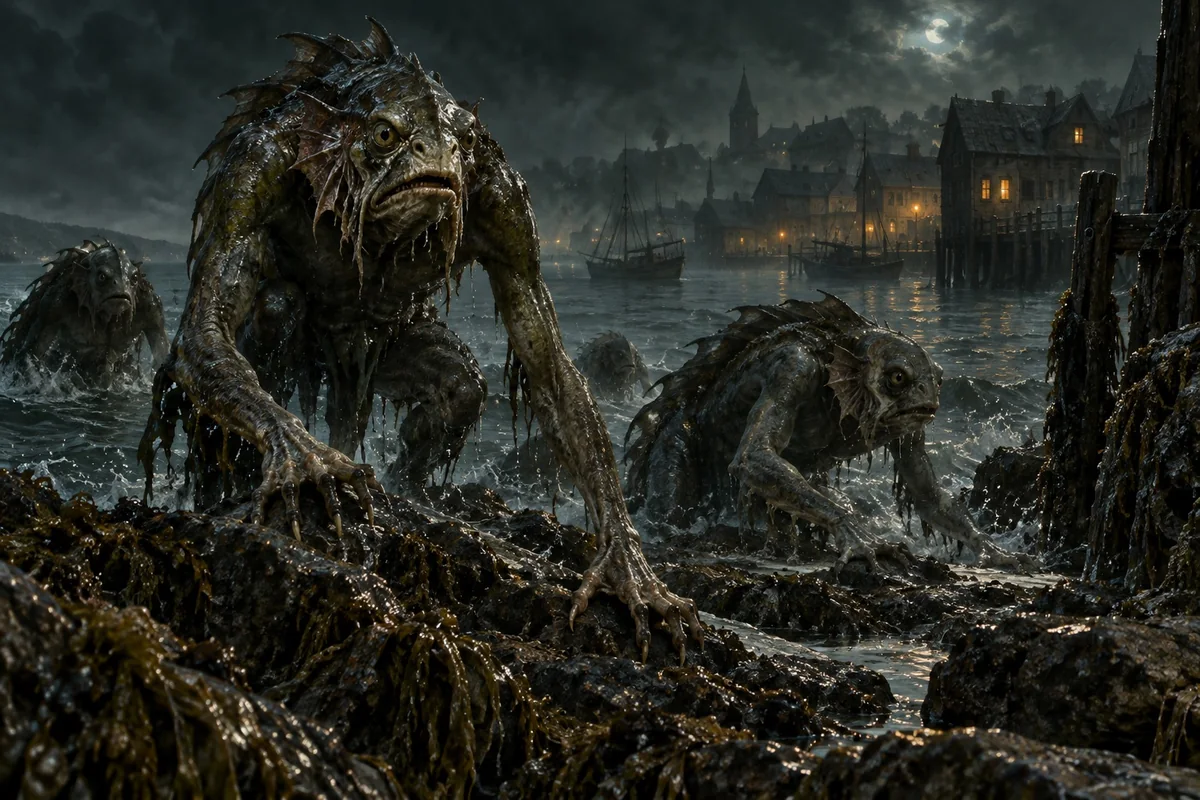
The fully developed beings seen during the escape combine characteristics the narrator associates with fish and amphibians. They have bulging eyes, unusual mouths, scaled or ridged surfaces, webbed extremities and neck structures suggestive of gills. They can travel out of water and move with a gait that becomes unmistakably unlike the ordinary pedestrians the traveler first encountered. Their bodies resist a single familiar animal comparison.
Many townspeople do not initially display the full combination. The narrator notices narrow heads, staring eyes, coarse skin, peculiar voices and a shared facial appearance that outsiders call the Innsmouth look. These observations are not a medical diagnosis applied by an impartial observer. They are filtered through fear, social suspicion and the assumption that bodily difference reveals moral or hereditary degeneration.
The later explanation supplies a developmental pattern: descendants of human and Deep One unions may begin life in a more human form and change as they grow older. Some withdraw from public sight before leaving for the sea. Closed upper rooms and furtive movement therefore acquire a retrospective explanation. The story does not provide a single exact birthday or a fixed schedule on which every descendant must transform.
This makes ancestry a delayed revelation. A family member can travel away from Innsmouth, appear to belong entirely to ordinary society and only later recognize signs of the inheritance. The narrator’s own changing face is frightening because it connects the public category he has used to judge others with his private certainty about himself.
Sources: [1]
Obed Marsh and the maritime bargain
Zadok Allen traces the town’s changed fortunes to Captain Obed Marsh and his trading voyages. Marsh learns of islanders who receive fish and unusual gold-like objects through contact with beings from the sea. Chief Walakea supplies the account of the relationship and the means by which contact can be attempted elsewhere. The overseas episode reaches the reader through Allen’s report of what Marsh learned, not through a separate voyage narrated by an omniscient observer.
The exchange includes obligations as well as wealth. The island community offers sacrifices, and the sea people later seek unions with humans. Their descendants can eventually join the underwater population. Marsh’s interest is initially tied to gain, making commercial desperation and the desire for prosperity part of Innsmouth’s occult history.
Back in Massachusetts, the arrangement becomes a proposed answer to the failure of ordinary trade and fishing. The Deep Ones can make fish available and provide material that passes through the Marsh refinery. The town’s economy thus preserves visible traces of an invisible relationship: unusually dependable catches, unexplained gold and jewelry whose designs do not fit the history expected by outside collectors.
The story’s use of distant island communities draws on the prejudices of its narrator and period. Its bargain is a fictional explanation for an invented New England town, not anthropological evidence about real Pacific peoples. The narrative can be examined as a story about trade, extraction and inherited obligation without endorsing its treatment of cultural difference as contamination.
Sources: [1]
The crisis of 1846 and the town’s religious order
The epidemic and disturbances of 1846 mark the decisive break in Innsmouth’s remembered history. Official and local accounts do not give the same explanation. What outside histories treat as a poorly documented disaster becomes, in Allen’s telling, the moment at which resistance to Marsh’s arrangements fails and beings from the sea enforce a new settlement.
The Esoteric Order of Dagon provides an institutional center for the changed town. It occupies a former Masonic hall, while local churches adopt practices that separate them from their denominations elsewhere. The traveler sees distinctive vestments and a tiara recalling the jewelry he examined before entering the town. Religious practice, material objects and bodily transformation become mutually reinforcing clues.
Allen refers to successive oaths and to different degrees of participation. He says that he took the first two but refused the third. The text does not print a complete ceremonial manual for each stage. His refusal establishes a boundary he considers morally decisive, while his earlier involvement explains both his knowledge and his fear of disclosure.
The community’s secrecy includes a practical policy toward outsiders. Most people who pass through without investigating may leave, while someone who asks dangerous questions becomes a different kind of visitor. The narrator’s meeting with Allen and his growing curiosity turn an inexpensive stop on a sightseeing journey into an attempt to escape surveillance.
Sources: [1]
Jewelry, architecture and evidence of civilization
The tiara displayed in Newburyport is one of the story’s most important objects. Its size and outline suggest a head unlike the ordinary human shape. The alloy is unusually lustrous, and the worked designs depict marine beings and environments in a visual tradition that the observer cannot comfortably classify. The object establishes artistry before a living Deep One is fully seen.
Related jewelry appears among Innsmouth’s inhabitants and religious figures. These recurring objects connect museum display, trade goods, family possessions and ritual use. Their movement through human institutions helps explain how fragments of the secret can be visible without the whole relationship becoming widely understood.
Y’ha-nthlei, described near the end, supplies an underwater architectural counterpart to the jewelry. It is an immense, many-columned city beyond Devil Reef. The narrator’s expectation of dwelling there transforms it from a rumored monster habitat into a possible place of residence and belonging. The text gives powerful architectural impressions but no street map, population count or systematic description of its government.
The civilization is therefore glimpsed through selected material and personal evidence. Elaborate art and a monumental city imply more than animal survival, but they do not authorize an encyclopedia to invent occupations, laws or daily routines for which no source is given.
Sources: [1]
Longevity, inheritance and life beneath the sea
Allen’s account says that those who complete the change and join the sea people do not die naturally in the ordinary human way, though they can be killed by violence. The promise of continuing life is central to the bargain’s attraction. It also alters the meaning of disappearance: someone reported dead on land may instead have entered an existence inaccessible to the relatives who remain.
The narrator’s dream encounters make this claim personal. He learns of ancestral figures still living in Y’ha-nthlei and of Pth’thya-l’yi’s immense age. The knowledge no longer arrives solely as a frightening tale told by a stranger. It becomes part of the identity toward which his own body and dreams are moving.
The source does not reduce every generation to a uniform breeding chart. Family resemblance can remain hidden, marriage can carry the inheritance outside the town, and recognition may come late. What matters narratively is the persistence of the connection despite geographical and social distance. Leaving Innsmouth is not necessarily the same as escaping its lineage.
Longevity should also be separated from invulnerability. The government attack can injure the underwater city, and the dream account acknowledges damage even while claiming survival. The text’s promise of extraordinary duration does not mean that a Deep One cannot be wounded or that the entire species is immune to every form of physical force.
Sources: [1]
The hotel escape and the changing position of the narrator
The failed bus connection leaves the traveler in the Gilman House. During the night he detects an attempt to enter his room and improvises an escape through adjoining rooms and the exterior of the building. The town becomes a sequence of routes, hiding places and dangerous sightlines. He must use its decayed architecture to move past people who know the streets better than he does.
The pursuit brings the fully developed Deep Ones into view. Their appearance confirms that the town’s peculiarities cannot all be explained through economic decline or local gossip. His report to the authorities follows from that immediate experience of threat. At this stage, the division between a human witness and a nonhuman enemy appears secure to him.
The final genealogical investigation reverses that confidence. Portraits, family history and his own changing appearance connect him to the population he helped expose. Dreams then offer a future beneath the sea. He plans to release a similarly affected cousin from confinement and return with him to Innsmouth.
The ending does not erase the violence of the earlier pursuit. It changes the narrative voice’s relationship to it. Horror becomes entangled with attraction, and the place of the apparent enemy becomes the destination of an expected homecoming. A summary that ends at the chase misses the story’s most consequential transformation.
Sources: [1]
Dagon, Hydra, Cthulhu and the shoggoth reference
Father Dagon and Mother Hydra occur within the religious language Allen reports. Their names are connected with the promised return to the underwater community. The Cthulhu chant also appears in that same context. These connections place Innsmouth within a wider field of names already associated with old beings and concealed cults.
The narrative does not present a fully explained divine genealogy or prove that every sea creature is a child of the being encountered in the earlier story Dagon. The earlier sailor never gives his sighting that secure identification. The overlapping marine imagery is important, but the difference between the two accounts should remain visible.
Shoggoths are mentioned by Allen and later appear in the narrator’s dream. That is evidence of a connection in this story, while the created labor organisms of At the Mountains of Madness have their own historical account. The shared name invites comparison; it does not explain, by itself, every detail of how Innsmouth acquired such a presence or how it is controlled.
Reading the ending and later reinterpretation
The Deep Ones expose the instability of the viewpoint that first defines them. The narrator reads faces, clothing, buildings and ancestry as a threatening system, then discovers himself within it. That construction is inseparable from the story’s racial and hereditary anxieties. Identifying those anxieties helps explain the text without converting its fictional categories into judgments about actual people.
The ending also leaves room for a different emotional emphasis: continuity with ancestors, relief from mortality and the attraction of an unfamiliar home. Later writers can develop that possibility into a sympathetic account of Innsmouth’s descendants. Such a retelling is a new author’s intervention, not an omitted chapter of Lovecraft’s manuscript.
Within this wiki, the Deep Ones connect the town article with its people, jewelry, religion, underwater location and adaptations. Keeping those subjects separate allows each to receive detailed treatment while the links preserve their shared history. The beings remain central to all of them without reducing Innsmouth to a single monster description.
Sources: [1]
Related music
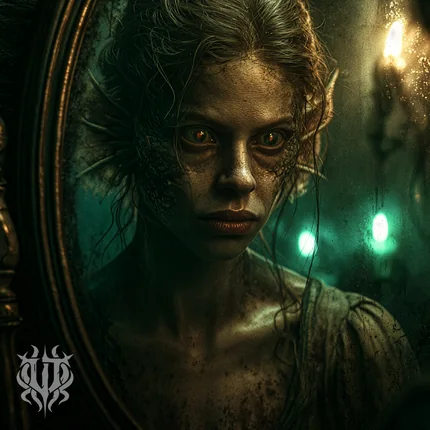
The Esoteric Order of Dagon is a dark metal descent into the world of Innsmouth, where ancient bloodlines, forgotten covenants and the call of the sea endure through countless generations.
References
- The Shadow over Innsmouth — Unspeakable Tales ebook
The fictional narrative is evidence for what the story says, not proof of events in the real world.
- H. P. Lovecraft Archive — fiction in publication order
First publication dates and venues; issue dates can differ from actual release dates.
- H. P. Lovecraft Archive — fiction in composition order
Composition dates; question marks and ranges retain the source uncertainty.
- Dagon — Unspeakable Tales ebook
The fictional narrative is evidence for what the story says, not proof of events in the real world.
- At the Mountains of Madness — original text
The fictional narrative is evidence for what the story says, not proof of events in the real world.
At a glance
H. P. Lovecraft
The Shadow over Innsmouth
November–December 1931
1936 · book edition
Y’ha-nthlei near Innsmouth
Intermarriage and hereditary transformation
No ordinary natural death; violent death remains possible
Father Dagon; Mother Hydra; Cthulhu