

The Shadow over Innsmouth
A young traveler enters a decaying Massachusetts port to study its buildings and local history, escapes a nocturnal pursuit, and then discovers that the town’s hidden ancestry is also his own. The Shadow over Innsmouth combines a detailed urban adventure with an ending that transforms the meaning of escape, family and belonging.
14 min read · 2,774 words
Writing, first edition and the unnamed narrator
Lovecraft completed The Shadow over Innsmouth on 3 December 1931; the Archive places the beginning of composition tentatively in November. Its first publication was the 1936 book issued by Visionary Publishing Company. The composition, the first book and the later magazine or collection appearances are separate bibliographical events.
The finished narrative does not give the traveler a personal name. It identifies him through his age, interests, education, home and family connections. The name Robert Olmstead is used in discussions of the story’s background and later reception, but a synopsis of the completed text can accurately call him the narrator without pretending that he introduces himself by that name.
He begins as an antiquarian visitor from Ohio, interested in New England buildings and his maternal ancestry. The two purposes seem compatible but independent. By the ending they have converged: the investigation of an unfamiliar town has become an investigation of his own body and future.
Sources: H. P. Lovecraft Archive — fiction in composition order, H. P. Lovecraft Archive — fiction in publication order, The Shadow over Innsmouth — Unspeakable Tales ebook
The federal action comes before the visit in the telling
The opening describes an operation against Innsmouth during the winter of 1927–28. Buildings are destroyed, residents disappear into official custody, and rumors circulate about unusual military activity off the coast. Public explanations and restricted information leave the wider population unable to reconstruct what has happened.
The narrator then identifies his own appeals as the cause of the investigation. He escaped from Innsmouth on 16 July 1927 and later spoke with officials in Arkham and Boston. The reader therefore knows before entering the town with him that he will survive the immediate visit and that the incident will have consequences beyond one traveler’s fright.
This frame also establishes a tension the ending will reopen. At first, official intervention appears to place society’s organized power against a concealed threat. Later dreams claim that the underwater city survived and that the narrator himself belongs to the population he helped expose. The action has damaged a place without resolving the biological and personal connections that made it frightening.
Sources: The Shadow over Innsmouth — Unspeakable Tales ebook
Newburyport: warnings, transport and the first ornament
In Newburyport, the narrator learns that a cheap bus can take him toward Arkham by way of Innsmouth. Local accounts discourage the route. People speak of isolation, declining trade, strange looks and disturbing family histories, supplying an atmosphere of suspicion before he has met the town’s inhabitants.
The warnings increase rather than extinguish his interest. Old architecture and the possibility of an unusual local history appeal to his antiquarian ambitions. He consults available information and sees a remarkable piece of jewelry at the historical society. Its workmanship is sophisticated, but its figures and design do not fit the traditions he expects to recognize.
The ornament is an early piece of material evidence. It suggests a culture more complex than the outsiders’ picture of a merely decayed fishing town. Its marine imagery and alien proportions also establish a visual vocabulary that will return in ritual dress, living bodies and family heirlooms.
The bus driver, Joe Sargent, gives the traveler his first close encounter with the appearance later called the Innsmouth look. The journey then carries him through a landscape of abandonment toward the port. The transportation choice is practical and inexpensive, yet it delivers him into a setting whose social rules he does not understand.
Sources: The Shadow over Innsmouth — Unspeakable Tales ebook
The town by daylight
Innsmouth is presented as a specific built environment rather than a single haunted building. The traveler sees old houses, churches, industrial remains, a waterfront, the river gorge and roads leading toward neighboring communities. Signs of former prosperity coexist with abandonment. The town’s geography becomes essential once he must navigate it in darkness.
A young grocery clerk from outside the town proves comparatively approachable. He explains local arrangements, offers warnings and draws a map. This mundane help later becomes a survival tool. The difference between his speech and the silence or hostility of other inhabitants also tells the narrator that the town is socially divided, not simply an empty ruin.
The Esoteric Order of Dagon occupies a conspicuous institutional position. The narrator glimpses a robed figure wearing an ornament related to the museum piece and finds that the unusual art belongs to a living practice. Devil Reef offshore becomes another focus of attention: it is a physical landmark around which accounts of disappearances, signaling and maritime contact gather.
The daylight walk has two functions. It lets curiosity collect clues, and it quietly teaches the reader the routes, open spaces, buildings and obstacles through which the later pursuit will move. Details that first seem scenic become tactical.
Sources: The Shadow over Innsmouth — Unspeakable Tales ebook
Zadok Allen and the history of Obed Marsh
The elderly Zadok Allen is a surviving witness to the town’s transformation. The narrator supplies liquor and draws him into conversation away from the most conspicuous public spaces. Allen’s account moves between recollection, report, fear and local interpretation; his age and distress affect its delivery without making every statement merely interchangeable rumor.
At its center is Captain Obed Marsh, whose voyages brought him into contact with islanders who possessed unusual wealth and plentiful fish. According to Allen, their prosperity came through a bargain with marine beings. Worship and offerings sustained the arrangement, while relations between humans and the beings could produce children who initially lived on land.
Marsh brings the possibility of such a bargain to a struggling Innsmouth. The promise of material rescue makes the offer politically and economically consequential. Gold and fish are not decorative rewards: they help explain how a town could tolerate an increasingly coercive religious arrangement.
The local conflict reaches a crisis in 1846. Opposition to Marsh is followed by violence, deaths and the destruction of the old balance of authority. The officially remembered epidemic conceals another history in Allen’s account. The Order of Dagon and the sea people’s demands become central to the town that the traveler now sees.
Sources: The Shadow over Innsmouth — Unspeakable Tales ebook
The bargain, the descendants and the hidden population
Allen describes a relationship that changes over generations. The children of human and Deep One parents can grow up among ordinary people, then develop physical differences and eventually take to the water. The timing varies. The more advanced transformations help explain why some residents remain hidden and why the visible population seems to dwindle in unusual ways.
Father Dagon and Mother Hydra belong to the religious language surrounding the arrangement. Y’ha-nthlei, beneath the sea near Devil Reef, offers another place to live. The promise is not merely escape from a poor town but a form of continued existence beyond ordinary human aging. That attraction coexists with oaths, pressure and the threat of violence.
Allen also describes Obed’s family and a daughter whose ancestry was concealed through arrangements outside Innsmouth. This initially appears to be one more piece of a complicated local genealogy. Only later does the narrator connect it with records of his own great-grandmother.
The conversation ends in alarm. Allen sees signs that they have been noticed and fears the consequences of having spoken. He subsequently disappears. The narrative does not provide a witnessed scene of his death or a recoverable body; his absence leaves the traveler with a story that can no longer be clarified by its teller.
Sources: The Shadow over Innsmouth — Unspeakable Tales ebook
The Gilman House and the failed departure
The traveler intends to leave, but the bus is reported unable to continue. He takes a room at the Gilman House with increasing reluctance. What had been an optional excursion becomes an overnight confinement in a town whose population may know what he has learned.
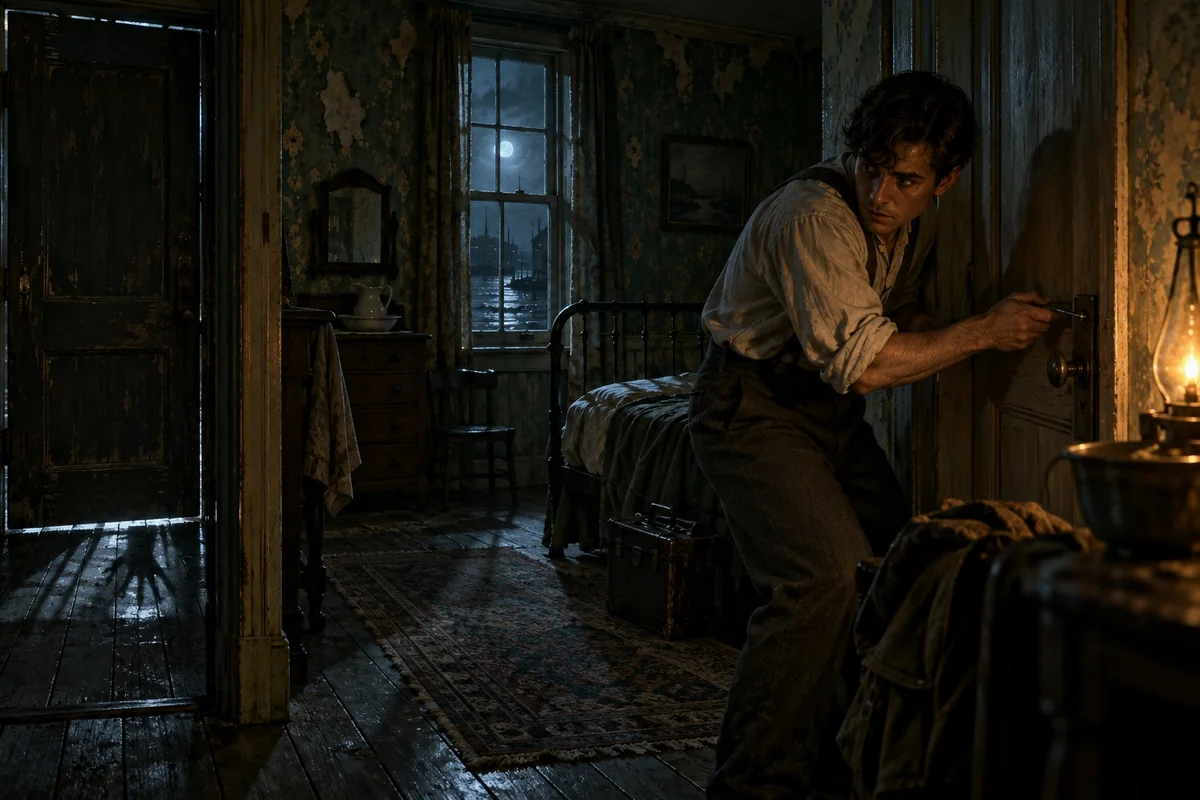
His inspection of the room becomes methodical. He considers locks, adjoining doors, windows, the layout of neighboring rooms and the objects available for securing or forcing a passage. These ordinary architectural details distinguish the sequence from a sudden unexplained escape: the reader follows the reasoning by which a vulnerable guest tries to preserve alternatives.
During the night someone tests his door and attempts entry. Sounds elsewhere in the building suggest coordinated movement. The danger develops through delay and preparation; the narrator hears enough to understand that remaining in bed and trusting the hotel would be fatal, while he cannot yet see the full extent of the pursuit.
He uses adjoining rooms and another route out of the building to escape. The immediate success depends on observation, improvised tools and timing. It is a genuine act of agency even though the story will later complicate what it means for him to have escaped Innsmouth at all.
Sources: The Shadow over Innsmouth — Unspeakable Tales ebook
The street pursuit and the abandoned railway
Outside the hotel, the narrator discovers that leaving the building has not meant leaving the search. Groups are moving through town and toward the roads. Open intersections expose him to view, while ruined buildings and dark doorways offer temporary concealment. The grocery clerk’s map helps him think through the unfamiliar street network.
He sometimes imitates the local shambling gait to avoid attracting attention. This tactical resemblance anticipates the later recognition of a deeper likeness: for the moment he treats bodily performance as a disguise, unaware that his ancestry will make the distinction between imitation and identity unstable.
Glimpses of swimmers, activity at the wharves and signals near Devil Reef suggest that the population mobilizing against him exceeds the residents he saw by daylight. The town appears connected to a much larger reserve of life beyond its visible streets. Its apparent depopulation has concealed rather than eliminated its numbers.
Believing the ordinary roads are watched, he chooses the abandoned railway toward Rowley. The track offers a difficult but continuous route through the marshy surroundings. He crosses a dangerous gap in an old covered bridge and pushes through vegetation that both tears his clothes and conceals him. Infrastructure left behind by the town’s decline becomes the means of evading its current inhabitants.
Sources: The Shadow over Innsmouth — Unspeakable Tales ebook
The procession at the railway cut
Near a point where the road crosses the track, the narrator hides in a brush-filled cutting. A large group approaches, announced by movement, cries and the now familiar smell. He first resolves not to look, then cannot resist seeing what passes in the moonlight.
The beings are no longer merely people whose features he finds unusual. Their bodies are adapted to an amphibious existence, with broad heads, gills, webbed extremities and a movement the narrator cannot reconcile with ordinary humanity. The scene turns Allen’s account and the jewelry’s imagery into an apparently direct encounter with a nonhuman population.
The narrator collapses. On recovering, he continues toward Rowley and eventually obtains food, clothes and transport. His subsequent reports to officials lead back to the operation described at the beginning. The immediate adventure has a complete arc: arrival, disclosure, entrapment, flight and public response.
The story deliberately continues beyond that arc. If it ended here, the narrator would remain an outsider whose frightening experience established the difference between his own world and Innsmouth. The final movement dismantles that difference.
Sources: The Shadow over Innsmouth — Unspeakable Tales ebook
Arkham records and the family in Ohio
While in Arkham, the narrator gathers information about his maternal grandmother, Eliza Orne, who married James Williamson of Ohio. E. Lapham Peabody at the historical society tells him about her parents and the uncertain background of her mother, a Marsh raised under arrangements that obscure her origins. Peabody also notices the narrator’s resemblance to the Marsh family.
The traveler returns home and attempts to resume ordinary life. The next year he examines family papers and heirlooms in Cleveland. Photographs of his grandmother and uncle Douglas now evoke the features he saw at Innsmouth. Douglas’s suicide after an earlier genealogical journey and the grandmother’s disappearance become newly disturbing.
His cousin Lawrence has been confined in an institution at Canton and is said to have deteriorated physically as well as mentally. The family has already developed ways of explaining or concealing changes that the narrator will begin to experience himself. What had seemed private misfortune acquires a shared pattern.
The decisive material shock is a group of inherited ornaments kept in a safe-deposit vault. Their workmanship and imagery correspond to the strange jewelry he has already encountered. He faints on seeing the tiara. The object’s return makes the early museum visit essential: he can recognize the family artifact because he first approached the same tradition as a curious outsider.
Sources: The Shadow over Innsmouth — Unspeakable Tales ebook
Transformation, dreams and the final intention
For a time the narrator resists the implications and immerses himself in routine work. During the winter of 1930–31, dreams of immense underwater spaces begin to intensify. In sleep, the beings and customs that horrify him on waking feel familiar. His appearance changes, and the mirror becomes another source of evidence he cannot comfortably dismiss.
A dream encounter with his grandmother reinterprets her disappearance as a return to the sea. He also meets the ancient ancestor Pth’thya-l’yi. The dream claims that Y’ha-nthlei was injured but not destroyed by the surface attack and that the Deep Ones will endure. Those claims reach the reader through the narrator’s changing consciousness, rather than through a detached inspection of the city after the raid.
His fear gradually gives way to attraction. He considers suicide but abandons that course and begins to anticipate an underwater existence. He plans to release Lawrence from confinement, return with him to Innsmouth and descend beyond Devil Reef to Y’ha-nthlei.
The ending records an intention, not a completed journey. The reader does not witness the cousin’s release or the final descent. Its force comes from the change in desire: the destination that once represented the furthest possible horror now promises kinship, wonder and continuing life.
Sources: The Shadow over Innsmouth — Unspeakable Tales ebook
Ancestry, coercion and the unstable meaning of belonging
The narrative’s central reversal depends on ancestry. The traveler initially reads physical difference as evidence of an alien community outside his own identity. Genealogical records and bodily change make him apply that same interpretation to himself. His categories do not remain safely external to the observer who uses them.
The story is deeply shaped by racist fears of mixture, inherited difference and the contamination of a supposedly secure lineage. These are ideological features of the writing, not accurate descriptions of real human ancestry. The invented biology of Deep Ones cannot validate the narrator’s contempt for actual ethnic or social groups.
At the same time, the ending creates interpretive tension within the story itself. The narrator’s new sense of belonging can be read as surrender to a transforming influence, as recognition of a suppressed identity, or as an unsettling combination of both. The text supplies the change but does not give an outside authority who settles its emotional meaning for the reader.
Coercion remains part of the town’s history. Marsh’s bargain involves institutional power, threatened reprisals and demands extending beyond an individual’s choice. A sympathetic reading of the narrator’s final attraction should not erase those events; a purely monstrous reading should not erase the genuine shift in his experience of kinship. The story holds both problems within the same family and community.
Sources: The Shadow over Innsmouth — Unspeakable Tales ebook
Objects, geography and the larger mythology
Jewelry carries the plot across otherwise separate settings: a historical collection, local ritual and an Ohio family vault. Its recognizable style makes it a compact record of cultural continuity. It tells the narrator something that names and incomplete documents have helped conceal.
The town’s physical geography performs a comparable function. The bus route draws him in, the hotel traps him, the roads channel the search, and the railway provides a possible exit. Offshore, Devil Reef marks the connection with Y’ha-nthlei. The same place can be a boundary from one viewpoint and an entrance from another.
The Deep Ones receive their fullest Lovecraftian social and biological presentation here. Dagon and Hydra have cultic roles; Cthulhu is invoked in the account of the marine world; a shoggoth appears in the narrator’s late dream. Those different kinds of presence should be distinguished. The story does not stage a direct confrontation with Cthulhu or identify the giant in the earlier Dagon as an ordinary Innsmouth resident.
The connected entity, place and artifact entries expand those subjects across the fiction. The present article keeps them tied to the narrator’s sequence of discovery, because the timing of each recognition is central to the work’s effect.
Sources: The Shadow over Innsmouth — Unspeakable Tales ebook, Dagon — Unspeakable Tales ebook
Screen adaptation and further reading
Stuart Gordon’s Dagon (2001) draws principally on this story, relocating and reshaping its coastal community and pursuit. The film’s title can obscure that relationship for readers expecting a direct adaptation of the earlier sailor’s tale. Its own entry records the production and the changes in characters and setting.
The 1931 discarded draft is separately cataloged in this wiki. It belongs to the work’s textual history and should not be silently blended into the finished narrative. The two versions can be compared to study the development of the opening and the management of disclosure.
Useful connected routes include Innsmouth for the town, the Deep Ones for the beings’ biology and social world, Obed Marsh and Zadok Allen for the reported history, and Innsmouth jewelry for the material evidence. The unnamed narrator’s entry follows the family transformation without treating the final planned descent as an event already completed on the page.
Sources: The Shadow over Innsmouth — Unspeakable Tales ebook, Dagon (2001) — credits, synopsis and release history, H. P. Lovecraft Archive — fiction in composition order, H. P. Lovecraft Archive — fiction in publication order
Related music

The Esoteric Order of Dagon is a dark metal descent into the world of Innsmouth, where ancient bloodlines, forgotten covenants and the call of the sea endure through countless generations.
References
- H. P. Lovecraft Archive — fiction in composition order
Composition dates; question marks and ranges retain the source uncertainty.
- H. P. Lovecraft Archive — fiction in publication order
First publication dates and venues; issue dates can differ from actual release dates.
- The Shadow over Innsmouth — Unspeakable Tales ebook
The fictional narrative is evidence for what the story says, not proof of events in the real world.
- Dagon — Unspeakable Tales ebook
The fictional narrative is evidence for what the story says, not proof of events in the real world.
- Dagon (2001) — credits, synopsis and release history
At a glance
H. P. Lovecraft
November?–3 December 1931
1936
The Shadow over Innsmouth, Visionary Publishing Co.
Fiction